Category Archives: Fresh Worldwide Press

What is going on in the Franchisig, Ho.Re.Ca, Hospitality and Retail business worldwide? A selection of my favorite news, with sustainability on top!

Fashionable sustainability or sustainable fashion?

Starting from Edun fashion brand, by Ali Hewson and Bono, whose mission is to encourage trade with Africa, to H&M’s Conscious Collection and Zara’s eco-friendly stores, it seems that “sustainability and responsibility” are now a must in the fashion industry.
The latest news regarding fashion and sustainability is the PPR Group’s (home of GucciPuma,Yves Saint Laurent and Stella McCartney) Sustainability Initiative PPR HOME to Set New Standard in Luxury, Sport & Lifestyle and Retail Sectors.

By moving beyond the traditional Corporate Social Responsibility model, the group launched PPR HOME and is setting a new standard in sustainability and business practice in the Luxury, Sport & Lifestyle and Retail sectors.

My deep conviction that Sustainability creates value is part of my strategic vision for PPR. Sustainability can – and must – give rise to new, highly ambitious business models and become a lever of competitiveness for our brands. PPR HOME will provide us with novel, more sustainable approaches to contribute to a better world for the long run”, said Francois- Henri Pinault, CEO of PPR.

PPR HOME’s first announcements are setting the pace for the Group’s sustainability mission in order to reduce the social and environmental footprint for its Luxury, Sport and Lifestyle brands. These pioneering initiatives include:
-PPR HOME launches the Creative Sustainability Lab to help lead the industry and foster creativity, innovation and sustainability. Its inaugural partnership with Cradle-to-Cradle® will drive PPR HOME to challenge traditional approaches and proactively re-think and re-consider product and business development. The Cradle-to-Cradle® concept believes that ‘good design’ of products and services should move beyond typical measures of quality – cost, performance and aesthetics – to integrate and apply additional objectives addressing environmental and social concerns.
– PPR has offset its 2010 global CO2 emissions from PPR’s Luxury group, PUMA and PPR’s headquarters of 98,729 tons to achieve carbon neutrality in Scopes 1 & 2 of the Greenhouse Gas Protocol and purchased carbon credits from Wildlife Works’ leading REDD (Reduced Emissions from Deforestation and Degradation) offsetting project in Kenya that takes the needs of the local communities and the conservation of biodiversity into account. As the first step in making REDD a reality, Wildlife Works recently provided proof that REDD conforms to the accounting rigor that other carbon credit classes provide, resulting in Wildlife Works project becoming the first-ever Voluntary Carbon Standard (VCS) validated and verified REDD program.
-PPR’s premiere Sportlifestyle brand, PUMA, has applied a groundbreaking methodological approach to measuring and costing their use of ecosystems and their ecological footprint. This is the initial step to measuring the full economic impact on ecosystem services by PUMA and its supply chain and the delivery of the first-ever Environmental Profit and Loss (EP&L) account statement. PPR HOME will take a leadership role in building understanding and support for this corporate shift, encouraging others within the industry to share PUMA’s pioneering efforts towards fully-integrated reporting.

Our opinion as sustainability advocates and retail consultants is that all these strategies, well planned and communicated, must follow the companies products from production to sale. The risk is that fashion consumers do not perceive the real added value of sustainability when in-store communication lacks and when the store itself it is not sustainable. An example? Keep following us: ECOFFEE case studies to come in the next weeks!

Beverage industry and sustainability: TATA beverages

We have previously wrote about how the beverage industry is getting more and more Sustainable, with more sustainable packaging like the Coca-Cola Company PlantBottle packaging, or by taking greater attention to the supply chain, as PepsiCo is doing with its recent committment to purchase only 100% Mexico sustainably grown sunflower crops.

 
Today, we will take a quick insight in what TATA Global Beverages is doing regarding sustainability. But first, a couple of information about the Company: TATA Global Beverages is part of the TATA Group, it currently employs 3,000 people around the world and it reported a 28% profit increase on Q3 2010, with profits being Rs 471.5 million (more than 74 million Euros).
 
If you take a look at Tata beverages website, it is clear that TATA Global Beverages is deeply involved in sustainability: from its mission “to make the world a better place through ‘life enhancing sustainable hydration’ to its long term goals and its collaborating with the Rainforest Alliance.
In a recent interview with The Guardian, TATA Global Beverages Director of Sustainibility Sara Howe, talked about the challenge to balance sustainability with the Company’s present short-term financial and commercial pressures.
She stated to be optimistic about the number of big companies who are now seriously and credibly engaging with the sustainability agenda, setting ambitious sustainability targets and demonstrating progress towards achieving them.
 ” As more companies come to understand the risks and opportunities that issues like climate change, water stress, population growth, health and wealth disparity, represent, then the necessary capacity and capability building will follow” Howe states.
But what is the role of consumers in the process towards a more sustainable business? Howe’s reply: “In a consumer-focused business like ours a particular challenge is getting permission from consumers to act for the future. Traditional research and insight methodologies tend to drive responses based on their current experience and understanding. We need to find a way of showing consumers what the future might look like from a sustainability point of view. Then they can then help us design products and services fit for that future” yet adding that her main concern about the ability to create a more sustainable world is that “That too many people won’t get it until it’s too late“.

A greener wine for happier wine connaisseurs

Vinitaly 2011 ended with excellent results, an increase of 10% in visitors confirmed once again that good wine never goes out of fashion. Good wines, not only for the undisputed quality of the products, but also because of its being good for the environment and  for the community. The bio wine, produced by following the precepts of organic agriculture, with no sulfur and, above all, free of chemical residues and pesticides, is not new thing on the market.
But what is innovative is that sustainability in the wine industry is becoming more and more popular and required by wine consumers. A recent WineNews / Vinitaly survey showed that “green” labelled wine, the one ensuring the environmental commitment of the winery, would be an added value for 55% of the interviewed. The survey results were collected in a sort of handbook of the sustainable wine drinking, whose must are: locally grown wine, organic and biodynamic viticulture, ISO 14001 or EMAS certified wineries, lighter bottles, recycled paper labels, use of recycled or recyclable packaging, low-impact in terms of carbon footprint of production.
There are several Italian producers who understand the importance of sustainability to adequately respond to consumer demands. Zonin for instance, is already eliminating herbicides, fertilizers and chemical treatments, using only those permitted by the organic or biodynamic agriculture. “Approaching a more sustainable production also requires us to use a more precise viticulture, an aspect that we can no longer overlook in the vineyards where we bring this new philosophy. A lot of attention is paid to the fertility of the soil which must not only be maintained but improved over time without the use of chemicals, “says Franco Giacosa, technical director of the Zonin company in Gambellara (Vicenza, Italy).
It is not a suprise to find the Zonin name amont the list of the 73 Italian companies participating to the Bayer CropScience Magis project  for social and economic sustainability in the wine industry: from Caviro to Planeta,  Barone Ricasoli and Castello Banfi, to name some of the companies appearing in the Magis list. The aim of the Magis project is to provide companies with a common objective and measurable parameters and elements of communication to meet the demands of industry and consumers in terms of sustainability.
Obviously, the added value of a wine produced accordingly to the Magis criteria, will be lost if the supply chain and bars, restaurants and hotels do not abide to the same sustainable and responsible criteria. And this is what the ECOFFEE project is working at!

An agreement to boost Lebanon HoReCa business

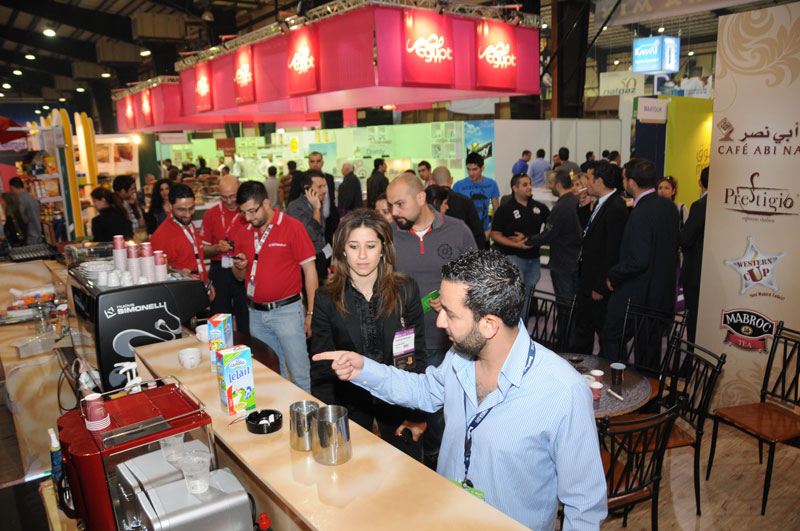
Among the exhibitions and trade shows we attended to during these first months of 2011, Beirut’s HORECA 2011 was the most surprising.

Despite the turmoil hitting the region, HORECA 2011 welcomed its many visitors – almost 6,000 a day – with a great number of exhibitors and many interesting meetings.  But what is more important for the whole Ho.Re.Ca regional business, was the signing of an agreement that will certainly boost the turnover in the Lebenon region: the Beirut Capital of Taste Charter. 

In doing so, Mr. Fady Abboud, Minister of Tourism, Mr. Mouhamad Choucair, President of Commerce, Industry, and Agriculture of Beirut and Mount Lebanon, Mr. Nehmat Frem, President of the Association of Lebanese Industrialists, Mr. Pierre Ashkar, President of the Federation for Tourism Association and President of Lebanese Hotel Association, Mr. Paul Ariss, President of the Syndicate of Owners of Restaurants, Cafes, Night Clubs and Pastries, Mr. Georges Nassrawi, President of the Syndicate of Lebanese Food Industries, Mr. Nouhad Dammous, President of ADFTH, and Mrs. Joumana Salame, Managing Director of Hospitality Services, all united to put Beirut on the map as a world leader with its international standards in terms of innovation, inspiration, know-how and conviviality.

We are very thrilled to have this charter finally signed”, said Mrs. Joumana Salame, Managing Director of Hospitality Services. “We have been working on this plan for the past 3 years, and we strongly believe that Lebanon will be up to the title it has been awarded

By bringing together European and Middle Eastern countries and strengthening Lebanon’s international bonds, Horeca serves not only as an economic boost adding to the development of the country, but also as a tourism attraction, by enticing hundreds of thousands of visitors yearly.

DESITA, showfood and ECOFFEE are among the companies who have already benefited from the Beirut Capital of Taste Charter, with great projects done and to come and the foreseen participation at HORECA 2012, where we will present the best Italian shop concept design, the best catering equipment products and the most innovative practices to bring sustainability in the Ho.Re.Ca. & Hospitality sectors, food Retail and Franchising. (Picture Credit: Hospitalitynewsmagazine)

The Coca Cola Company and the new PlantBottle® packaging: sustainability comes from sugarcane!

Beginning April 4, 2011 the first 100 percent recyclable beverage packages made with plants are readily available to people across the U.S. If you want to enjoy the fresh taste of DASANI, or a nourishing Odwalla beverage in a more environmentally responsible package made from plants, now you can. There’s no more waiting.

PlantBottle® packaging for both brands was developed with the planet in mind by PlantBottle® Packaging Platform, The Coca Cola Company.  Single-serve Odwalla packages are made from up to 100 percent plant-based materials with high-density polyethylene (HDPE) plastic. PET bottles for DASANI are made with up to 30 percent plant-based materials.

“It’s our goal to make traditional plastic bottles a thing of the past and ensure that every beverage we produce is available in 100 percent plant-based, fully recyclable packaging,” said Scott Vitters, General Manager, PlantBottle® Packaging Platform, The Coca-Cola Company. “The national launch of DASANI PlantBottle® packaging represents an important step toward reducing our carbon footprint, and the up to 100 percent plant-based, recyclable packaging used for Odwalla is the first of its kind in the beverage industry.”

Traditional PET bottles are made from petroleum and other nonrenewable fossil fuels. Incorporating a blend of petroleum-based materials with up to 30 percent plant-based materials allows PlantBottle® packaging for DASANI to reduce potential intrinsic carbon dioxide emissions when compared with PET plastic bottles

“DASANI is designed to make a difference by offering a better designed package for a more sustainable future,” said John Roddey, Vice President and General Manager, Water, Tea and Coffee, Coca-Cola North America. “Because DASANI PlantBottle® packaging is up to 30 percent made from plants and still 100 percent recyclable, it was designed with the planet in mind by helping to reduce the impact of our packaging on the environment.”

The plant-based materials for both DASANI and Odwalla PlantBottle® packaging are produced through a process that turns sugarcane into a key component for PET and HDPE plastic. Currently, PlantBottle® packaging is made using sugarcane ethanol from Brazil, the only source widely recognized globally for its unique environmental and social performance. Brazilian sugarcane is primarily rain fed and industrially grown on abundant, arable land using organic fertilizers. The plantations from which PlantBottle materials are sourced are located far away from Amazon rain forests, and their impact on biodiversity is reduced thanks to advanced farming practices and sound public policy.

Unlike other plant-based plastics, PlantBottle® packaging is entirely recyclable and can be processed through existing systems. This ensures PlantBottle® packaging can be repeatedly used, recycled and reused. In addition, there are no differences in shelf life, weight, composition or appearance between traditional PET plastic bottles and PlantBottle® plastic bottles.

In late 2009, PlantBottle® packaging was launched in the western U.S. and eight other markets around the world. To date, PlantBottle® packaging is estimated to have eliminated the equivalent of 30,000 metric tons of carbon dioxide, or three million gallons of gasoline used to produce PET plastic bottles. Currently, The Coca-Cola Company is working to further technology so other plant materials can be used in future PlantBottle® packaging. The ultimate long-term goal is to turn waste into a resource, resulting in a carbon neutral, 100 percent renewable, responsibly sourced bottle that is fully recyclable.

“Several approaches to a PET package made entirely from plants have been successfully demonstrated in laboratory testing. We’re working to advance this breakthrough science to ensure it is commercially viable,” said Vitters. “PlantBottle® packaging means only good things for everybody. We welcome others in the industry joining us in advancing the science behind packaging made from plants.”

The technology used to make PlantBottle® packaging already has been adopted by Heinz, which recently announced it will begin packaging its ketchup using that technology this summer under license from The Coca-Cola Company.

The rollout of PlantBottle® packaging for DASANI will be supported by a national television spot breaking in April. Additional executions will include enhanced packaging graphics, as well as out-of-home, print, digital and point-of sale-advertising to build awareness for PlantBottle® packaging. Odwalla’s marketing program includes coupons, print advertising, digital programs and new labeling Point-of-sale materials for in-store displays will feature attention-grabbing messages such as “Paper or Plastic? Try Plant!” (Source: Businesswire)

Vinitaly opens its doors with interesting data

Vinitaly focus on export and on the Italian market decline.

How to seize the new opportunities coming from abroad, particularly from Asian markets, and how to support the internal Italian market are the two main themes of the 2011 Vinitaly, the most important Italian Wine exhibition,  which is taking place in Verona (Italy), and will end on April 12 .

The Italian wine business is quite a big one, worth € 13.5 billion plus  a €2 billion deriving from induced activities. But there are lights and shadows. For example, on the exports side, 2010 experienced a growth  reaching a +12% equal to 3.93 billion euro, while domestic consumption is decreasing.
For the first time, reports Coldiretti (the Italian association of Agriculture farmers), 2010 showed a stagnation in the internal sales, now at € 3.89 billion. 

Riello, the President of Veronafiere, has stressed even more the wine business critical situation, the decline in domestic consumption, which continues, “was between 100 liters per capita in the Seventies, up to 45 liters in 2007, about 40 liters per person nowadays” showing a “further decreasing trend by 2015. ” The problem, recently highlighted by Giuseppe Martelli, director general of Assoenologi (the Italian Association of oenologists), is that “an oenology structured like the Italian one, cannot rely only on export.”

A couple of data: “in Australia only ten companies produce more than 90% of the wine exported, in Chile of 120 wineries, 100 are working only for export. In Italy, however, companies are more than 450 thousand, with an average size that is below the three hectares, compared to 300 in Chile and Australia. ”

Even a survey Vinitaly Winenews-emerges as foreign markets are critical to revenue growth, a situation that can cope with the larger companies, but few compared to many small enterprises that characterize the Italian production scenario and still have turnover rather weak.

A Vinitaly-Winenews survey on 50 companies among the most representative of the Italian business, show that 2010 ended with an average revenue increase of 8%, driven in particular by exports  (+14%).  As per 2011, the report show a degree of optimism: 75% of the interviewed said to be quite positive, 15% positive while a 10% of wineries that still feels the situation to be critical. The most critical points highlighted by the survey are economy instability, weak consumption, the loss of international competitiveness, the hars internatioanl competition.

The boom in exports, according to Coldiretti, is due largely to the U.S., which in 2010 became the country with the highest consumption of wine in the world. The American market, which is worth about $ 30 billion, is covered for 61% of production in California, but Italian wines are the most consumed ones, growing in value by 11%.

The most important destination of Italian wines are Germany, +4% in 2010, China – exports to this country doubled in 2010 – India, +65%, and Russia, +58%, equal to €104 million.

Coldiretti also analyzed the important value of the employment world of wine: the 250,000 Italian companies create jobs for for 1.2 million people. There are about half a million owners of vineyards, which have about 210,000 employees, of which over 50,000 are young and 30,000 are foreigners. And the wine business does not end in the vineyard, opportunities being in adjacent sectors like trade and catering, glass, cork, label and packaging, as well as research, publishing, finance, wine tourism, health, bio-energy. (Source:manageronline.it)

Illycaffè Earns the First DNV Responsible Supply Chain Process Certification

On March 18, 2011 illycaffè became the world’s first company to receive a Det Norske Veritas (DNV) Responsible Supply Chain Process certification, attesting to the company’s long-running sustainable approach to production and its relations with stakeholders throughout the production chain, particularly with green coffee suppliers.

The illycaffè model is innovative in assigning critical roles to quality and value creation. The certification was officially conferred at illycaffè’s twentieth annual meeting in Brazil, recognizing suppliers for coffee production meeting the company’s industry-leading quality standards.

DNV, an international, independent leader in product and process certification, in part modeled its new certification standard on the illycaffè supply chain model, buttressing it with current and emerging stringent guidelines for sustainability and corporate responsibility, and with standards of reference for certification and accreditation activities. The certification incorporates both pan-industry standards and industry specific standards. Officially, illycaffè received the DNV Green Coffee Responsible Supply Chain Process certification.

The standard developed by DNV is innovative because it marks the passage from the certification of an organization’s supply chain to the certification of an organization’s ability to create value that benefits everyone involved.

“We are proud to have obtained this certification, which recognizes and validates how we have operated over the past 20 years, through protocols and procedures that guarantee the excellence of our final product,” said Andrea Illy, President and Managing Director of illycaffè. “illycaffè has always been a stakeholder company, based on ethics and with the objective of improving quality of life. Quality is a key concept in our company philosophy. Our continuous search for quality creates a virtuous cycle that creates value for everyone involved, from coffee growers to coffee drinkers, in growing magnitude over time.”

Quality and sustainability are for illycaffè inseparable: a truly excellent product cannot be anything but sustainable in three critical aspects: economic, social and environmental. Economic sustainability is achieved through the creation of value for all those involved, from the grower to the final consumer. Social sustainability rests on the concepts of individual growth and self-realization. Environmental sustainability means respect for the ecosystem, through, for example, the use of recyclable shipping and packaging materials and the application of non-polluting practices.

“This supply chain certification standard is particularly innovative in demonstrating a company’s ability to create value over the long term,” said Thomas Vogth-Eriksen, Chief Executive Officer DNV Business Assurance. “The schema focuses on the building of shared value in a context where social development stimulates economic development, recognizing that a business grows in large part through its ability to help its partners and suppliers grow.”

Over the past two decades illycaffè has perfected a system of direct relationships with its suppliers, based on three main pillars: selecting the best growers in coffee producing countries; transferring to these growers, through the company’s Università del Caffè and the daily field work of specialized agronomists, comprehensive knowledge accumulated over 80 years of practical experience and research to produce coffee meeting illy’s high quality standards; and purchasing the best production directly from growers, paying them a premium over the going market price to reward quality achieved, and incentivize ongoing improvement. (Source: BusinessWire)

American consumers punish greenwashing practices, a survey says

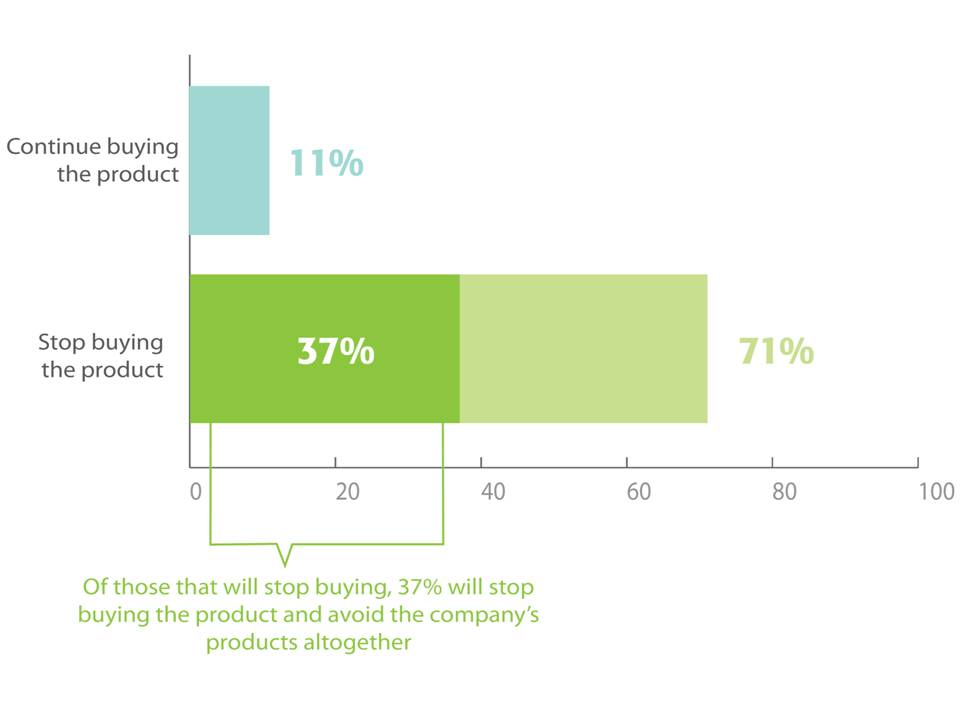
Nearly three-quarters of consumers (71%) will stop buying a product if they feel misled by environmental claims”

Two days ago an ECOFFEE prospect tried to convince us that sustainability is just a marketing word, and that consumers are not able to understand whether the retail product/store is really sustainable or it is just greenwashing.
We have already dealt with this kind of prospect – and many became enthousiast ECOFFEE customers and sustainability advocates. Data and market analysis are the only way to convince the sustainability skeptical about the counter effects of greenwashing practices.

That day, we showed to our prospect the Cone Inc. Trend Tracker recent analysis about U.S consumers and their behaviour towards greenwashing practices, dated March 24 2011.

Results are very interesting – and very motivating for those of us who believe in real sustainable business practices.
When consumers discover a claim to be misleading, they will take the following actions:


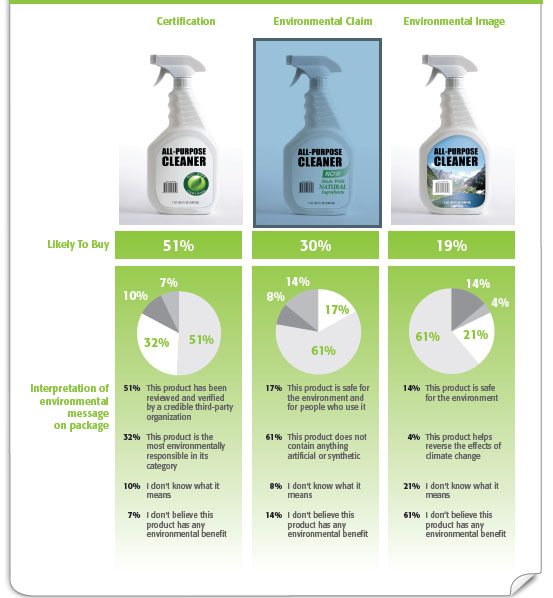
Three mock cleaning products were showed to consumers, who were asked to “purchase” the one they believed to be the most environmentally responsible. They were also required to indicate what they think the certification, claim or image on each package represents.
The results are as follow:

Another very interesting survey finding concerns the inaccurate interpretation by U.S. consumers when it comes to words such as “green” and “environmental friendly”. More than two-in-five Americans (41%) erroneously believe these terms mean a product has a positive (i.e., beneficial) impact on the environment. Only 29 percent understand that these terms more accurately describe products with less environmental impact than previous versions or competing products.
Last but not least, 59% say it is only acceptable for marketers to use general environmental claims when they are backed up with additional detail and explanation:
-23% say vague environmental claims should never be used.
-79% want detailed information readily accessible on product packaging.
-75% wish companies would do a better job helping them understand the environmental terms they use.

It is not necessary to add other comments to the above survey results, but if you are interested to know more, you can download the whole survey linking to the Cone Inc. website.

China retail luxury: a long-term insight

China: a market that is continuously growing, a very rich but still unknown to the many. What is clear is that China is set to become the most powerful economy in the world, and this will happen in a very short time. Many are the companies that have already sucessfully entered the Chinese market, luxury good brands being the pioneers.

A McKinsey survey over 1.500 Chinese luxury consumers during spring 2010, shows interesting trends which are basically telling to the world that the “consumer culture” is changing at a very high speed, following the changes in the society and urban landscape. For those who are interested, the whole report can be downloaded here, but three are main facts:

  • “Rapid increases in wealth, and shifting social mores that sanction the display of that wealth, are driving a growing infatuation for luxury goods among Chinese consumers.”
  • “Access to an explosion of information on the Internet, an increasing penchant for overseas travel, and first-hand experience purchasing and consuming luxury goods are contributing to a substantial rise in sophistication among luxury consumers in China. Contrary to popular belief, a growing number of Chinese luxury consumers are exhibiting a noticeable trend away from overt displays of wealth, and towards more understated forms of luxury consumption.”
  • “Rapid urbanization and growing wealth outside of China’s largest cities is driving the emergence of several new geographic markets with sizable pools of luxury goods consumers. Over the next 5 years, [McKinsey] expects that the number of such cities will double from 30 to 60.”

Other key findings are social-demographics related. Not only traditional luxury brands consumers, but also 13 million upper-middle-class households (earning $15,000 to $30,000), which are stretching their budgets to buy luxury watches, jewelry, handbags, shoes and clothing. This segment represented 12% of Chinese luxury consumption in 2010, but is expected to reach 22% by 2015.

The survey also shows that approximately 73% of luxury consumers in China are under age 45, significantly younger than their counterparts in western nations or even nearby Japan. 

All these findings essentially reinforce the widespread idea that if this trend is going to be followed in 2011 too, China will become the biggest retal luxury market in the close future. (Source: McKinsey, Picture credits: TheChinaObserver)

What is Masdar and why it is so important for our future?

Masdar is a familiar word to all of us who are concerned about the future of our dear planet Earth. But for the few of you who have never heard of it, please allow us the pleasure to introduce you this incredible project.

Masdar is first of all a company, notably a Mubadala – Abu Dhabi government owned company, based in Abu Dhabi, UAE. As stated in the company’s website ” Masdar is a commercially driven enterprise that operates to reach the broad boundaries of the renewable energy and sustainable technologies industry – there by giving it the necessary scope to meet these challenges.  Masdar operates through five integrated units, including an independent, research-driven graduate university (Masdar Institute, other units are Masdar Capital, Masdar Power, Masdar Carbon, Masdar City cfr.) and seeks to become a leader in making renewable energy a real, viable business and Abu Dhabi a global centre of excellence in the renewable energy and clean technology category. The result is an organisation greater than the sum of its parts and one where the synergies of shared knowledge and technological advancement provide this commercial and results-driven company with a competitive advantage that includes an ability to move with agility and intelligence within an industry that is evolving at great speed.
This holistic approach keeps Masdar at the forefront of this important global industry, while ensuring it remains grounded in the pursuit of pioneering technologies and systems that also are feasible. As a result, it delivers innovation to the market while deriving profits for its shareholders.”

This huge project deals with all the aspects of sustainability: research, energy, finance, architecture, urbanism. Last but not least, retail. Because of its importance in the life of all the people who will live in Masdar City and for “its contribution to the city’s appeal as a renewable energy and clean-technology hub“, retail in Masdar “will provide valuable lessons regarding commercial activities (…) increasing our understanding of how retail activities can be conducted in a sustainable manner”. The list of the companies who have already been involved in the Masdar City retail project includes Caribou Coffee, health insurance provider Daman, telecom provider Etisalat, Sumo Sushi, express delivery company Aramex, Omeir Travel, Organic Foods & Cafe and National Bank of Abu Dhabi. The first commercial building, the Courtyard Building,  has been planned to be finished by 2012, therefore there is enough time for this list to become a very long one.

In the meanwhile, many are the people who are praizing the incredible urban project designed by Foster and Partners, but to be fair, there are also critics like New York Times journalist Nicolai Ouroussof  who wrote that “…its design also reflects the gated-community mentality that has been spreading like a cancer around the globe for decades. Its utopian purity, and its isolation from the life of the real city next door, are grounded in the belief — accepted by most people today, it seems — that the only way to create a truly harmonious community, green or otherwise, is to cut it off from the world at large“.

Our point of view and what we are always stressing in our ECOFFEE projects, is that sustainability is too important for our future and each and every project that has a little bit of sustainability in it is important to raise people awareness. To be too critical towards sustainability-related projects, requiring their perfection – which at this stage is quite hard to achieve – postpones any action and creates confusion among people, these two being the worst enemies of sustainability. (Picture credits: Masdar.ae)