All posts by Silvia

A greener Novotel by 2012

PARIS Accor’s midscale Novotel brand is on pace to meet its goal of becoming 100% environmentally sustainable by next year, the group says.

To date, 78 of Novotel’s portfolio of more than 400 hotels have been certified as sustainable by EarthCheck, the organization formerly known as Green Globe. Novotel’s commitment to sustainable development has enabled the brand to achieve the following green results as of year-end 2010:

  • 98% of hotels apply and monitor the 65 actions in the Accor Hotel Environment Charter
  • 80% have installed energy-efficient light bulbs in areas that stay lit 24 hours a day
  • 92% have installed flow regulators on faucets and in showers
  • 89% recycle paper and cardboard packaging
  • 86% dispose of compact fluorescent tubes and light bulbs safely
  • 60% serve organic products
  • 60% offer nutritionally balanced meals for children.

EarthCheck certification is awarded after a preliminary assessment of a hotel’s performance and the deployment of an appropriate management system covering implementation of a sustainable development policy, water use, energy use, waste management, paper consumption, use of pesticides, use of cleaning and sanitation products, and commitments to the local community. At least 10 months are required for a hotel to receive certification, which is awarded by an independent outside auditor and is reevaluated every two years.

“Since 2008, Novotel teams have been actively involved in the EarthCheck certification program so that we can meet our goal of certifying the entire network by 2012,” says Pierre Lagrange, Novotel’s global marketing director. “Novotel’s commitment to the principles of sustainable development is an integral part of the brand’s promise of customer well-being (Source: Ghaward.ie)

Paperless Cafés

Getting green while following technology? Sure! Many Cafés are now offering digital newsstand, which are both green and modern, providing people with paper-free updated news at no cost. Here you can find two examples. The big corporation one, Starbucks, and a small Café in Croatia. 

The Starbucks Digital Network has debuted their exclusive content network to further enhance the customer’s in-store experience. Customers who use the free Wi-Fi at more than 6,800 U.S. Starbucks locations will be greeted with the Starbucks Digital Network. As a channel where consumers will be plugged into a variety of reading sections like news, entertainment and business, this Starbucks Digital Network will keep readers engaged and going back to the famous coffee house for more access

On the other side of the Ocean, the Box Coffee Shop in Split, Croatia is replacing its offer of free newspapers with iPads. While each tablet is free to use, there is a security tag to alert baristas of any theft.
The idea is the same, the scale is a little bit different, but what is important is that the message must be clear: less paper, more green. (Credits: Trendhunter)

The Art of display: enhancing customer experience

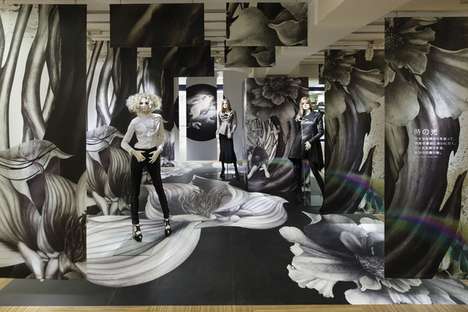
More businesses are incorporating artful accents to their shops, realizing that customers are more likely to enter and spend more time in a store with artistic retail displays than one with basic white walls and grid-like shelves. Everything from oversized art installations to crafty storefronts are giving retailers attention-grabbing elements that are simply too eye-catching for a customer to ignore.

Created by Kahori Maki, ‘Moon Princes’ begins with the window display and then leaks into the store’s interior space. It’s black-and-white coloring contrasts vividly with the relatively vibrant clothing. The result might be considered overwhelming but it charmes the most adventurous shoppers.

On the opposite, the Valencia Munich store, design by Dear Design studio, is very minimal, yet very impressive. Its all white color, the complex X display structure, seem to expand the display surface at libitum, giving to the full range of Munich Shoes on diplay the deserved importance.

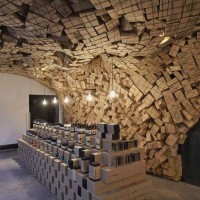
At the famous Merci store in Paris, Aesop has installed a creation designed by the Melbourne-based March studio, which can not passed unnoticed. A wall of stacked Aesop cardboard boxes, held together by a black net, looks like a tornado which is going to wrap over the shopper.

These are only few examples, what is clear is that shoppers now need more stimuli: products are available almost everywhere, what differs is the shopping experience. And art can be the solution. (Credits: Trendhunter)

Is augmented reality the future of retail?

Global revenues from augmented reality (AR) applications and services are projected to reach $1.5 billion by 2015, according to Pocket-lint.com

Augmented reality is a term for a live direct or an indirect view of a physical, real-world environment whose elements are augmented by computer-generated sensory input, such as sound or graphics.

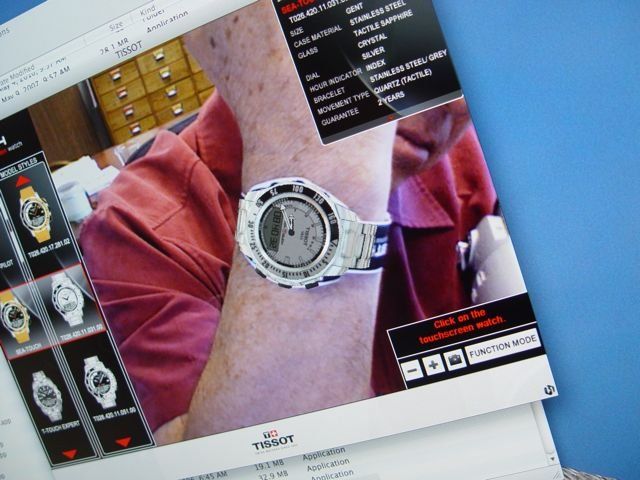
Tissot watches has had success implementing an AR campaign. By placing a dummy watch around your wrist, which has a code on the face, and holding it in front of your webcam, the app displays it on the screen as a virtual, 1:1 scale version. The benefit is you get to “try on” the watches to see which suits you best before purchasing.

Holition, AR, 3D and future technology creative agency, which is based in East London, is responsible for the campaign.

“What we’re trying to do with the worn-on-the-body applications is enable a real business functionality for it. It engages consumers, it enables people to understand the product and therefore it enables them to take that step closer to purchasing the product as well,” said Lynne Murray, brand manager at Holition.

“Tissot’s brand public relations grew 600 percent through the campaign compared to 100 percent growth that they usually expect to achieve. So, even as a communication tool, it’s a hugely engaging way for brands to have another and new point of contact with its audience. AR is a new way of communicating socially, a new way of getting people on board with the brand.”

Murray expects these types of technologies to give way to a fully integrated retail experience in the not too distant future. (Source: Retailcustomerexperience.com)

Luxury and sustainability… a trend we will see more of in China

URBN Hotels & Resorts announced plans for URBN Hotel Pudong, a new green hotel that will become the first positive-impact hotel in China. The hotel is slated to open Spring 2012.

In collaboration with Vanke, China’s largest residential real estate developer, URBN’s 20,000 square metre boutique hotel is part of a larger commercial, retail and residential development in the Sanlin district of Pudong in Shanghai. They have tapped Fumihiko Maki, the world-acclaimed Japanese architect whose current works include the United Nations building and World Trade Center Tower 4 in New York City, to design the project.

The development, which is estimated to cost RMB 312 million (US$47 million), will include 55 hotel rooms, 50 URBN serviced residences, and 4,500 square metres of dining, wellness and art spaces.

URBN created China’s first carbon-neutral hotel, the chic and hip URBN Shanghai in the Jingan district. URBN Shanghai is passionately committed to the environment and is at the forefront of the growing consumer eco-movement in China. URBN tracks the hotel’s entire carbon footprint and offsets it by purchasing carbon credits or investing in local “green” energy development and emission reduction projects. The hotel provides guests the option to find out their footprint during their stay and by donating trees to Jane Goodall’s Roots and Shoots foundation to offset.

For the new URBN Hotel Pudong, Jules Kwan, Managing Director of URBN Hotels indicated that “the aim is to make this hotel go beyond sustainability … the hotel will increase the biodiversity of the site, and will discharge water that is cleaner than the water from the city’s water supply.” The hotel hopes to get LEED and China Green Star certifications. Also, URBN Hotel Pudong aims to surpass the 35% energy savings target hit by URBN Shanghai. (Source: Red-Luxury)

Preparing for the consumer economy of 2020

In a recent super session at Retail’s BIG Show, Ira Kalish, Director of Global Economics for Deloitte Research, gave an all-encompassing overview on the state of the global retail industry ten years from now, as well as his take on what the consumer of the future will look like.
Kalish kicked off with a run through of recent developments in global retailing, noting that it’s always useful to think about the future by reviewing the past.
In particular, Kalish highlighted some of the paths that lead towards the economic crisis of 2008 and 2009 and the lessons that were learned from that crisis: massive consumer leveraging in the U.S., U.K. and Spain; the collapse of the asset price bubble; emerging currencies rising; U.S. consumers paying down debts and saving more; housing no longer being seen as a source of economic growth; China’s move towards consumerism and consumer spending rising as a source of GDP; and the challenges faced in Europe due to imbalances between countries like Germany and Portugal, Ireland and Spain.

As for what retailers can expect in the consumer economy of 2020, Kalish pointed to a number of challenges and opportunities retailers should certainly have on their long term radar, such as the massive increase in emerging middle classes and the disproportionate share of growth in emerging areas of the world like Indonesia, Colombia and Africa.

The effects of an aging population in an increasingly affluent world will also be a key consideration for retailers of all shapes and sizes, while hot markets with younger demographics (India, Middle East and Africa) will also keep global retailers on their toes.

Kalish also noted, the impact of obesity, changing global food market dynamics, an ever-increasing focus on sustainability and the possibility of a social media revolution could play a heavy role within the consumer economy of 2020.

So what can retailers do to prepare for this new consumer outlook? Kalish believes that aligning company values with those of consumers will be critically important, as will leading and listening to customers. Taking care of your brands, your people and your investments will also pay dividends when it comes to engaging with consumers, something that will be fundamental for 2020’s consumer – and not a bad idea for 2011. (Source: NRF)

Sodexo and Costco for a sustainable seafood

Food giants Sodexo and Costco have both committed to improve the sustainability of their seafood.

Sodexo, the $21 billion food service company, has announced a goal for all its contracted seafood to be certified by the Marine Stewardship Council (MSC) or the Global Aquaculture Alliance’s Best Aquaculture Practices (BAP) by 2015.

Under the plan, Sodexo will review all wild caught and farm raised seafood purchases and set short, medium and long-term goals with its contracted seafood vendors.

The target is part of Sodexo’s Better Tomorrow sustainability plan. The Better Tomorrow Plan makes 14 commitments to the environment, health, wellness and community support.

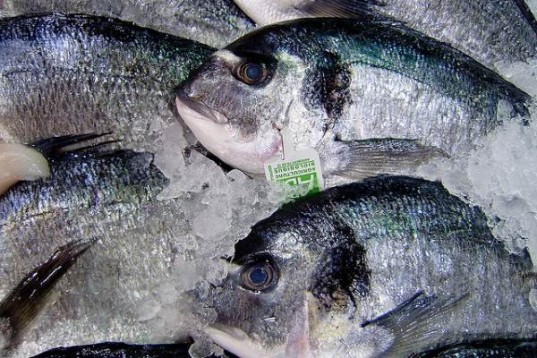
Meanwhile, Greenpeace has announced that after eight months of pressure, the world’s ninth-largest retailer has agreed to remove over a dozen seafood items from sale until the company can find an MSC-certified option. Costco will place a hold on selling Atlantic cod, Atlantic halibut, bluefin tuna, Chilean sea bass, Greenland halibut, grouper, monkfish, orange roughy, redfish, shark, swordfish, skates and rays.

Costco is also in the process of shifting towards more sustainable sources of tuna for fresh, frozen and canned varieties of the fish, Greenpeace said.

Costco will work with the World Wildlife Fund (WWF) to examine its remaining wild-caught species and determine the best way of moving to sustainable alternatives, Greenpeace said.

Costco and WWF have had a partnership since July of last year. Its first goal was to gauge the adherence of Thai-based shrimp farmers to draft standards drawn up by the Shrimp Aquaculture Dialogue, WWF said, and then to develop a strategy to guide those suppliers to full compliance. (Source: Environmentalleader.com, Photo: Thomas Quine)

Need some customer interaction? Here it goes!

There are many ways to enhance customer experience..Let’s start from the window display, for istance. Technology is helping retailers a lot, and we have found some great examples that we would like to share with you. Not so much to add, just watch and enjoy – and maybe give us your feedback!


Interactive Window Concept made for the module Advanced Interface Design at Hyper Island hosted by North Kingdom


Project for an interactive display window for BNP Paribas, place de l’Opéra, Paris


The Interactive Apple Store in Berlin, Germany.

How to add another plus to organic food: this is marketing!

We have always written about communication being the success key to sustainability in the retail business. Thanks to communication retailers can help consumers understand the real value of their efforts when it comes to sustainability: why they choose this product instead of the competitor one, why they are recycling, why they are preferably purchasing locally grown food and so on.

A post on Hive Health Media made me smile, considering it a great example of how to market organic food in a more appealing way. Everywhere, organic food is associated with “not that good-looking food that does not pollutes the Earth” concept. This might be not strong enough to convince the average consumer. But what about saying: “Buy organic and keep in a good shape”?. This was essentially the message broadcasted in that post. Three key points:

– The organic food at the supermarket is often 30-50% more expensive than standard food, doesn’t contain chemicals such as herbicides, pesticides, hormones and antibiotics( This means is healthier and it is true  that consumers buy less because of the price, but in this case, less food means a better shape.)
– Organic food also helps detoxify the body and puts it in a state that makes it easier for the consumer to get in shape.
– As an added bonus, an overall sense of wellness will develop over time when consumers are living organic.

Obviously, there was some marketing in that post, not related to organic food though but to how to cook it, but this is a different story.

The colors of Ikea Italy: blue, yellow and.. green!

Ikea Italy announced an environmental investment of € 20 million: 150,000 solar panels to be installed by the end of August 2011in each store so that to create a small solar power station. Clean, renewable, sustainable.

About 150,000 solar panels modules will be placed on a aluminum structure resting on the Ikea store roofs, and in Catania (Sicily), also on the bus shelters in the parking lot. An area as big as 16 football fields to cover about 10% of the electricity needs of Ikea Italy. The first floor (showroom) of all stores will be then lightened with this renewable energy. A total of 10,000,000 kWh of electricity, equal to the average consumption of 3,300 households will be produced each year with a reliable and innovative technology.

This will prevent the annual emission of approximately 4,000 tons of carbon dioxide, equivalent to the quantity of CO2 absorbed annually by 400 acres of tropical forest and the emissions of 3,300 cars travelling an average of 10,000 km. Another key point of the Company policy is to reduce waste and an effective use of raw materials, recycled materials or easy to recycle ones, natural and renewable energy, CO2 emission reduction thanks to a clever consumption, the optimization of facilities’operational activities and electricity from renewable sources (in 2010 equal to 83% of the total consumption).

When dealing with waste management, the goal is to reduce it thanks to the development of a less bulky packaging and a careful waste disposal collection so that to assure their almost full recycling. Ikea is bio too. In restaurants, the group includes more than 58 recipes and organic products from biological origin. In 2010, Ikea Italy purchased 2,080 tons of organic products (+38% compared to 2009). Ikea Italy is now the third third largest Ikea supplier company in the world after China and Poland, as stated by the managing director of Ikea Italy, Lars Petersson during a meeting in Milan. (Source. Greenbiz.it)