Tag Archives: sustainable

Beverage industry and sustainability: TATA beverages

We have previously wrote about how the beverage industry is getting more and more Sustainable, with more sustainable packaging like the Coca-Cola Company PlantBottle packaging, or by taking greater attention to the supply chain, as PepsiCo is doing with its recent committment to purchase only 100% Mexico sustainably grown sunflower crops.

 
Today, we will take a quick insight in what TATA Global Beverages is doing regarding sustainability. But first, a couple of information about the Company: TATA Global Beverages is part of the TATA Group, it currently employs 3,000 people around the world and it reported a 28% profit increase on Q3 2010, with profits being Rs 471.5 million (more than 74 million Euros).
 
If you take a look at Tata beverages website, it is clear that TATA Global Beverages is deeply involved in sustainability: from its mission “to make the world a better place through ‘life enhancing sustainable hydration’ to its long term goals and its collaborating with the Rainforest Alliance.
In a recent interview with The Guardian, TATA Global Beverages Director of Sustainibility Sara Howe, talked about the challenge to balance sustainability with the Company’s present short-term financial and commercial pressures.
She stated to be optimistic about the number of big companies who are now seriously and credibly engaging with the sustainability agenda, setting ambitious sustainability targets and demonstrating progress towards achieving them.
 ” As more companies come to understand the risks and opportunities that issues like climate change, water stress, population growth, health and wealth disparity, represent, then the necessary capacity and capability building will follow” Howe states.
But what is the role of consumers in the process towards a more sustainable business? Howe’s reply: “In a consumer-focused business like ours a particular challenge is getting permission from consumers to act for the future. Traditional research and insight methodologies tend to drive responses based on their current experience and understanding. We need to find a way of showing consumers what the future might look like from a sustainability point of view. Then they can then help us design products and services fit for that future” yet adding that her main concern about the ability to create a more sustainable world is that “That too many people won’t get it until it’s too late“.
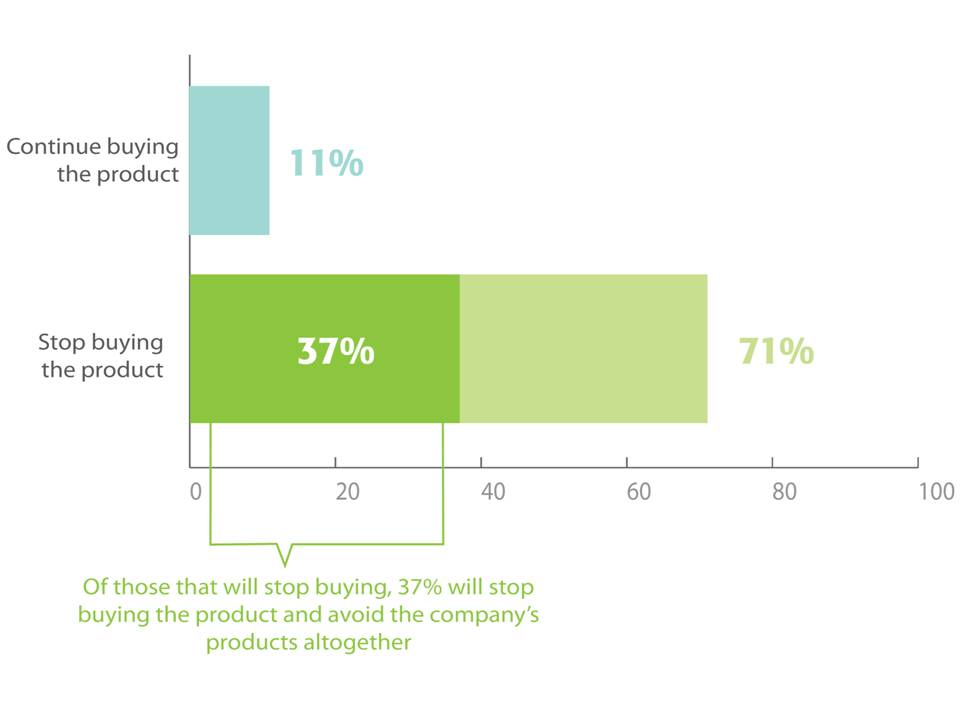
American consumers punish greenwashing practices, a survey says

Nearly three-quarters of consumers (71%) will stop buying a product if they feel misled by environmental claims”

Two days ago an ECOFFEE prospect tried to convince us that sustainability is just a marketing word, and that consumers are not able to understand whether the retail product/store is really sustainable or it is just greenwashing.
We have already dealt with this kind of prospect – and many became enthousiast ECOFFEE customers and sustainability advocates. Data and market analysis are the only way to convince the sustainability skeptical about the counter effects of greenwashing practices.

That day, we showed to our prospect the Cone Inc. Trend Tracker recent analysis about U.S consumers and their behaviour towards greenwashing practices, dated March 24 2011.

Results are very interesting – and very motivating for those of us who believe in real sustainable business practices.
When consumers discover a claim to be misleading, they will take the following actions:


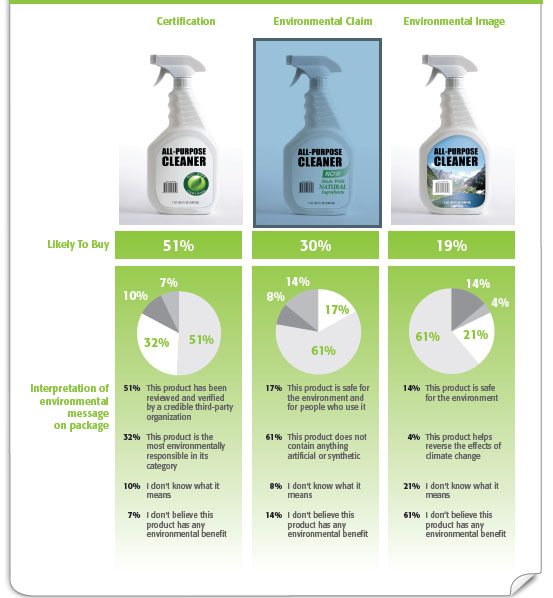
Three mock cleaning products were showed to consumers, who were asked to “purchase” the one they believed to be the most environmentally responsible. They were also required to indicate what they think the certification, claim or image on each package represents.
The results are as follow:

Another very interesting survey finding concerns the inaccurate interpretation by U.S. consumers when it comes to words such as “green” and “environmental friendly”. More than two-in-five Americans (41%) erroneously believe these terms mean a product has a positive (i.e., beneficial) impact on the environment. Only 29 percent understand that these terms more accurately describe products with less environmental impact than previous versions or competing products.
Last but not least, 59% say it is only acceptable for marketers to use general environmental claims when they are backed up with additional detail and explanation:
-23% say vague environmental claims should never be used.
-79% want detailed information readily accessible on product packaging.
-75% wish companies would do a better job helping them understand the environmental terms they use.

It is not necessary to add other comments to the above survey results, but if you are interested to know more, you can download the whole survey linking to the Cone Inc. website.

What is Masdar and why it is so important for our future?

Masdar is a familiar word to all of us who are concerned about the future of our dear planet Earth. But for the few of you who have never heard of it, please allow us the pleasure to introduce you this incredible project.

Masdar is first of all a company, notably a Mubadala – Abu Dhabi government owned company, based in Abu Dhabi, UAE. As stated in the company’s website ” Masdar is a commercially driven enterprise that operates to reach the broad boundaries of the renewable energy and sustainable technologies industry – there by giving it the necessary scope to meet these challenges.  Masdar operates through five integrated units, including an independent, research-driven graduate university (Masdar Institute, other units are Masdar Capital, Masdar Power, Masdar Carbon, Masdar City cfr.) and seeks to become a leader in making renewable energy a real, viable business and Abu Dhabi a global centre of excellence in the renewable energy and clean technology category. The result is an organisation greater than the sum of its parts and one where the synergies of shared knowledge and technological advancement provide this commercial and results-driven company with a competitive advantage that includes an ability to move with agility and intelligence within an industry that is evolving at great speed.
This holistic approach keeps Masdar at the forefront of this important global industry, while ensuring it remains grounded in the pursuit of pioneering technologies and systems that also are feasible. As a result, it delivers innovation to the market while deriving profits for its shareholders.”

This huge project deals with all the aspects of sustainability: research, energy, finance, architecture, urbanism. Last but not least, retail. Because of its importance in the life of all the people who will live in Masdar City and for “its contribution to the city’s appeal as a renewable energy and clean-technology hub“, retail in Masdar “will provide valuable lessons regarding commercial activities (…) increasing our understanding of how retail activities can be conducted in a sustainable manner”. The list of the companies who have already been involved in the Masdar City retail project includes Caribou Coffee, health insurance provider Daman, telecom provider Etisalat, Sumo Sushi, express delivery company Aramex, Omeir Travel, Organic Foods & Cafe and National Bank of Abu Dhabi. The first commercial building, the Courtyard Building,  has been planned to be finished by 2012, therefore there is enough time for this list to become a very long one.

In the meanwhile, many are the people who are praizing the incredible urban project designed by Foster and Partners, but to be fair, there are also critics like New York Times journalist Nicolai Ouroussof  who wrote that “…its design also reflects the gated-community mentality that has been spreading like a cancer around the globe for decades. Its utopian purity, and its isolation from the life of the real city next door, are grounded in the belief — accepted by most people today, it seems — that the only way to create a truly harmonious community, green or otherwise, is to cut it off from the world at large“.

Our point of view and what we are always stressing in our ECOFFEE projects, is that sustainability is too important for our future and each and every project that has a little bit of sustainability in it is important to raise people awareness. To be too critical towards sustainability-related projects, requiring their perfection – which at this stage is quite hard to achieve – postpones any action and creates confusion among people, these two being the worst enemies of sustainability. (Picture credits: Masdar.ae)

Sustainable supply chain: how to build it?

At the beginning of March 2011, McDonald’s announced its Sustainable Land Management Commitment (SLMC), a long-term plan to ensure the corporation only serves food (and uses packaging) certified as sustainably sourced. The initial focus is on five high impact products: beef, poultry, coffee, palm oil and packaging.  McDonald’s certainly have all the power to be able to win negotiations with suppliers and reach its goals, but what about small retailers who are buying from overseas?

Shirahime, a UK based ethical fashion consultancy, has published a guide to responsibly sourcing textiles and clothes from India.

Despite its narrow country and industry focus, the guide is packed with advice for any business looking to find responsible goods or services suppliers from overseas. Here’s an excerpt of the Shiraname’s guide.

Be clear about the outcomes you want to achieve
Define aims clearly and build a strategy around the outcomes you want to achieve. Don’t look exclusively for suppliers who have certification. Certification is a costly process and may not guarantee the specific outcomes youwant.

Instead, visit potential suppliers and examine their operations for yourself. If you do this, make sure you have a suitable translator and cultural liaison who can guide your decision making process. In addition, start networking, even if it’s with your competitors. If you do this up front it can vastly increase your chances of success in finding the right supplier.

Consider company size alongside business practices
There can be a correlation between a supplier’s size, the goods or services it provides, and its ability to operate responsibly.

As a broad rule of thumb, the larger the company the more comprehensive their offering will be. Yet the larger the company, the more likely it is that their business is focussed upon financial efficiency, not responsible practice. Therefore, if you’re looking for a responsible supplier it may be worth choosing smaller producers rather than bulk providers as your partners.

Consider alternatives to your preferred goods, service or country
In order to get the most responsible procurement deal, businesses have to change their mindset and be open minded about both the country of origin and the goods or service they’re looking to procure.

Be prepared to invest as well as purchase
Businesses need to think about how they can contribute long term value to their suppliers’ enterprise beyond a simple commercial deal. This is where the value of being clear in your outcomes and partnering with other companies can yield substantial benefits. (Source: Guardian.co.uk)

Italian consumers love sustainable products but need better product information.

One of the findings of the “For a Sustainable Supply Chain: business and consumers point of view” survey conducted by the GfK Eurisko and promoted by the Sodalitas Foundation,  the product/service sustainability is ranked fourth among the criterias used by consumers when choosing, but if better communicated, will become an increasingly important requirement. During the investigation 500 consumers and 183 businesses were interviewed . To more than a third of the companies, sustainability is very important. However, only a minority (29%) in the interviewed sample declares to be thoroughly familiar with this concept, while a substantial percentage (45%) say they have “enough information”, confirming the gradual integration of this concept in the corporate culture .
The majority of consumers (63%) had heard of sustainability, even if only 19% of them (mostly young and with a high level of education) believe to know well its meaning, with a prevalence of the environmental (83% ) on the social aspects (64%).

The responsibility for a “sustainable development” is primarily attributed to the central Government (86%) and to local governments (82%), but a very high percentage of respondents (over 70%)  thinks businesses and citizens responsible to ensure the sustainability of the development. The opinions about the companies’ commitment to sustainability is different: one third of the sample (35%) expressed a positive opinion, a  third is critical and another third has no a definite opinion about it.

Only a third of consumers (32%) had heard of “sustainability of the supply chain” (a percentage that is growing in those aged more mature and – especially – among those with a higher education degree). But after the concept was briefly explained a large majority (76%) said to believe that companies must ensure the sustainability of their supply chain. Today, already one quarter of Italian consumers are chosing which products to buy also using supply chain sustainability criterias. Three quarters of consumers also agreed to pay more for a product which is guaranteed in terms of its sustainability. The focus is on all product categories but in particular on food (71%) and detergents (65%). And, at least in theory, the majority of consumers (76%) would be willing to pay more for a guaranteed product in terms of sustainability (though – the majority said to be ready to pay only “little” or “very little” more). (Source: GfK Eurisko, Image credits: Transocean)

Sustainable Coffee: what is it and is it really profitable?

Sustainability in the Retail & Ho.Re.Ca Business, what our ECOFFEE project is about, is based on a main concept: communication to consumers and customers must be clear and simple to make them better understand what are the added values of buying/consuming sustainable products.

For instance, let’s talk about Fairtrade, organic, Rain Forest Alliance or UTZ certified coffee. These are some of the labels with which coffee is traded nowadays and consumers can be quite confused by this abundance of sometimes not well explained terms. 

Among the many information source we always refer to when asked “What is sustainable coffee about?” we found that the Imbibe magazine one is the most consumer-friendly one, covering all main aspects of sustainability in the coffee business.

The other well known issue to our blog readers is “Is it really worth investing in sustainable coffee?”. Commodity traders know the answer, and this is “Yes, of course”. A recent publication by Intracen organization (International Trade Center), shows that “Demand for conventional (i.e. non-certified) coffee is largely stagnant in these markets, whilst it is thriving in emerging markets. Certified coffee, however, is showing strong growth and higher retail prices, particularly in mature markets. This trend is also followed by other commodities, including tea, cocoa and cotton. A new industry of inspectors and technicians has emerged to service the sustainability segment of the market”. 

How to add another plus to organic food: this is marketing!

We have always written about communication being the success key to sustainability in the retail business. Thanks to communication retailers can help consumers understand the real value of their efforts when it comes to sustainability: why they choose this product instead of the competitor one, why they are recycling, why they are preferably purchasing locally grown food and so on.

A post on Hive Health Media made me smile, considering it a great example of how to market organic food in a more appealing way. Everywhere, organic food is associated with “not that good-looking food that does not pollutes the Earth” concept. This might be not strong enough to convince the average consumer. But what about saying: “Buy organic and keep in a good shape”?. This was essentially the message broadcasted in that post. Three key points:

– The organic food at the supermarket is often 30-50% more expensive than standard food, doesn’t contain chemicals such as herbicides, pesticides, hormones and antibiotics( This means is healthier and it is true  that consumers buy less because of the price, but in this case, less food means a better shape.)
– Organic food also helps detoxify the body and puts it in a state that makes it easier for the consumer to get in shape.
– As an added bonus, an overall sense of wellness will develop over time when consumers are living organic.

Obviously, there was some marketing in that post, not related to organic food though but to how to cook it, but this is a different story.

The colors of Ikea Italy: blue, yellow and.. green!

Ikea Italy announced an environmental investment of € 20 million: 150,000 solar panels to be installed by the end of August 2011in each store so that to create a small solar power station. Clean, renewable, sustainable.

About 150,000 solar panels modules will be placed on a aluminum structure resting on the Ikea store roofs, and in Catania (Sicily), also on the bus shelters in the parking lot. An area as big as 16 football fields to cover about 10% of the electricity needs of Ikea Italy. The first floor (showroom) of all stores will be then lightened with this renewable energy. A total of 10,000,000 kWh of electricity, equal to the average consumption of 3,300 households will be produced each year with a reliable and innovative technology.

This will prevent the annual emission of approximately 4,000 tons of carbon dioxide, equivalent to the quantity of CO2 absorbed annually by 400 acres of tropical forest and the emissions of 3,300 cars travelling an average of 10,000 km. Another key point of the Company policy is to reduce waste and an effective use of raw materials, recycled materials or easy to recycle ones, natural and renewable energy, CO2 emission reduction thanks to a clever consumption, the optimization of facilities’operational activities and electricity from renewable sources (in 2010 equal to 83% of the total consumption).

When dealing with waste management, the goal is to reduce it thanks to the development of a less bulky packaging and a careful waste disposal collection so that to assure their almost full recycling. Ikea is bio too. In restaurants, the group includes more than 58 recipes and organic products from biological origin. In 2010, Ikea Italy purchased 2,080 tons of organic products (+38% compared to 2009). Ikea Italy is now the third third largest Ikea supplier company in the world after China and Poland, as stated by the managing director of Ikea Italy, Lars Petersson during a meeting in Milan. (Source. Greenbiz.it)

GoodGuide for Good Products for a more sustainable Retail

Yesterday I was reading a post concerning Levi Strauss & Co as the Top Jeans Brand, scoring a 7.4. The brand Prana was listed as the next highest, with a score of 6.3—followed by H&M (6.1), Banana Republic (6.1), and Old Navy (6.1).

I did not know what GoodGuide is – shame on me – so I checked out their very interesting website, which is said to be the world’s largest and most reliable source of information on the health, environmental and social impacts of consumer products. And I think it really is, rating over 95000 products, mainly available on the US market only: from food, toys, personal care to apparel, electronics and appliances. What is really striking is the scientific approach they have on their ratings, which are compiled from three sub-scores addressing Health, Environment and Society.


 Each of these sub-scores are based on an analysis of a set of indicators that GoodGuide has determined are the best-available measures of performance in these areas. Their methodology differs from the product belonging to different categories, each and every one having its own scoring methodology. Amazing. Let’s talk about apparel for example.

Quoting the Good Guide site: “Until (apparel) companies do a better job of providing transparency into their supply chain, our ability to accurately score brands based on their relative performance will be subject to significant uncertainties Environment scores are assigned to apparel brands by combining GoodGuide’s standard company indicators of environmental performance (weighted at 50%) with brand-level environmental indicators that address issues that are specific to the apparel sector (weighted at 50%).(….) Social scores are assigned to apparel brands by combining GoodGuide’s standard company indicators of social performance (50%) with brand-level social indicators that address issues that are specific to the apparel sector (weighted at 50%).(…) Health scores are not assigned to apparel brands because this product category does not generally pose health risks to consumers.”

The Good Guide website is also very good at using the Web 2.0 tools to “spread the word” and improve the accuracy of the product information thanks to a “support product info” page which enables visitors to add further details.

It would be also very interesting to test the effect of this kind of structured and scientific information directly at the point-of-sale, to see how the consumer react when discovering that his/her favourite brand of pasta is not that “good”. Because thanks to GoodGuide mobile App this is possible: consumers can scan the product, check the GoodGuide database and then purchase, or decide to choose another brand.

With this detailed level of “scientific” information, producers and retailers have nothing to hide and their achieving a high/low score can have a boomerang effect on brand reputation which must not be ignored and will not be ignored by consumers. Sustainability pays, and it will pay even more in the future.

Sustainability and retail: a big Italian player point of view

Two days ago a couple of ECOFFEE‘s team members attended an interesting meeting regarding the Retail landscape in Italy, with a special focus on the sunglasses and eyeglasses sector. When the “Any question?” moment arrived, we asked to the speaker “What about sustainability in the Retail business?”. The answer was a HUGE “?”, followed by a: “Maybe in 2015”.

This answer made us smile, because it was the usual answer of those professionals in the Retail field who pretend that a trend does not exist until the trend has changed into an issue to be solved. 

No more than two weeks ago, Andrea Illy, Chairman and CEO of illycaffè S.p.A,  expressed his point of view about sustainability in a very interesting post published by Fastcompany. Here’s a couple of key sentences. “I’m taking about a broader notion of sustainability that includes social and economic equity right alongside environmental responsibility, serving a triple bottom line. (….) The key is acting early–acting now–before the confidence of consumers, investors and other stakeholders is irreparably damaged. The best rescue of sustainability’s meaning and power is one that is never made….Consequently, a genuinely holistic approach to sustainability is required: one that creates value throughout the entire supply chain. And in order to do that we must focus on raising quality. (…) By perpetually seeking higher quality, a cycle goes into motion, creating sustainable value for every player. The result is long-term viability in lockstep with ever-increasing quality in the cup.(…) Broader adoption and smart marketing of a powerful certification symbol (….) will create widespread understanding of what sustainable agriculture means, and place the power to demand genuinely responsible production squarely where it belongs: in the consumer’s hands.” We obviously share Andrea Illy’s point of view, and we wish that knowing his opinion about sustainability, all the skeptical retail professional will make up their minds.