Category Archives: Fresh Worldwide Press

What is going on in the Franchisig, Ho.Re.Ca, Hospitality and Retail business worldwide? A selection of my favorite news, with sustainability on top!

How to engage consumers?

Dealing with customer engagement has never been easy – especially today when customers are all inter-connected and receive all kind of information from all kind of media. This is why the rules that apply to old media such as TV and press can not work with nowadays  consumers.

CDJ by McKinsey

McKinsey devised a model, the Consumer Decision Journey (CDJ), whose simple four steps can be applied to companies belonging to different fields, retail too. Its implementation is not easy but as stressed by McKinsey, rewards can be worth the effort.

But let’s get into the four CDJ steps a little deeper, quoting the McKinsey study which can be fully downloaded on their website.

“Align: Invest marketing resources where consumers spend their time. In most cases, this will involve shifting resources from the “consider” and “buy” stages of the CDJ to the “evaluate” and “advocate” stages. Many companies will also have to shift their investments from paid media (channels owned by other companies, such as print or online newspapers) to self-owned media (such as the brand’s Web sites) and earned media (customer-created channels, such as communities of brand enthusiasts).

Link: Make sure that your messages reinforce each another. Given the proliferation of channels, this can be challenging and many companies have been disconcerted to discover that information about their products— including model numbers, descriptions, images, and promotions—isn’t the same across online channels and even within their stores. Coordinating your message might require new techniques. Apple, for example, took steps to eliminate jargon, align product descriptions, create a rich library of explanatory videos, and institute off-line Genius Bars to ensure consistency, accuracy, and integration across touchpoints.

Lock: Keeping your customers’ attention is key. To do so, companies need to develop direct, opt-in channels, such as e-mail promotions, Twitter and Facebook feeds, and apps. One good example comes from Nike, which progressed from simply exhorting consumers to “just do it” to helping them act on its motto. Nike+ gear records and transmits customer workout data, holds global fund-raising races, and provides customized online training programs. For its part, McDonald’s has enticed millions of Japan’s mobile-savvy consumers to sign up for mobile alerts with discount coupons, contest opportunities, special-event invitations, and other brand-specific content.

Loop: Mine content created by consumers and experts for insights into customers and the brand, and use data collected about customers to create content that will engage them. Consumer-generated content is particularly valuable because it reveals their wants and needs. A classic example comes from Amazon, which allows customers to rate products, and makes these ratings available to shoppers. Amazon doesn’t stop there, though; it also uses this data to decide how it presents its products. This creates an information-rich loop—from data to content and back to data—that strengthens Amazon’s value chain and contributes to product development and customer support. Data loops can also help companies personalize communications, thus deepening the customer relationship.”


ECOFFEE approved by Green Maven

It is with a great pleasure that we announce that our ECOFFEE project for responsible business has been officially approved by GreenMaven, the Green Search Engine.


GreenMaven.com, the world’s largest Green Search Engine, was launched in 2006 by Joey Shepp, a green maven and founder of Earthsite, new media for sustainable brands.


GreenMaven.com currently searches over 1 million pages.  Everything searchable by Green Maven has been approved by Green Maven editors using Green Maven Approval Policy.


The guiding principles on which the editors base their decisions are the following:


1. Green Values – The site must demonstrate green values clearly on the homepage. GreenMaven.com does not necessarily determine whether a business, organization or individual is Green, rather its editors consider how the website addresses green issues, ideas or principles. Green Maven editors take special care to select websites that resonate with green consumers.


2. Quality – The site must be complete, fully functioning, and demonstrate an acceptable level of quality according to today’s web standards. No offensive material is permitted, including obscenity or nudity.


3. Green certifications – Third-party validation, such as Co-op America green business certification, are considered and can boost a site’s chances of inclusion.


The approval by Green Maven is a great result for ECOFFEE, just the first step towards a brighter future for sustainability in the Retail business. Thanks to all of you for your support and help!

Tailoring local retailing is the trend

The UK retail industry has been on the receiving end of a lot of criticism over recent years, particularly with regard to the role it has played in homogenising Britain’s high streets and creating a nation of so-called ‘identikit’ towns.

However, Marks & Spencer chief executive Marc Bolland announced last month that the retailer was on a mission to redesign its stores to suit local preferences, based on factors such as affluence, demographics, local competition as well as regional and ethnic differences, rather than on store size.

Tailoring ranges for local demographics is, of course, nothing new, particularly within grocery. Asda, for example, redesigned its Hounslow store in 2009 to better cater for the 70% of shoppers there who were of Asian, Mediterranean, Polish or Afro-Caribbean descent. More retailers are similarly starting to realise that catering for local tastes is critical for success.

James Daunt, incoming managing director of Waterstone’s, appointed after new owner Alexander Mamut bought the chain from HMV Group last month, has implied that the bookseller’s 300-strong chain will be adopting a tailored approach to retail, with ‘bookshops that mirror the tastes of customers as closely as possible’.

Ian Thurman, vice-president of location at data consultancy CACI, which has recently completed a store-segmentation project for footwear brand Clarks, says retailers are putting a bigger focus on locality – and not just in terms of the differences between big cities and the provinces.

‘The demographic differences between a Middlesbrough and a Guildford have become wider over the past few years, even for a retailer such as M&S,’ he says.

In its drive to better appeal to local preferences, M&S will use data from an array of sources, such as attitudinal insights gleaned from focus groups and information from online purchases, all of which will paint a much more detailed picture of who is buying what and where.

Bolland says work on segmentation has already been completed. ‘All stores have been grouped into clusters using several criteria including affluence and age,’ he said when M&S revealed its results last month. ‘In the autumn, we will begin to catalogue pilot stores according to one of these segments.’

Thurman says he is surprised that M&S did not adopt a segmentation approach years ago. Daunt, who joins Waterstone’s next month, is equally adamant that all retailers must prioritise the issue.

‘The best have done it,’ he says. ‘The degree to which they do so is dependent upon what they sell. Starbucks, with 50 products, can differentiate only so much; a supermarket with 20,000 lines much more; a bookshop that can draw from a million titles lies at the extreme end of this scale.’

Nonetheless, the fact that many retailers, including less salubrious ones, have made inroads into segmentation begs the question: why has it taken until now for M&S to adopt a store-segmentation approach?

A spokeswoman for the retailer says it is a case of evolution. ‘Over the past five to six years, we have a made a lot of progress in terms of the logistics of our stores,’ she says, referring to redesigned stores, new structures and layouts.

‘The new chief executive presented his business strategy in November. A big part of that focus is on UK operations, to look at stores and inject further inspiration into them. We’re not looking at ceilings and floors again, we’re looking at the way stores are shopped by customers.’

Beware bespoke

While creating tailored ranges for every store would appear to be the goal for retailers, Tim Greenhalgh, chief creative officer at retail consultancy Fitch, warns that ‘going local’ is not right for every brand.

‘Consumers don’t want everything to be local,’ he says. ‘People get quite excited about what the likes of Zara or Urban Outfitters have coming into their stores. The local thing does work particularly well when you touch people’s everyday lives.’

Mark Dickens, retail innovations consultant at customer communications specialist Wanda Communications, says that consumers should not expect to notice dramatic differences at their local M&S.

‘You might see changes, but they will be subtle,’ he says. ‘The trick is to ensure customers don’t notice. Put simply, customers aren’t interested in brand – they’re interested in buying stuff.’

And customers buying more stuff is what Bolland hopes will be the result of his strategy. If it is, and more retailers follow suit, could such moves reinvigorate the ailing high street?

‘Yes,’ says Daunt. ‘Nothing is more dull than the identikit parade of multiple retailers. Localism within these same retailers would reintroduce the sense of discovery that a diverse high street offers.’ (Source: Ben Bold for Marketingmagazine.co.uk)

Groceries stores getting greener with roof hydroponic gardens

This great idea comes directly from the United States – and it is the best way for selling REAL locally grown products in grocery stores.


It’s in fact no secret that most produce purchased in grocery stores is far from “green,” grown in far away states and countries and transported hundreds, even thousands of miles, adding costs and carbon footprint along the way.

A New York City start-up called BrightFarms hopes to changes all that, one grocery store rooftop at a time. The company plans to design, build, finance and operate hydroponic greenhouse farms on supermarket rooftops, eliminating time, distance and cost from the food supply chain.

“It’s better food, better for the environment and better for business,” CEO Paul Lightfoot told Greener Design during a recent interview. “The idea of growing veggies on the roof of a supermarket struck me as cute, but what I wanted to know was whether it could become a real business, with scale. One of my reservations about local food is that small farms (and most farms near cities are small) can’t compete on price with big ones. So food at many farmer’s markets tends to be a pleasant indulgence for those of us who can afford it.”

 The business premise is that BrightFarms can deliver better, fresher, more nutritious produce. Secondarily, Lightfoot said, it is better for the environment. The hydroponic greenhouses (which uses only water and nutrients, no soil) would focus on high-volume vegetables such as lettuces, tomatoes, herbs, cucumbers and peppers, typically at a cheaper cost.

“In some instances, we’re actually selling for less,” Lightfoot said. “We can pretty much match the market’s wholesale tomato costs. We can beat the market’s loose leaf lettuce costs.”

Although he would not reveal which grocers BrightFarms is currently speaking to about installing the rooftop greenhouses, Lightfoot said seven large retailers have signed letters of intent, noting that he expects a few of them to be built before the end of the year.

BrightFarms grew out of New York Sun Works (WYSW), a non-profit organization set up in 2006 by environmental engineer and urban farming visionary Dr. Ted Caplow. Its mission was to design and promote ecologically responsible systems for the production of energy, water and food in the urban environment. In 2007 NYSW launched the renowned Science Barge, prototype urban farm.

Last month, BrightFarms announced the completion of another round of financing through private investors, however it did not disclose the amount of money raised. (Source: GreenRetailDecisions)

Hospitality Industry Leaders Launch Sustainable Purchasing Consortium

A group of leaders in the hotel industry representing brands, hotel suppliers, architecture firms, purchasing companies, and sustainability experts today launched the Hospitality Sustainable Purchasing Consortium.  The Consortium, led by MindClick SGM™, will work collaboratively to facilitate greening the furniture, fixture and equipment (FF&E) supply chain for hotels by: 

  • Leading the industry in development of an industrywide Hospitality Sustainable Purchasing Index (HSPI) to comprehensively measure the sustainability of FF&E suppliers and the products they sell;
  • Collaborating to establish consistent measures of sustainable purchasing performance for brands, owners and FF&E manufacturers; and 
  • Establishing key performance indicators that enhance the environmental and social impact of the hotel industry while continuing to provide the highest levels of quality and service for hotel guests.

With nearly 51,000 lodging properties in the United States alone, and billions of dollars spent in FF&E purchasing annually, the hospitality industry has an important role to play in its path toward greater sustainability.  Industry leaders recognize that reducing their environmental footprint can only be accomplished through the combination of sustainable buildings, operations and greening the supply chain.  

The goal of the Consortium is to provide the industry with a unified approach to greening the global supply chain through customization of an industrywide purchasing index (HSPI) that measures and reports on the sustainability performance of suppliers.  Beginning with FF&E, the HSPI will set the standard for sustainable purchasing and create a repository of supplier performance, including corporate social responsibility, product, and environmental sustainability.

Consortium founding members include Marriott International, Audit Logistics, Benjamin West, Delta Faucet Company, Innvision, InterfaceFLOR, PE INTERNATIONAL Inc., RTKL, SERA Architects, and Valley Forge Fabrics.

“Marriott has a more than 20-year commitment to environmental sustainability,” said Dave Lippert, Marriott vice president of architecture & construction procurement.  “Our membership in this consortium will help us meet our aggressive goals to continue to reduce our global footprint.”

MindClick SGM™ and Consortium members will work together to facilitate alignment of HSPI with industry accepted sustainability standards including the LEED® rating system and various product category standards. ( Source: HSPI Press Release)

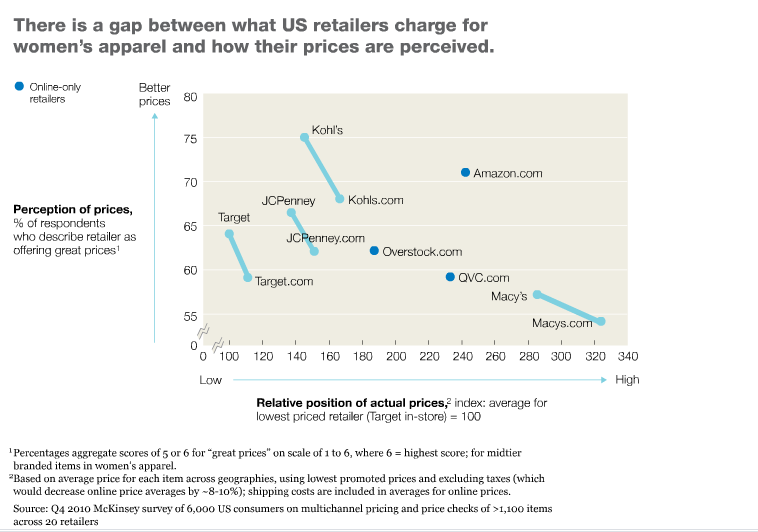
Multichannel marketing and value proposition: how do customers perceive value?

I was reading a very interesting article by McKinsey about the value proposition to offer to multichannel retail customers: it does not only competitive price but also the degree of trust they have in a retailer, its product assortment, and their previous buying experiences. The article goes on presenting two exhibits, both related to a U.S. based research whose results I think can be easily applied to many other other Western culture countries. 

Essentially, what McKinsey researchers state is that:
– multichannel retailers can use certain pricing moves to play the value card, applied to key value items, priced competitively to create a public perception that a retailer offers good value across the many retail channels a consumer uses: stores, the Web, or catalogs;
-retailers also can carefully craft product assortments in ways that influence value perceptions;
– value “heroes” with low price points should be overrepresented in online, in-store, and external marketing;
– tactics such as free shipping, in-store pickup, generous return policies, and price-match guarantees are critical drivers of value perceptions.

Where are Retail’s Hottest Emerging Markets?

Wondering whether to open your new fashion store in China or in Brazil but you don’t have any clue? The annual A.T. Kerney’s Retail Index  provides you with a detailed list of the most emerging countries for apparel retail.

The A.T. Kearney Global Retail Development Index (GRDI)™ ranks the top 30 emerging countries for retail development and identifies windows of opportunity for global retailers to invest in developing markets. The GRDI is unique because it doesn’t just identify which markets are bigger or richer, but rather which markets are hotter and bursting with opportunity. The full annual report can be read at this link, but let’s take a quick look at what the report shows.


China ranks as the most attractive emerging market for apparel retailers according to a study by global management consulting firm A.T. Kearney. Its first place ranking was driven by the country’s large population and the growing disposable income of the middle class. With its compound annual growth rate of more than 20 percent in recent years, apparel retail in China has grown at a rapid pace, and this trend is expected to continue for the next five years.

China was followed in the ranking by two Middle East Countries, U.A.E. and Kuwait, then by Russia and Saudi Arabia.

The United Arab Emirates holds the second position in the 2011 Apparel Index, driven by a population with a high disposable income and immense fashion consciousness. The expatriate populace and tourism in particular are driving forces of consumption in this market. Additionally, the UAE is a regional commerce center in the Middle East, and is a preferred market for entering the Middle East as well as testing new products and retail formats.

Kuwait is ranked #3 in the Apparel Index. Key factors driving retail growth in Kuwait are a favorable long-term economic outlook, a sophisticated consumer base with high levels of disposable income and fashion awareness, more women entering the workforce, and a significant expansion in retail real estate. The gross leasable retail space in Kuwait has expanded from 345,000 square meters in 2006 to 1.15 million square meters in 2010.

The remaining top ten markets in the 2011 A.T. Kearney Retail Apparel Index are Russia, Saudi Arabia, India, Brazil, Turkey, Vietnam and Chile. (Source: A.T.Kerney)

Coffee and tea drinking habits in Asia: when culture matters.

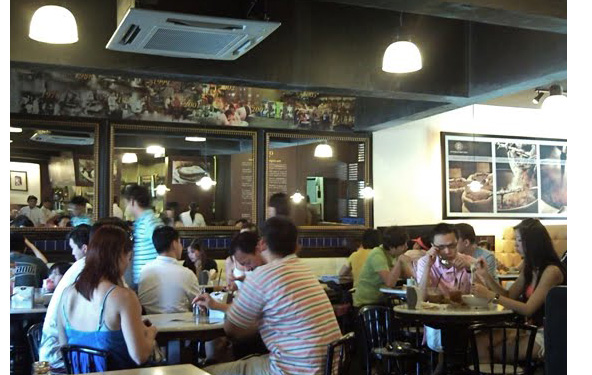
Evening drinking habits differ from country to country, and this is very important when creating customer-centric food Retail concepts, as our DESITA and ECOFFEE projects are. In Singapore, for example it’s not unusual to see coffee shops packed at 11pm/12 midnight every night of the week including weekends. This experience is replicated across many countries in the region from India to Malaysia, Vietnam to Indonesia.

The culture of drinking in Asia is not about alcohol it’s about coffee and tea. It’s still about friends but it’s sober conversation as oppose to drunken ones. There are more coffee shops in Singapore than bars. Coffee shops are growing at a faster rate in India than any other form of F&B outlet. This appears to be down to more affluence, a desire to eat and drink out and a predominantly non-drinking culture. Of course there are a mass of bars in Singapore and across Asia but these tend to be filled with expats and Chinese and focused on certain areas and linked to Karaoke.

Religiously Muslims, Hindus and Buddhists – the main religions across the region – actively prescribe non-drinking of alcohol to their followers. Singaporean’s are just not brought up to get drunk in the way their English and American counterpart’s inparticular are. This in turn leads to a more civilized society, there are no drink related injuries for hospitals to deal with and society to pay for. There is not the violence that happens every weekend in most towns in the UK, no alcohol means that it just doesn’t happen, it’s just not accepted and not desired.

From a marketing point of view it means that if you want to target these people you have to think in a more sophisticated and creative way. Starbucks may be much maligned but they, Costa and other Western brands are growing in Asia at a rate of knots and along with the monster Asia coffee brands like Gloria Jean’s,Café Coffee Day and Coffee Bean are more effective at reaching many Asians than marketing through bars and alcohol. (Source: BrandRepublic; Picture: 4theloveoffood).

Where Fast Food mobile Apps fail, ECOFFEE mobile experience is set to win

A couple of days ago Appolicious published an interesting article about the increasing number of mobile Apps for fast food restaurants and their being mostly not useful. Many are the apps listed, from Taco Bell to McDonald’s.

All these chains offers accurate information on the internet but extremely bare bones restaurant locator apps. In McDonalds’ defense, at least their app offers information on getting a career with McD’s, along with some nutritional information.  Burger King’s lack of an app caught everybody by surprise because they have been so good with marketing their products through games via the Xbox 360 for years that you expected something that appealing on the apps side too.

Useful functionalities and entertainment are a must for nowadays apps, especially in a field – the one of Ho.Re.Ca – where interaction and service have always been a key factor to achieve a high customer satisfaction. Add that customers now are spoiled with information: they love to get informed about the brand and the goods they are going to purchase, about the environment where they are sitting, about the other customers comments and opinions about the “experience” they are going to go through.

We discussed this subject with our partners, a team of skilled UX designers, in order to create a useful, entertaining and carefully designed iPhone/iPad app for DESITA’s Retail and Ho.Re.Ca customers, delivering not only a great user experience but also the  sustainability and responsibility messages which are ECOFFEE’s own. Brainstorming led to the first draft of what is set to become the ECOFFEE mobile experience, the perfect blend among social marketing, in-store advertising and a great user experience to create a stronger bond among the brand, the consumer and the brand’ sustainability and responsibility strategies. Please inquire us directly for further information silvia@ecoffee.it

Green Certification Awarded to French Supermarket in China

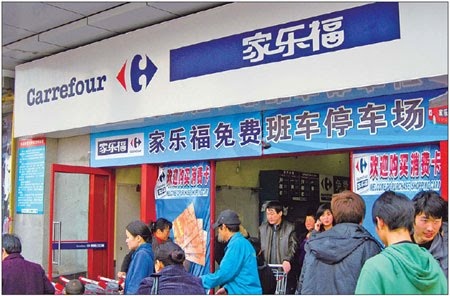
China Certification & Inspection Group has reportedly issued the Green Market Certification to Carrefour’s six stores in Beijing, making the French supermarket one of the first retailers to gain the certification in the Beijing region.

20110607-135536.jpg

Liu Shengming, chairman of CCIC, told local media that the Green Market Certification has been fully launched in the retail sector of Beijing. Green Market Certification is a national certification system co-developed by the Ministry of Commerce together with the Certification & Accreditation Administration of China. Organizations that have obtained the Green Market Certification are allowed to use the uniform certification board. The Green Market Certification logo can be used in their marketing materials or other relevant information.

Luc Vandevelde, chairman of the Supervisory Board of Carrefour, has revealed the plan for Carrefour’s first green shopping center, where rainwater and energy can be recycled. Compared with a regular architecture, the green shopping center can save up to 30% in water and energy. In addition, it will use efficient materials to reduce the consumption of resources.

China Certification & Inspection Group, Shenzhen Company Ltd. operates a wide network of over 300 offices and laboratories which are located in major ports and cargo distribution centers around the world. With over 20 years’ experience in the inspection and certification field, CCIC has established cooperation relationships with more than 120 inspection and certification companies in over 60 countries and regions, including foreign organizations such as UL, CSA, and TUV Rhineland.(Source: China Sourcing News)