All posts by Silvia

Biometrics and retail marketing: the future is now

Biometrics, methods for uniquely recognizing humans based upon one or more intrinsic physical or behavioural traits, is very important when evaluating the efficacy of a retail store design or display and assessing counter actions to make the retail environment more customer friendly. According to NY Times, IBM is currently testing a revolutionary biometrics method in two location in downtown Milan – a fashion company flagship’s store and an electronic store. Biometrics the future of retail marketing
The I.B.M. solution, involves tracking biometrics through a mini camera in a mannequin’s eye or placed somewhere in a store and the collected data will be aggregated so that not to be traced to any individual.

“We started with fashion because it is a creative and innovative industry, but it’s clear that people have to be educated so they know their privacy will not be compromised,” said Enrico Bozzi, the manager of I.B.M. Forum Milano, the department that developed the technology. “It is a question of changing people’s perception.”

 The IBM biometric test is already showing its first results. At the pilot in the Milan fashion store, for example, the client noticed that almost all Asian customers enter the store through one particular door, even though five are available. “We thought it was a mistake, but we checked it out and it was right and it continues to happen,” Mr. Bozzi said. “We don’t know why yet but, in the meantime, the store is considering positioning products by that door that are known to appeal particularly to Asian shoppers.”

I.B.M.is now also working on software that will let clients try on jewelry and makeup wirelessly thanks to a mobile phone or computer, with an iPad application likely to debut soon.
Sustainable Apparel Coalition: what is it?

In the last days there has been a lot of buzz about the Sustainable Apparel coalition, officially launched on March 1st. But what is it?

The Sustainable Apparel Coalition (SAC), which includes* Nike, Gap Inc, H&M, Levi Strauss, Marks & Spencer, and Patagonia, will work to lead the apparel industry towards developing improved sustainability strategies and tools to measure and evaluate sustainability performance. 

The Coalition’s purpose at a higher level has two goals.  First, the member organizations will develop plans to soften the apparel industry’s impact on water and industry consumption, while making commitments to improved waste diversion and the reduction in the use of chemicals. To that end, the Coalition’s members will work with industry peers and supply chain partners to achieve the fullest possible life cycle transparency for clothing. Meanwhile, the SAC seeks to ensure that workplaces throughout the apparel industry adopt fair employment practices and a safe working environment, while eliminating any exposure to toxic chemicals.

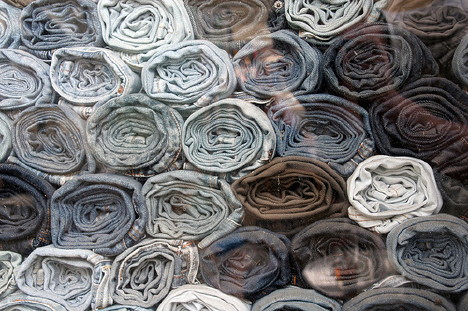
Second, the Coalition will develop a metrics-based tool that will assist companies in the measurement of their environmental and social impacts.  For now described as the Version 1.0 Apparel Index, the tool works similarly to Nike’s Apparel Environmental Design Tool and the Outdoor Industry Association’s Eco Index.  Besides offering an assessment on companies’ usages of energy, water, and chemicals, the index will also evaluate products’ entire life cycles.  Companies will be able to measure their performance, compare them to their peers, and receive guidelines and resources for how they can improve their performance all such metrics.  The Apparel Index is slated to launch next month.(Source: Triplepundit Photo: Treehugger)
*Founding members of the Sustainable Apparel Coalition are based in North America, Asia, Europe and the U.K. They include Adidas, Arvind Mills, C&A, Duke University, Environmental Defense Fund, Esprit, Esquel, Gap Inc., H&M, HanesBrands, Intradeco, JC Penney, Kohl’s Department Stores, Lenzing, Levi Strauss & Co., LF USA, a division of Li & Fung Limited, Marks & Spencer, Mountain Equipment Coop, New Balance, Nike, Nordstrom, Otto Group, Outdoor Industry Association, Patagonia, Pentland Brands, REI, TAL Apparel, Target, Timberland, U.S. Environmental Protection Agency, Verité, VF Corp, and Walmart.

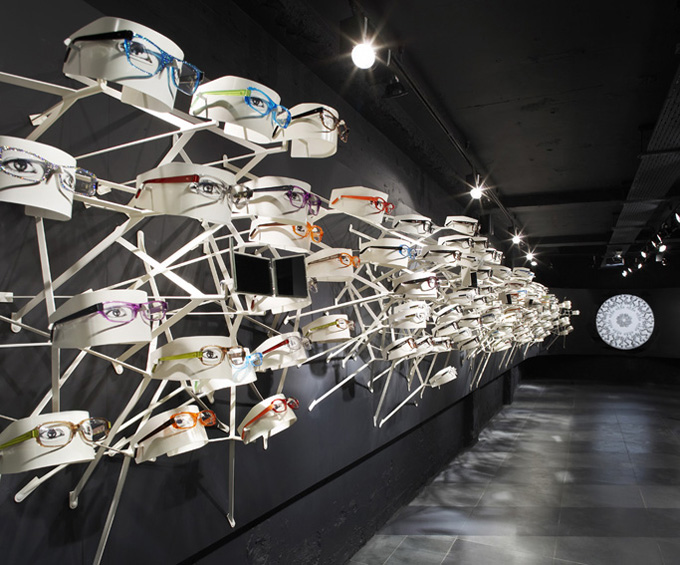
Innovative communication or design innovation: eyewear

Italy is famous for its eyewear giants, Luxottica first. If you have ever visited an eyewear retail store in Italy, you would have noticed that more or less they all look the same: neon lights, mirrors, traditional displays, sales people wearing a white coat.
Today we would like to show you two very different approach to this kind of point of sale: Salmoiraghi & Viganò at Piazza San Babila, Milan and Kirk Originals in London.

The first looks like a “traditional Italian” eyewear store, we might say the “deluxe” version of it but from the design point of view, nothing extremely different from the typical layout, displays included. What is “unusual” in this point of sales is the concept and the services offered: a very fast service for those who need new spectacles, culture, events and corners managed by several fashion brands.

Kirk Originals flagship store, on the opposite, looks very unusual, and the only one eyewear wall with 187 “heads” for frames, and practically no furnishings ensure that customers will focus on the eyewear, not the trappings. Eye examinations and fitting take place in the basement, away from the main display space.

Two different, opposite concepts for the same product. Which one do you think will sell most? (Photo: courtesy of Salmoiraghi&Viganò, Luca Oliverio and TheCoolHunter).

GoodGuide for Good Products for a more sustainable Retail

Yesterday I was reading a post concerning Levi Strauss & Co as the Top Jeans Brand, scoring a 7.4. The brand Prana was listed as the next highest, with a score of 6.3—followed by H&M (6.1), Banana Republic (6.1), and Old Navy (6.1).

I did not know what GoodGuide is – shame on me – so I checked out their very interesting website, which is said to be the world’s largest and most reliable source of information on the health, environmental and social impacts of consumer products. And I think it really is, rating over 95000 products, mainly available on the US market only: from food, toys, personal care to apparel, electronics and appliances. What is really striking is the scientific approach they have on their ratings, which are compiled from three sub-scores addressing Health, Environment and Society.


 Each of these sub-scores are based on an analysis of a set of indicators that GoodGuide has determined are the best-available measures of performance in these areas. Their methodology differs from the product belonging to different categories, each and every one having its own scoring methodology. Amazing. Let’s talk about apparel for example.

Quoting the Good Guide site: “Until (apparel) companies do a better job of providing transparency into their supply chain, our ability to accurately score brands based on their relative performance will be subject to significant uncertainties Environment scores are assigned to apparel brands by combining GoodGuide’s standard company indicators of environmental performance (weighted at 50%) with brand-level environmental indicators that address issues that are specific to the apparel sector (weighted at 50%).(….) Social scores are assigned to apparel brands by combining GoodGuide’s standard company indicators of social performance (50%) with brand-level social indicators that address issues that are specific to the apparel sector (weighted at 50%).(…) Health scores are not assigned to apparel brands because this product category does not generally pose health risks to consumers.”

The Good Guide website is also very good at using the Web 2.0 tools to “spread the word” and improve the accuracy of the product information thanks to a “support product info” page which enables visitors to add further details.

It would be also very interesting to test the effect of this kind of structured and scientific information directly at the point-of-sale, to see how the consumer react when discovering that his/her favourite brand of pasta is not that “good”. Because thanks to GoodGuide mobile App this is possible: consumers can scan the product, check the GoodGuide database and then purchase, or decide to choose another brand.

With this detailed level of “scientific” information, producers and retailers have nothing to hide and their achieving a high/low score can have a boomerang effect on brand reputation which must not be ignored and will not be ignored by consumers. Sustainability pays, and it will pay even more in the future.

Eco packaging: are biodegradable Cans the future?

A few info:
– 4 million tonnes of aluminium is produced annually
– the production of aluminium disrupts the landscape where bauxite ore is mined, consumes large amounts of electricity and produces waste.
– More than 75% of all the aluminium ever produced is still in use
– In the UK 51,000 tonnes of which ends up as packaging  If all cans in the UK were recycled, we would need 14 million fewer dustbins.
– £36,000,000 worth of aluminium is thrown away each year.

We are not condamning aluminium itself, also because it can be 100% recycled, and its use in the automotive industry can help reduce the oil consumption and CO2 emissions. But we would like to point out that consumers must understand that their refusal to recycle aluminium cans impact negatively the environment and create great social costs.

Retailers first should have to explain to their customers the added value in purchasing recycled aluminium packaged goods and/or offer alternatives to the traditional aluminium can.

Right now, the only product we found are these PLA Studio’s biodegradable Tin Cans, whose price does not make them suitable for nowadays industry use, but we are sure that in the future they will. (Photo courtesy of PLA Studio)

Where are the greenest ATMs? In Abu Dhabi!

We are always thought of sustainability in the retail business as related to  production-delivery-waste disposal. But what about the money that we currently use to purchase raw materials, pay delivery, purchase items? Is money really green?
We are not going to get into the sustainability of the “manufacturing process” of money. Not today.  But we are going to talk about how to make dispensing money the greenest ever.

This is what the National Bank of Abu Dhabi (NBAD), the Number One Bank in the UAE, has done last January, becoming the first bank in the UAE to launch a solar-powered ATM. NBAD’s first solar ATM became operational at Al Bateen Branch in Abu Dhabi.

The NBAD’s green ATM, launched in cooperation with Apex Power Concepts, is powered by solar panels installed on the branch’s roof. The panels are connected to a circuit breaker board, which feeds a power controller where part of the collected energy is stored for the ATM’s night operation.
NBAD aims to eventually implement this solution in all NBAD branches as well as at stand alone offsite ATMs. The Bank has one of the largest branch and ATM network in the country with more than 110 branches and 429 ATMs all over the UAE.
“CSR at NBAD is a way of doing business. Therefore, we adopt methods and technologies that are aligned with this strategy,” said Ahmed Al Naqbi, the Head of Channels & Electronic Banking Services at NBAD. “In addition to delivering quality products and services, NBAD differentiates itself in the market by its corporate sustainability credentials.”

Sustainability and retail: a big Italian player point of view

Two days ago a couple of ECOFFEE‘s team members attended an interesting meeting regarding the Retail landscape in Italy, with a special focus on the sunglasses and eyeglasses sector. When the “Any question?” moment arrived, we asked to the speaker “What about sustainability in the Retail business?”. The answer was a HUGE “?”, followed by a: “Maybe in 2015”.

This answer made us smile, because it was the usual answer of those professionals in the Retail field who pretend that a trend does not exist until the trend has changed into an issue to be solved. 

No more than two weeks ago, Andrea Illy, Chairman and CEO of illycaffè S.p.A,  expressed his point of view about sustainability in a very interesting post published by Fastcompany. Here’s a couple of key sentences. “I’m taking about a broader notion of sustainability that includes social and economic equity right alongside environmental responsibility, serving a triple bottom line. (….) The key is acting early–acting now–before the confidence of consumers, investors and other stakeholders is irreparably damaged. The best rescue of sustainability’s meaning and power is one that is never made….Consequently, a genuinely holistic approach to sustainability is required: one that creates value throughout the entire supply chain. And in order to do that we must focus on raising quality. (…) By perpetually seeking higher quality, a cycle goes into motion, creating sustainable value for every player. The result is long-term viability in lockstep with ever-increasing quality in the cup.(…) Broader adoption and smart marketing of a powerful certification symbol (….) will create widespread understanding of what sustainable agriculture means, and place the power to demand genuinely responsible production squarely where it belongs: in the consumer’s hands.” We obviously share Andrea Illy’s point of view, and we wish that knowing his opinion about sustainability, all the skeptical retail professional will make up their minds. 


M’Illumino di meno: awakening Italy to sustainability

Today is the M’Illumino di Meno 2011 day organized by Italian Rai2 Caterpillar radio program. The campaign aims to the awaken public attention toward the energy issues by inviting people, companies and public structures (schools and municipalities) to reduce the waste of energy during this day. Many companies and municipalities have adhered to the campaign – the whole list is available here.
NH Hoteles Italia sustains this event by turning off all the facade lights of its Italian Hotels, and switching off unused energy appliances  for the whole day (Source: NH Hoteles and Caterpillar)

NH Eco Conscious

Last January 10th, NH Hoteles, the leading Spanish chain of cool design hotels, has presented to the Italian market its Ecomeeting product, which is perfectly in line with the Company’s 2008 to 2012 Strategic Environmental Plan to reduce CO2 emission, water and energy consumption, waste generation by 20% within 2012.
The plan, principally a gathering of people for information exchange purposes, but also characterized by four distinguishing parameters:
•Efficiency in the usage of energy and water
•Low impact materials
•Fair-trade products
•carbon offsetting on client demand. Offsetting carbon strives to reduce greenhouse gas emissions. Companies’ offsets are typically achieved through financial support of projects that reduce the emission of greenhouse gases in the short or long term. For this purpose NH Hotels preferred choice and what they consider the best way is through renewable energy projects.

This is why NH hotels financially support a hydropower plant located in the Rôndonia, Brazil. This renewable energy river hydropower project reduces greenhouse gas emissions by displacing power from higher emission fossil fuel sources on the national electric grid.

NH Hotels clients can now choose to offset the emissions created as a result of their meeting, by including carbon offsetting in the Ecomeeting purchase agreement. The fixed extra cost is 1€ per person for low or medium travelling impacts, 2€ for meeting where attendees are coming from long distances and 3€ for transoceanic.

The client can also opt for a more detailed analysis of their meeting and the offsetting needed, NH Hoteles can calculate the offset required for the specific client. NH provides all this information for the client: client origin, destination and transportation used. Clients under this special purchase agreement will receive an official certificate issued by Carbon Clear, stating the specific amount of CO2 equivalent, compensated by the hydropower plant project (Source: NH hoteles)

A CONSCIOUS COLLECTION – SUSTAINABLE STYLE AT H&M

Sustainability is a long term trend at H&M and this April as part of the focus on sustainability H&M will introduce the Conscious Collection – The collection which is for women, men and children is made from enviromentally – adapted and greener materials such as organic cotton, Tencel® and recycled polyester. H&M’s designers have been inspired by different shades of white, one of the most important colours this Spring. A minimalist, tailored look is combined with romantic lace, Broderie Anglaise, frills and draping. The Conscious Collection will be on sale in all H&M stores from 14th April. “It’s not just about organic cotton any more, the possibilities for creating a complete fashion statement with eco smarter materials are huge now. By designing recurring Conscious Collections we have the opportunity to show in a variety of ways what’s possible using more sustainable fabrics,” says Ann-Sofie Johansson, H&M Head of design. “Shades of white are the season’s biggest fashion trend and it feels right for this collection. White creates a romantic feeling with lace and Broderie Anglaise, but is also the basic colour in a sporty, relaxed style and in a preppy tailored look for men.” Womenswear is inspired by an updated romantic style in which blouses, tunics and T-shirts with Broderie Anglaise are a key trend. Tiered dresses are perfect for day or more dramatic Grecian gowns for night. Long floaty skirts are key as are cut-off shorts. The collection also includes the perfect white blazer and pleated trousers for a more minimalist look as well as Broderie Anglaise and lace lingerie. Menswear takes on a preppy mood with a white two-button blazer, collarless shirts and T-shirts with Henley detailing at the neck. There are printed and striped T-shirts, as well as a tank top for layering and trousers are either five-pocket jeans or tailored. Meanwhile the Children’s collection is full of white pieces for both girls and boys. It’s all about tiered dresses, tops, skirts for girls, and for boys t-shirts and jeans. (Source: H&M press release, Photos: H&M)