Tag Archives: sustainability

Fashionable sustainability or sustainable fashion?

Starting from Edun fashion brand, by Ali Hewson and Bono, whose mission is to encourage trade with Africa, to H&M’s Conscious Collection and Zara’s eco-friendly stores, it seems that “sustainability and responsibility” are now a must in the fashion industry.
The latest news regarding fashion and sustainability is the PPR Group’s (home of GucciPuma,Yves Saint Laurent and Stella McCartney) Sustainability Initiative PPR HOME to Set New Standard in Luxury, Sport & Lifestyle and Retail Sectors.

By moving beyond the traditional Corporate Social Responsibility model, the group launched PPR HOME and is setting a new standard in sustainability and business practice in the Luxury, Sport & Lifestyle and Retail sectors.

My deep conviction that Sustainability creates value is part of my strategic vision for PPR. Sustainability can – and must – give rise to new, highly ambitious business models and become a lever of competitiveness for our brands. PPR HOME will provide us with novel, more sustainable approaches to contribute to a better world for the long run”, said Francois- Henri Pinault, CEO of PPR.

PPR HOME’s first announcements are setting the pace for the Group’s sustainability mission in order to reduce the social and environmental footprint for its Luxury, Sport and Lifestyle brands. These pioneering initiatives include:
-PPR HOME launches the Creative Sustainability Lab to help lead the industry and foster creativity, innovation and sustainability. Its inaugural partnership with Cradle-to-Cradle® will drive PPR HOME to challenge traditional approaches and proactively re-think and re-consider product and business development. The Cradle-to-Cradle® concept believes that ‘good design’ of products and services should move beyond typical measures of quality – cost, performance and aesthetics – to integrate and apply additional objectives addressing environmental and social concerns.
– PPR has offset its 2010 global CO2 emissions from PPR’s Luxury group, PUMA and PPR’s headquarters of 98,729 tons to achieve carbon neutrality in Scopes 1 & 2 of the Greenhouse Gas Protocol and purchased carbon credits from Wildlife Works’ leading REDD (Reduced Emissions from Deforestation and Degradation) offsetting project in Kenya that takes the needs of the local communities and the conservation of biodiversity into account. As the first step in making REDD a reality, Wildlife Works recently provided proof that REDD conforms to the accounting rigor that other carbon credit classes provide, resulting in Wildlife Works project becoming the first-ever Voluntary Carbon Standard (VCS) validated and verified REDD program.
-PPR’s premiere Sportlifestyle brand, PUMA, has applied a groundbreaking methodological approach to measuring and costing their use of ecosystems and their ecological footprint. This is the initial step to measuring the full economic impact on ecosystem services by PUMA and its supply chain and the delivery of the first-ever Environmental Profit and Loss (EP&L) account statement. PPR HOME will take a leadership role in building understanding and support for this corporate shift, encouraging others within the industry to share PUMA’s pioneering efforts towards fully-integrated reporting.

Our opinion as sustainability advocates and retail consultants is that all these strategies, well planned and communicated, must follow the companies products from production to sale. The risk is that fashion consumers do not perceive the real added value of sustainability when in-store communication lacks and when the store itself it is not sustainable. An example? Keep following us: ECOFFEE case studies to come in the next weeks!

Beverage industry and sustainability: TATA beverages

We have previously wrote about how the beverage industry is getting more and more Sustainable, with more sustainable packaging like the Coca-Cola Company PlantBottle packaging, or by taking greater attention to the supply chain, as PepsiCo is doing with its recent committment to purchase only 100% Mexico sustainably grown sunflower crops.

 
Today, we will take a quick insight in what TATA Global Beverages is doing regarding sustainability. But first, a couple of information about the Company: TATA Global Beverages is part of the TATA Group, it currently employs 3,000 people around the world and it reported a 28% profit increase on Q3 2010, with profits being Rs 471.5 million (more than 74 million Euros).
 
If you take a look at Tata beverages website, it is clear that TATA Global Beverages is deeply involved in sustainability: from its mission “to make the world a better place through ‘life enhancing sustainable hydration’ to its long term goals and its collaborating with the Rainforest Alliance.
In a recent interview with The Guardian, TATA Global Beverages Director of Sustainibility Sara Howe, talked about the challenge to balance sustainability with the Company’s present short-term financial and commercial pressures.
She stated to be optimistic about the number of big companies who are now seriously and credibly engaging with the sustainability agenda, setting ambitious sustainability targets and demonstrating progress towards achieving them.
 ” As more companies come to understand the risks and opportunities that issues like climate change, water stress, population growth, health and wealth disparity, represent, then the necessary capacity and capability building will follow” Howe states.
But what is the role of consumers in the process towards a more sustainable business? Howe’s reply: “In a consumer-focused business like ours a particular challenge is getting permission from consumers to act for the future. Traditional research and insight methodologies tend to drive responses based on their current experience and understanding. We need to find a way of showing consumers what the future might look like from a sustainability point of view. Then they can then help us design products and services fit for that future” yet adding that her main concern about the ability to create a more sustainable world is that “That too many people won’t get it until it’s too late“.

Illycaffè Earns the First DNV Responsible Supply Chain Process Certification

On March 18, 2011 illycaffè became the world’s first company to receive a Det Norske Veritas (DNV) Responsible Supply Chain Process certification, attesting to the company’s long-running sustainable approach to production and its relations with stakeholders throughout the production chain, particularly with green coffee suppliers.

The illycaffè model is innovative in assigning critical roles to quality and value creation. The certification was officially conferred at illycaffè’s twentieth annual meeting in Brazil, recognizing suppliers for coffee production meeting the company’s industry-leading quality standards.

DNV, an international, independent leader in product and process certification, in part modeled its new certification standard on the illycaffè supply chain model, buttressing it with current and emerging stringent guidelines for sustainability and corporate responsibility, and with standards of reference for certification and accreditation activities. The certification incorporates both pan-industry standards and industry specific standards. Officially, illycaffè received the DNV Green Coffee Responsible Supply Chain Process certification.

The standard developed by DNV is innovative because it marks the passage from the certification of an organization’s supply chain to the certification of an organization’s ability to create value that benefits everyone involved.

“We are proud to have obtained this certification, which recognizes and validates how we have operated over the past 20 years, through protocols and procedures that guarantee the excellence of our final product,” said Andrea Illy, President and Managing Director of illycaffè. “illycaffè has always been a stakeholder company, based on ethics and with the objective of improving quality of life. Quality is a key concept in our company philosophy. Our continuous search for quality creates a virtuous cycle that creates value for everyone involved, from coffee growers to coffee drinkers, in growing magnitude over time.”

Quality and sustainability are for illycaffè inseparable: a truly excellent product cannot be anything but sustainable in three critical aspects: economic, social and environmental. Economic sustainability is achieved through the creation of value for all those involved, from the grower to the final consumer. Social sustainability rests on the concepts of individual growth and self-realization. Environmental sustainability means respect for the ecosystem, through, for example, the use of recyclable shipping and packaging materials and the application of non-polluting practices.

“This supply chain certification standard is particularly innovative in demonstrating a company’s ability to create value over the long term,” said Thomas Vogth-Eriksen, Chief Executive Officer DNV Business Assurance. “The schema focuses on the building of shared value in a context where social development stimulates economic development, recognizing that a business grows in large part through its ability to help its partners and suppliers grow.”

Over the past two decades illycaffè has perfected a system of direct relationships with its suppliers, based on three main pillars: selecting the best growers in coffee producing countries; transferring to these growers, through the company’s Università del Caffè and the daily field work of specialized agronomists, comprehensive knowledge accumulated over 80 years of practical experience and research to produce coffee meeting illy’s high quality standards; and purchasing the best production directly from growers, paying them a premium over the going market price to reward quality achieved, and incentivize ongoing improvement. (Source: BusinessWire)

American consumers punish greenwashing practices, a survey says

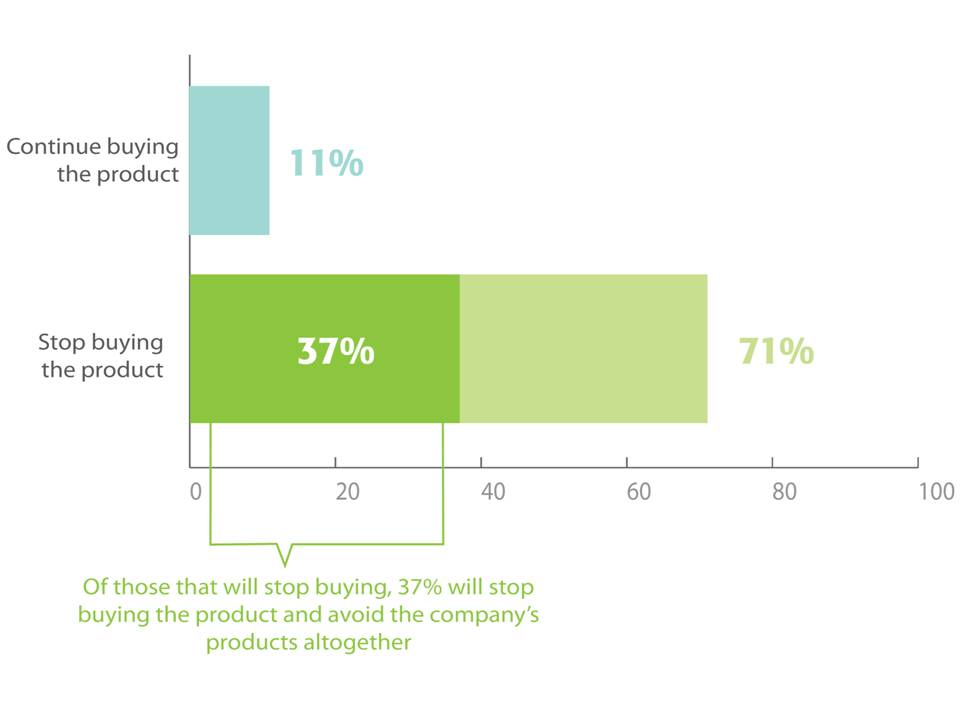
Nearly three-quarters of consumers (71%) will stop buying a product if they feel misled by environmental claims”

Two days ago an ECOFFEE prospect tried to convince us that sustainability is just a marketing word, and that consumers are not able to understand whether the retail product/store is really sustainable or it is just greenwashing.
We have already dealt with this kind of prospect – and many became enthousiast ECOFFEE customers and sustainability advocates. Data and market analysis are the only way to convince the sustainability skeptical about the counter effects of greenwashing practices.

That day, we showed to our prospect the Cone Inc. Trend Tracker recent analysis about U.S consumers and their behaviour towards greenwashing practices, dated March 24 2011.

Results are very interesting – and very motivating for those of us who believe in real sustainable business practices.
When consumers discover a claim to be misleading, they will take the following actions:


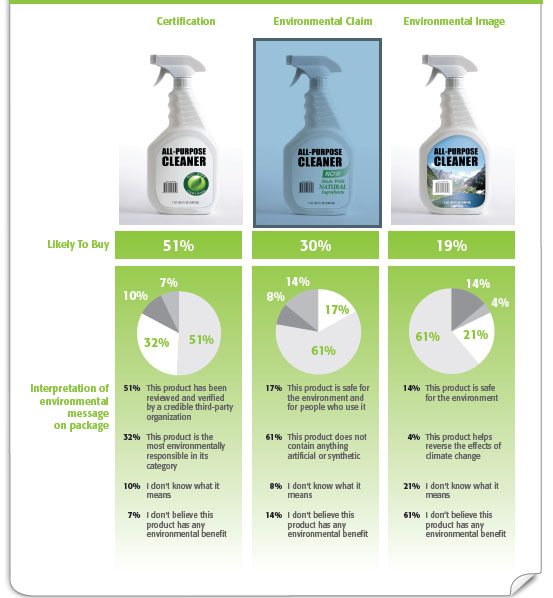
Three mock cleaning products were showed to consumers, who were asked to “purchase” the one they believed to be the most environmentally responsible. They were also required to indicate what they think the certification, claim or image on each package represents.
The results are as follow:

Another very interesting survey finding concerns the inaccurate interpretation by U.S. consumers when it comes to words such as “green” and “environmental friendly”. More than two-in-five Americans (41%) erroneously believe these terms mean a product has a positive (i.e., beneficial) impact on the environment. Only 29 percent understand that these terms more accurately describe products with less environmental impact than previous versions or competing products.
Last but not least, 59% say it is only acceptable for marketers to use general environmental claims when they are backed up with additional detail and explanation:
-23% say vague environmental claims should never be used.
-79% want detailed information readily accessible on product packaging.
-75% wish companies would do a better job helping them understand the environmental terms they use.

It is not necessary to add other comments to the above survey results, but if you are interested to know more, you can download the whole survey linking to the Cone Inc. website.

What is Masdar and why it is so important for our future?

Masdar is a familiar word to all of us who are concerned about the future of our dear planet Earth. But for the few of you who have never heard of it, please allow us the pleasure to introduce you this incredible project.

Masdar is first of all a company, notably a Mubadala – Abu Dhabi government owned company, based in Abu Dhabi, UAE. As stated in the company’s website ” Masdar is a commercially driven enterprise that operates to reach the broad boundaries of the renewable energy and sustainable technologies industry – there by giving it the necessary scope to meet these challenges.  Masdar operates through five integrated units, including an independent, research-driven graduate university (Masdar Institute, other units are Masdar Capital, Masdar Power, Masdar Carbon, Masdar City cfr.) and seeks to become a leader in making renewable energy a real, viable business and Abu Dhabi a global centre of excellence in the renewable energy and clean technology category. The result is an organisation greater than the sum of its parts and one where the synergies of shared knowledge and technological advancement provide this commercial and results-driven company with a competitive advantage that includes an ability to move with agility and intelligence within an industry that is evolving at great speed.
This holistic approach keeps Masdar at the forefront of this important global industry, while ensuring it remains grounded in the pursuit of pioneering technologies and systems that also are feasible. As a result, it delivers innovation to the market while deriving profits for its shareholders.”

This huge project deals with all the aspects of sustainability: research, energy, finance, architecture, urbanism. Last but not least, retail. Because of its importance in the life of all the people who will live in Masdar City and for “its contribution to the city’s appeal as a renewable energy and clean-technology hub“, retail in Masdar “will provide valuable lessons regarding commercial activities (…) increasing our understanding of how retail activities can be conducted in a sustainable manner”. The list of the companies who have already been involved in the Masdar City retail project includes Caribou Coffee, health insurance provider Daman, telecom provider Etisalat, Sumo Sushi, express delivery company Aramex, Omeir Travel, Organic Foods & Cafe and National Bank of Abu Dhabi. The first commercial building, the Courtyard Building,  has been planned to be finished by 2012, therefore there is enough time for this list to become a very long one.

In the meanwhile, many are the people who are praizing the incredible urban project designed by Foster and Partners, but to be fair, there are also critics like New York Times journalist Nicolai Ouroussof  who wrote that “…its design also reflects the gated-community mentality that has been spreading like a cancer around the globe for decades. Its utopian purity, and its isolation from the life of the real city next door, are grounded in the belief — accepted by most people today, it seems — that the only way to create a truly harmonious community, green or otherwise, is to cut it off from the world at large“.

Our point of view and what we are always stressing in our ECOFFEE projects, is that sustainability is too important for our future and each and every project that has a little bit of sustainability in it is important to raise people awareness. To be too critical towards sustainability-related projects, requiring their perfection – which at this stage is quite hard to achieve – postpones any action and creates confusion among people, these two being the worst enemies of sustainability. (Picture credits: Masdar.ae)

Sustainable supply chain: how to build it?

At the beginning of March 2011, McDonald’s announced its Sustainable Land Management Commitment (SLMC), a long-term plan to ensure the corporation only serves food (and uses packaging) certified as sustainably sourced. The initial focus is on five high impact products: beef, poultry, coffee, palm oil and packaging.  McDonald’s certainly have all the power to be able to win negotiations with suppliers and reach its goals, but what about small retailers who are buying from overseas?

Shirahime, a UK based ethical fashion consultancy, has published a guide to responsibly sourcing textiles and clothes from India.

Despite its narrow country and industry focus, the guide is packed with advice for any business looking to find responsible goods or services suppliers from overseas. Here’s an excerpt of the Shiraname’s guide.

Be clear about the outcomes you want to achieve
Define aims clearly and build a strategy around the outcomes you want to achieve. Don’t look exclusively for suppliers who have certification. Certification is a costly process and may not guarantee the specific outcomes youwant.

Instead, visit potential suppliers and examine their operations for yourself. If you do this, make sure you have a suitable translator and cultural liaison who can guide your decision making process. In addition, start networking, even if it’s with your competitors. If you do this up front it can vastly increase your chances of success in finding the right supplier.

Consider company size alongside business practices
There can be a correlation between a supplier’s size, the goods or services it provides, and its ability to operate responsibly.

As a broad rule of thumb, the larger the company the more comprehensive their offering will be. Yet the larger the company, the more likely it is that their business is focussed upon financial efficiency, not responsible practice. Therefore, if you’re looking for a responsible supplier it may be worth choosing smaller producers rather than bulk providers as your partners.

Consider alternatives to your preferred goods, service or country
In order to get the most responsible procurement deal, businesses have to change their mindset and be open minded about both the country of origin and the goods or service they’re looking to procure.

Be prepared to invest as well as purchase
Businesses need to think about how they can contribute long term value to their suppliers’ enterprise beyond a simple commercial deal. This is where the value of being clear in your outcomes and partnering with other companies can yield substantial benefits. (Source: Guardian.co.uk)

Italian consumers love sustainable products but need better product information.

One of the findings of the “For a Sustainable Supply Chain: business and consumers point of view” survey conducted by the GfK Eurisko and promoted by the Sodalitas Foundation,  the product/service sustainability is ranked fourth among the criterias used by consumers when choosing, but if better communicated, will become an increasingly important requirement. During the investigation 500 consumers and 183 businesses were interviewed . To more than a third of the companies, sustainability is very important. However, only a minority (29%) in the interviewed sample declares to be thoroughly familiar with this concept, while a substantial percentage (45%) say they have “enough information”, confirming the gradual integration of this concept in the corporate culture .
The majority of consumers (63%) had heard of sustainability, even if only 19% of them (mostly young and with a high level of education) believe to know well its meaning, with a prevalence of the environmental (83% ) on the social aspects (64%).

The responsibility for a “sustainable development” is primarily attributed to the central Government (86%) and to local governments (82%), but a very high percentage of respondents (over 70%)  thinks businesses and citizens responsible to ensure the sustainability of the development. The opinions about the companies’ commitment to sustainability is different: one third of the sample (35%) expressed a positive opinion, a  third is critical and another third has no a definite opinion about it.

Only a third of consumers (32%) had heard of “sustainability of the supply chain” (a percentage that is growing in those aged more mature and – especially – among those with a higher education degree). But after the concept was briefly explained a large majority (76%) said to believe that companies must ensure the sustainability of their supply chain. Today, already one quarter of Italian consumers are chosing which products to buy also using supply chain sustainability criterias. Three quarters of consumers also agreed to pay more for a product which is guaranteed in terms of its sustainability. The focus is on all product categories but in particular on food (71%) and detergents (65%). And, at least in theory, the majority of consumers (76%) would be willing to pay more for a guaranteed product in terms of sustainability (though – the majority said to be ready to pay only “little” or “very little” more). (Source: GfK Eurisko, Image credits: Transocean)

Sustainable Coffee: what is it and is it really profitable?

Sustainability in the Retail & Ho.Re.Ca Business, what our ECOFFEE project is about, is based on a main concept: communication to consumers and customers must be clear and simple to make them better understand what are the added values of buying/consuming sustainable products.

For instance, let’s talk about Fairtrade, organic, Rain Forest Alliance or UTZ certified coffee. These are some of the labels with which coffee is traded nowadays and consumers can be quite confused by this abundance of sometimes not well explained terms. 

Among the many information source we always refer to when asked “What is sustainable coffee about?” we found that the Imbibe magazine one is the most consumer-friendly one, covering all main aspects of sustainability in the coffee business.

The other well known issue to our blog readers is “Is it really worth investing in sustainable coffee?”. Commodity traders know the answer, and this is “Yes, of course”. A recent publication by Intracen organization (International Trade Center), shows that “Demand for conventional (i.e. non-certified) coffee is largely stagnant in these markets, whilst it is thriving in emerging markets. Certified coffee, however, is showing strong growth and higher retail prices, particularly in mature markets. This trend is also followed by other commodities, including tea, cocoa and cotton. A new industry of inspectors and technicians has emerged to service the sustainability segment of the market”. 

A greener Novotel by 2012

PARIS Accor’s midscale Novotel brand is on pace to meet its goal of becoming 100% environmentally sustainable by next year, the group says.

To date, 78 of Novotel’s portfolio of more than 400 hotels have been certified as sustainable by EarthCheck, the organization formerly known as Green Globe. Novotel’s commitment to sustainable development has enabled the brand to achieve the following green results as of year-end 2010:

  • 98% of hotels apply and monitor the 65 actions in the Accor Hotel Environment Charter
  • 80% have installed energy-efficient light bulbs in areas that stay lit 24 hours a day
  • 92% have installed flow regulators on faucets and in showers
  • 89% recycle paper and cardboard packaging
  • 86% dispose of compact fluorescent tubes and light bulbs safely
  • 60% serve organic products
  • 60% offer nutritionally balanced meals for children.

EarthCheck certification is awarded after a preliminary assessment of a hotel’s performance and the deployment of an appropriate management system covering implementation of a sustainable development policy, water use, energy use, waste management, paper consumption, use of pesticides, use of cleaning and sanitation products, and commitments to the local community. At least 10 months are required for a hotel to receive certification, which is awarded by an independent outside auditor and is reevaluated every two years.

“Since 2008, Novotel teams have been actively involved in the EarthCheck certification program so that we can meet our goal of certifying the entire network by 2012,” says Pierre Lagrange, Novotel’s global marketing director. “Novotel’s commitment to the principles of sustainable development is an integral part of the brand’s promise of customer well-being (Source: Ghaward.ie)

Luxury and sustainability… a trend we will see more of in China

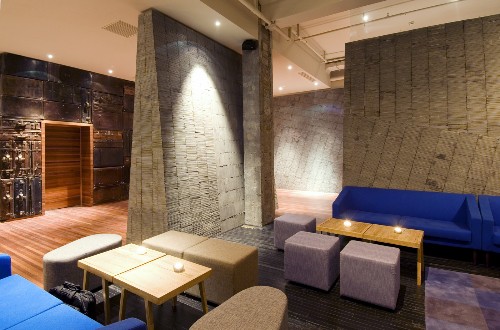
URBN Hotels & Resorts announced plans for URBN Hotel Pudong, a new green hotel that will become the first positive-impact hotel in China. The hotel is slated to open Spring 2012.

In collaboration with Vanke, China’s largest residential real estate developer, URBN’s 20,000 square metre boutique hotel is part of a larger commercial, retail and residential development in the Sanlin district of Pudong in Shanghai. They have tapped Fumihiko Maki, the world-acclaimed Japanese architect whose current works include the United Nations building and World Trade Center Tower 4 in New York City, to design the project.

The development, which is estimated to cost RMB 312 million (US$47 million), will include 55 hotel rooms, 50 URBN serviced residences, and 4,500 square metres of dining, wellness and art spaces.

URBN created China’s first carbon-neutral hotel, the chic and hip URBN Shanghai in the Jingan district. URBN Shanghai is passionately committed to the environment and is at the forefront of the growing consumer eco-movement in China. URBN tracks the hotel’s entire carbon footprint and offsets it by purchasing carbon credits or investing in local “green” energy development and emission reduction projects. The hotel provides guests the option to find out their footprint during their stay and by donating trees to Jane Goodall’s Roots and Shoots foundation to offset.

For the new URBN Hotel Pudong, Jules Kwan, Managing Director of URBN Hotels indicated that “the aim is to make this hotel go beyond sustainability … the hotel will increase the biodiversity of the site, and will discharge water that is cleaner than the water from the city’s water supply.” The hotel hopes to get LEED and China Green Star certifications. Also, URBN Hotel Pudong aims to surpass the 35% energy savings target hit by URBN Shanghai. (Source: Red-Luxury)