Tag Archives: coffee

Illycaffè Earns the First DNV Responsible Supply Chain Process Certification

On March 18, 2011 illycaffè became the world’s first company to receive a Det Norske Veritas (DNV) Responsible Supply Chain Process certification, attesting to the company’s long-running sustainable approach to production and its relations with stakeholders throughout the production chain, particularly with green coffee suppliers.

The illycaffè model is innovative in assigning critical roles to quality and value creation. The certification was officially conferred at illycaffè’s twentieth annual meeting in Brazil, recognizing suppliers for coffee production meeting the company’s industry-leading quality standards.

DNV, an international, independent leader in product and process certification, in part modeled its new certification standard on the illycaffè supply chain model, buttressing it with current and emerging stringent guidelines for sustainability and corporate responsibility, and with standards of reference for certification and accreditation activities. The certification incorporates both pan-industry standards and industry specific standards. Officially, illycaffè received the DNV Green Coffee Responsible Supply Chain Process certification.

The standard developed by DNV is innovative because it marks the passage from the certification of an organization’s supply chain to the certification of an organization’s ability to create value that benefits everyone involved.

“We are proud to have obtained this certification, which recognizes and validates how we have operated over the past 20 years, through protocols and procedures that guarantee the excellence of our final product,” said Andrea Illy, President and Managing Director of illycaffè. “illycaffè has always been a stakeholder company, based on ethics and with the objective of improving quality of life. Quality is a key concept in our company philosophy. Our continuous search for quality creates a virtuous cycle that creates value for everyone involved, from coffee growers to coffee drinkers, in growing magnitude over time.”

Quality and sustainability are for illycaffè inseparable: a truly excellent product cannot be anything but sustainable in three critical aspects: economic, social and environmental. Economic sustainability is achieved through the creation of value for all those involved, from the grower to the final consumer. Social sustainability rests on the concepts of individual growth and self-realization. Environmental sustainability means respect for the ecosystem, through, for example, the use of recyclable shipping and packaging materials and the application of non-polluting practices.

“This supply chain certification standard is particularly innovative in demonstrating a company’s ability to create value over the long term,” said Thomas Vogth-Eriksen, Chief Executive Officer DNV Business Assurance. “The schema focuses on the building of shared value in a context where social development stimulates economic development, recognizing that a business grows in large part through its ability to help its partners and suppliers grow.”

Over the past two decades illycaffè has perfected a system of direct relationships with its suppliers, based on three main pillars: selecting the best growers in coffee producing countries; transferring to these growers, through the company’s Università del Caffè and the daily field work of specialized agronomists, comprehensive knowledge accumulated over 80 years of practical experience and research to produce coffee meeting illy’s high quality standards; and purchasing the best production directly from growers, paying them a premium over the going market price to reward quality achieved, and incentivize ongoing improvement. (Source: BusinessWire)

Sustainable Coffee: what is it and is it really profitable?

Sustainability in the Retail & Ho.Re.Ca Business, what our ECOFFEE project is about, is based on a main concept: communication to consumers and customers must be clear and simple to make them better understand what are the added values of buying/consuming sustainable products.

For instance, let’s talk about Fairtrade, organic, Rain Forest Alliance or UTZ certified coffee. These are some of the labels with which coffee is traded nowadays and consumers can be quite confused by this abundance of sometimes not well explained terms. 

Among the many information source we always refer to when asked “What is sustainable coffee about?” we found that the Imbibe magazine one is the most consumer-friendly one, covering all main aspects of sustainability in the coffee business.

The other well known issue to our blog readers is “Is it really worth investing in sustainable coffee?”. Commodity traders know the answer, and this is “Yes, of course”. A recent publication by Intracen organization (International Trade Center), shows that “Demand for conventional (i.e. non-certified) coffee is largely stagnant in these markets, whilst it is thriving in emerging markets. Certified coffee, however, is showing strong growth and higher retail prices, particularly in mature markets. This trend is also followed by other commodities, including tea, cocoa and cotton. A new industry of inspectors and technicians has emerged to service the sustainability segment of the market”. 

Paperless Cafés

Getting green while following technology? Sure! Many Cafés are now offering digital newsstand, which are both green and modern, providing people with paper-free updated news at no cost. Here you can find two examples. The big corporation one, Starbucks, and a small Café in Croatia. 

The Starbucks Digital Network has debuted their exclusive content network to further enhance the customer’s in-store experience. Customers who use the free Wi-Fi at more than 6,800 U.S. Starbucks locations will be greeted with the Starbucks Digital Network. As a channel where consumers will be plugged into a variety of reading sections like news, entertainment and business, this Starbucks Digital Network will keep readers engaged and going back to the famous coffee house for more access

On the other side of the Ocean, the Box Coffee Shop in Split, Croatia is replacing its offer of free newspapers with iPads. While each tablet is free to use, there is a security tag to alert baristas of any theft.
The idea is the same, the scale is a little bit different, but what is important is that the message must be clear: less paper, more green. (Credits: Trendhunter)

Sustainability and retail: a big Italian player point of view

Two days ago a couple of ECOFFEE‘s team members attended an interesting meeting regarding the Retail landscape in Italy, with a special focus on the sunglasses and eyeglasses sector. When the “Any question?” moment arrived, we asked to the speaker “What about sustainability in the Retail business?”. The answer was a HUGE “?”, followed by a: “Maybe in 2015”.

This answer made us smile, because it was the usual answer of those professionals in the Retail field who pretend that a trend does not exist until the trend has changed into an issue to be solved. 

No more than two weeks ago, Andrea Illy, Chairman and CEO of illycaffè S.p.A,  expressed his point of view about sustainability in a very interesting post published by Fastcompany. Here’s a couple of key sentences. “I’m taking about a broader notion of sustainability that includes social and economic equity right alongside environmental responsibility, serving a triple bottom line. (….) The key is acting early–acting now–before the confidence of consumers, investors and other stakeholders is irreparably damaged. The best rescue of sustainability’s meaning and power is one that is never made….Consequently, a genuinely holistic approach to sustainability is required: one that creates value throughout the entire supply chain. And in order to do that we must focus on raising quality. (…) By perpetually seeking higher quality, a cycle goes into motion, creating sustainable value for every player. The result is long-term viability in lockstep with ever-increasing quality in the cup.(…) Broader adoption and smart marketing of a powerful certification symbol (….) will create widespread understanding of what sustainable agriculture means, and place the power to demand genuinely responsible production squarely where it belongs: in the consumer’s hands.” We obviously share Andrea Illy’s point of view, and we wish that knowing his opinion about sustainability, all the skeptical retail professional will make up their minds. 


Green packaging: here’s some news

In our ECOFFEE experience, Green Packaging and waste management are two of the most difficult to handle issues for a retailer who wants to approach a greener and more sustainable business. Just a couple of years ago, it was very difficult to find packaging that could be both resistant, green and easy to recycle or compost. Now life has been made easier by smart companies which are offering to retailers plenty of products to satisfy the most demanding client: from corn cups to sugar-beet takeout containers, degradable packaging is forecast to expand an impressive 13.6 percent annually to $685 million in 2014.

Now let's talk about two very different kind of packaging, coffee cups and pizza cardboard. Coffee cups are not that common in Italy, where coffee is still serverd in the traditional ceramic "tazzina", but everywhere else in the world, it is a must for those who want to sip the hot drink while driving to office. The Repurpose One Cup  is a new insulated hot cup that is 100 percent certified compostable. The design requires no sleeve, uses 65 percent less CO2 than a disposable coffee cup to produce, and can be composted in 90 days in an industrial facility. If the cups are thrown away with regular trash, they will degrade in the landfill just like food waste. Traditional insulated cups are made by adding additional layers of paper; however, the One Cup keeps coffee (and other beverages) hot by applying patented insulation material to a single wall cup made of FSC-Certified paper.

Talking about pizza, here's the "Salvapizza", a prototype developed in Italy by a pool of experts. Salvapizza is made of white cardboard printed with food ink and this prototype allows consumers to heat the pizza in the microwave. Thanks to the side slots, the pizza "breathes", ensuring the right kind of ventilation during the heating process, hence preserving the pizza fragrance. In the prototyping of Salvapizza, special attention was paid to the possibility of recycling the used container. The cardboard can be in fact easily divided in two parts: the upper part can be detached and easily recycled in the paper waste container. A simple idea, but that can help recycling a lot of waste material, thinking that each year, the Italian production of cardboards for pizza sums up to almost 620 million units. (Source: Crispgreen and Marrai A Fura)

A consumer point of view on sustainable coffee

Food Retailers sometimes wonder why consumers should have to prefer organic, sustainable coffee instead of the more “known and traditional” brands. We found this interesting article written by Johnathon D. Colman, a coffee snob, who explaines why he chooses sustainable coffee, and it can be summerized with his sentence: life is too short to drink bad caffeine!

Here are some other tips suggested by the Playgreen blog:

  • Look for Organically Grown Coffee
  • Buy Fair Trade Certified Coffee
  • Purchase ‘Shade Grown’ Coffee
  • Buy Locally Grown Coffee 

We think these are all greats article to show to all Food Retailers who are not yet sure that the key to future success in this business is.

What a sustainable Coffee retailer can do? Climbing mountains!

This is quite an interesting story that shows you a great way for raising awareness about climate change and global warming. Ishand Natalie, the national beverage manager for Woolworths Café and TriBeCa Coffee Roasting Company  is a member of a team from Woolworths and that was expected to summit the 5 895m Uhuru Peak (Tanzania) today. The expedition is set to arise the awareness on the effect that the mountain’s melting ice is having on coffee farmers in Tanzania, who grow the organic coffee that Woolworths sells in its cafés (courtesy of IOL lifestyle)

Sometimes when we drink our morning coffee cup we are not aware of all universe that is in that cup – luckily there are companies and people who are starting to spread the word of sustainability and responsibility also in the Coffee Retail market.

The Hospitality News Magazine Middle East introduces DESITA and ECOFFEE projects

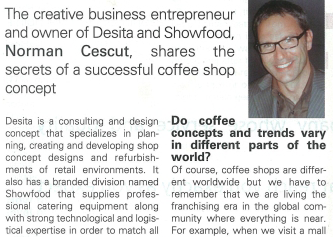
Hospitality news magazine interviewThanks to DESITA‘s activity in the Middle East countries, I was invited to participate to a special issue of Hospitality News Magazine dedicated to the Retail coffee business. It did not come as a suprise when I found that the ECOFFEE project gained great attention – sustainability is becoming a big hit in those countries, especially when related to the Retail Food sectore. You can read the whole interview here. Enjoy!

Retail Sustainability in the Middle East Countries: the new frontier

MEF, the Middle East Food magazine has bMEF article about the launch of ECOFFEEeen helping advance the Middle East & North African Food, Beverage, Ingredients and Packaging sectors since 1985 by acting as an information link / bridge between the highly advanced industrial countries and those in the developing world. The Retail Food market in that area is very sensitive to new products, new ideas and concepts and this is the reason why when I presented ECOFFEE I gained so much attention, as you can read here.