Category Archives: trends and forecasts

Beverage industry and sustainability: TATA beverages

We have previously wrote about how the beverage industry is getting more and more Sustainable, with more sustainable packaging like the Coca-Cola Company PlantBottle packaging, or by taking greater attention to the supply chain, as PepsiCo is doing with its recent committment to purchase only 100% Mexico sustainably grown sunflower crops.

 
Today, we will take a quick insight in what TATA Global Beverages is doing regarding sustainability. But first, a couple of information about the Company: TATA Global Beverages is part of the TATA Group, it currently employs 3,000 people around the world and it reported a 28% profit increase on Q3 2010, with profits being Rs 471.5 million (more than 74 million Euros).
 
If you take a look at Tata beverages website, it is clear that TATA Global Beverages is deeply involved in sustainability: from its mission “to make the world a better place through ‘life enhancing sustainable hydration’ to its long term goals and its collaborating with the Rainforest Alliance.
In a recent interview with The Guardian, TATA Global Beverages Director of Sustainibility Sara Howe, talked about the challenge to balance sustainability with the Company’s present short-term financial and commercial pressures.
She stated to be optimistic about the number of big companies who are now seriously and credibly engaging with the sustainability agenda, setting ambitious sustainability targets and demonstrating progress towards achieving them.
 ” As more companies come to understand the risks and opportunities that issues like climate change, water stress, population growth, health and wealth disparity, represent, then the necessary capacity and capability building will follow” Howe states.
But what is the role of consumers in the process towards a more sustainable business? Howe’s reply: “In a consumer-focused business like ours a particular challenge is getting permission from consumers to act for the future. Traditional research and insight methodologies tend to drive responses based on their current experience and understanding. We need to find a way of showing consumers what the future might look like from a sustainability point of view. Then they can then help us design products and services fit for that future” yet adding that her main concern about the ability to create a more sustainable world is that “That too many people won’t get it until it’s too late“.
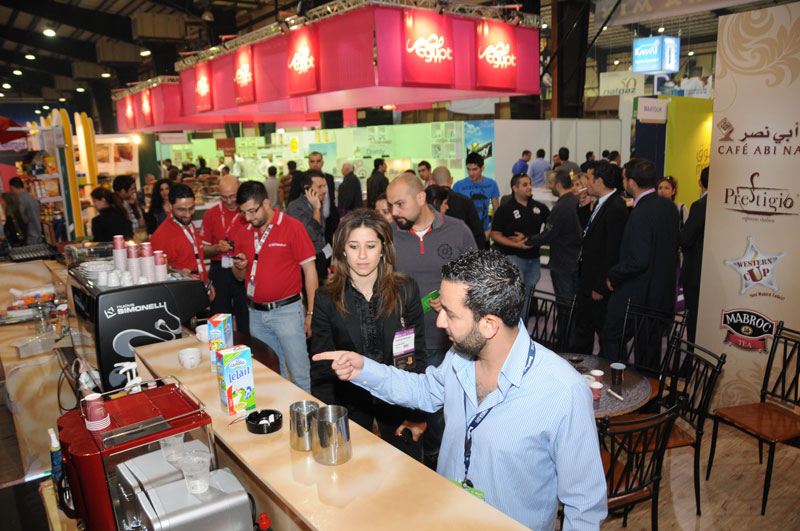
An agreement to boost Lebanon HoReCa business

Among the exhibitions and trade shows we attended to during these first months of 2011, Beirut’s HORECA 2011 was the most surprising.

Despite the turmoil hitting the region, HORECA 2011 welcomed its many visitors – almost 6,000 a day – with a great number of exhibitors and many interesting meetings.  But what is more important for the whole Ho.Re.Ca regional business, was the signing of an agreement that will certainly boost the turnover in the Lebenon region: the Beirut Capital of Taste Charter. 

In doing so, Mr. Fady Abboud, Minister of Tourism, Mr. Mouhamad Choucair, President of Commerce, Industry, and Agriculture of Beirut and Mount Lebanon, Mr. Nehmat Frem, President of the Association of Lebanese Industrialists, Mr. Pierre Ashkar, President of the Federation for Tourism Association and President of Lebanese Hotel Association, Mr. Paul Ariss, President of the Syndicate of Owners of Restaurants, Cafes, Night Clubs and Pastries, Mr. Georges Nassrawi, President of the Syndicate of Lebanese Food Industries, Mr. Nouhad Dammous, President of ADFTH, and Mrs. Joumana Salame, Managing Director of Hospitality Services, all united to put Beirut on the map as a world leader with its international standards in terms of innovation, inspiration, know-how and conviviality.

We are very thrilled to have this charter finally signed”, said Mrs. Joumana Salame, Managing Director of Hospitality Services. “We have been working on this plan for the past 3 years, and we strongly believe that Lebanon will be up to the title it has been awarded

By bringing together European and Middle Eastern countries and strengthening Lebanon’s international bonds, Horeca serves not only as an economic boost adding to the development of the country, but also as a tourism attraction, by enticing hundreds of thousands of visitors yearly.

DESITA, showfood and ECOFFEE are among the companies who have already benefited from the Beirut Capital of Taste Charter, with great projects done and to come and the foreseen participation at HORECA 2012, where we will present the best Italian shop concept design, the best catering equipment products and the most innovative practices to bring sustainability in the Ho.Re.Ca. & Hospitality sectors, food Retail and Franchising. (Picture Credit: Hospitalitynewsmagazine)

Vinitaly opens its doors with interesting data

Vinitaly focus on export and on the Italian market decline.

How to seize the new opportunities coming from abroad, particularly from Asian markets, and how to support the internal Italian market are the two main themes of the 2011 Vinitaly, the most important Italian Wine exhibition,  which is taking place in Verona (Italy), and will end on April 12 .

The Italian wine business is quite a big one, worth € 13.5 billion plus  a €2 billion deriving from induced activities. But there are lights and shadows. For example, on the exports side, 2010 experienced a growth  reaching a +12% equal to 3.93 billion euro, while domestic consumption is decreasing.
For the first time, reports Coldiretti (the Italian association of Agriculture farmers), 2010 showed a stagnation in the internal sales, now at € 3.89 billion. 

Riello, the President of Veronafiere, has stressed even more the wine business critical situation, the decline in domestic consumption, which continues, “was between 100 liters per capita in the Seventies, up to 45 liters in 2007, about 40 liters per person nowadays” showing a “further decreasing trend by 2015. ” The problem, recently highlighted by Giuseppe Martelli, director general of Assoenologi (the Italian Association of oenologists), is that “an oenology structured like the Italian one, cannot rely only on export.”

A couple of data: “in Australia only ten companies produce more than 90% of the wine exported, in Chile of 120 wineries, 100 are working only for export. In Italy, however, companies are more than 450 thousand, with an average size that is below the three hectares, compared to 300 in Chile and Australia. ”

Even a survey Vinitaly Winenews-emerges as foreign markets are critical to revenue growth, a situation that can cope with the larger companies, but few compared to many small enterprises that characterize the Italian production scenario and still have turnover rather weak.

A Vinitaly-Winenews survey on 50 companies among the most representative of the Italian business, show that 2010 ended with an average revenue increase of 8%, driven in particular by exports  (+14%).  As per 2011, the report show a degree of optimism: 75% of the interviewed said to be quite positive, 15% positive while a 10% of wineries that still feels the situation to be critical. The most critical points highlighted by the survey are economy instability, weak consumption, the loss of international competitiveness, the hars internatioanl competition.

The boom in exports, according to Coldiretti, is due largely to the U.S., which in 2010 became the country with the highest consumption of wine in the world. The American market, which is worth about $ 30 billion, is covered for 61% of production in California, but Italian wines are the most consumed ones, growing in value by 11%.

The most important destination of Italian wines are Germany, +4% in 2010, China – exports to this country doubled in 2010 – India, +65%, and Russia, +58%, equal to €104 million.

Coldiretti also analyzed the important value of the employment world of wine: the 250,000 Italian companies create jobs for for 1.2 million people. There are about half a million owners of vineyards, which have about 210,000 employees, of which over 50,000 are young and 30,000 are foreigners. And the wine business does not end in the vineyard, opportunities being in adjacent sectors like trade and catering, glass, cork, label and packaging, as well as research, publishing, finance, wine tourism, health, bio-energy. (Source:manageronline.it)

American consumers punish greenwashing practices, a survey says

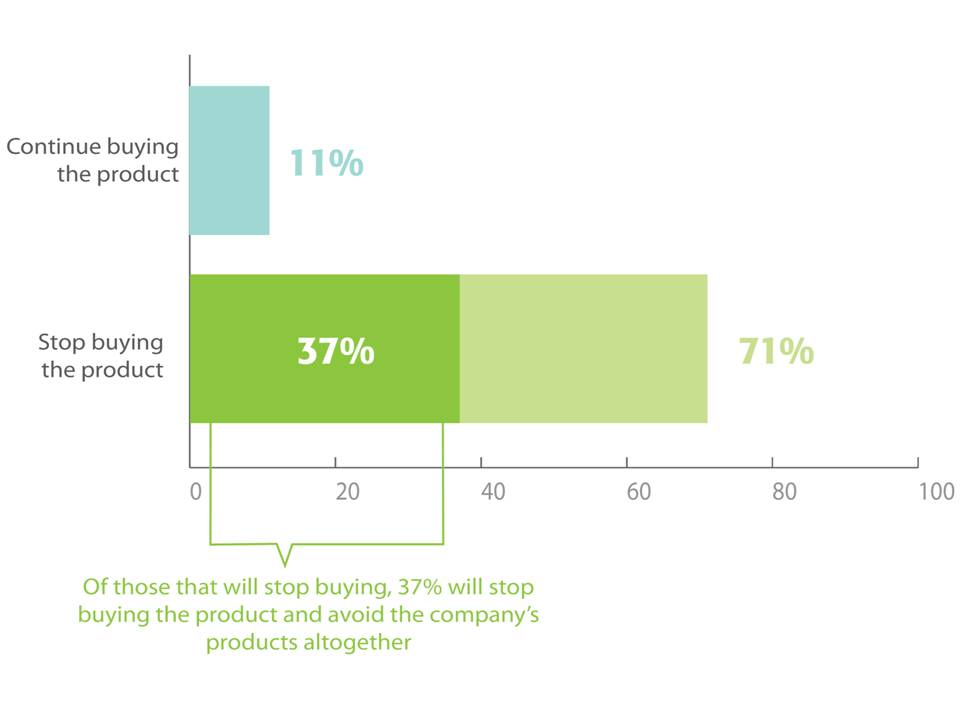
Nearly three-quarters of consumers (71%) will stop buying a product if they feel misled by environmental claims”

Two days ago an ECOFFEE prospect tried to convince us that sustainability is just a marketing word, and that consumers are not able to understand whether the retail product/store is really sustainable or it is just greenwashing.
We have already dealt with this kind of prospect – and many became enthousiast ECOFFEE customers and sustainability advocates. Data and market analysis are the only way to convince the sustainability skeptical about the counter effects of greenwashing practices.

That day, we showed to our prospect the Cone Inc. Trend Tracker recent analysis about U.S consumers and their behaviour towards greenwashing practices, dated March 24 2011.

Results are very interesting – and very motivating for those of us who believe in real sustainable business practices.
When consumers discover a claim to be misleading, they will take the following actions:


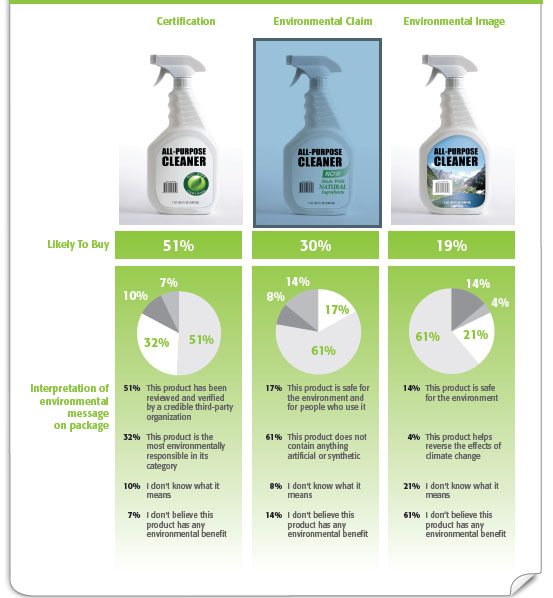
Three mock cleaning products were showed to consumers, who were asked to “purchase” the one they believed to be the most environmentally responsible. They were also required to indicate what they think the certification, claim or image on each package represents.
The results are as follow:

Another very interesting survey finding concerns the inaccurate interpretation by U.S. consumers when it comes to words such as “green” and “environmental friendly”. More than two-in-five Americans (41%) erroneously believe these terms mean a product has a positive (i.e., beneficial) impact on the environment. Only 29 percent understand that these terms more accurately describe products with less environmental impact than previous versions or competing products.
Last but not least, 59% say it is only acceptable for marketers to use general environmental claims when they are backed up with additional detail and explanation:
-23% say vague environmental claims should never be used.
-79% want detailed information readily accessible on product packaging.
-75% wish companies would do a better job helping them understand the environmental terms they use.

It is not necessary to add other comments to the above survey results, but if you are interested to know more, you can download the whole survey linking to the Cone Inc. website.

China retail luxury: a long-term insight

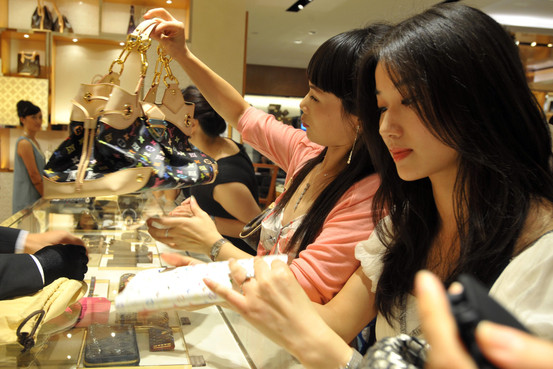
China: a market that is continuously growing, a very rich but still unknown to the many. What is clear is that China is set to become the most powerful economy in the world, and this will happen in a very short time. Many are the companies that have already sucessfully entered the Chinese market, luxury good brands being the pioneers.

A McKinsey survey over 1.500 Chinese luxury consumers during spring 2010, shows interesting trends which are basically telling to the world that the “consumer culture” is changing at a very high speed, following the changes in the society and urban landscape. For those who are interested, the whole report can be downloaded here, but three are main facts:

  • “Rapid increases in wealth, and shifting social mores that sanction the display of that wealth, are driving a growing infatuation for luxury goods among Chinese consumers.”
  • “Access to an explosion of information on the Internet, an increasing penchant for overseas travel, and first-hand experience purchasing and consuming luxury goods are contributing to a substantial rise in sophistication among luxury consumers in China. Contrary to popular belief, a growing number of Chinese luxury consumers are exhibiting a noticeable trend away from overt displays of wealth, and towards more understated forms of luxury consumption.”
  • “Rapid urbanization and growing wealth outside of China’s largest cities is driving the emergence of several new geographic markets with sizable pools of luxury goods consumers. Over the next 5 years, [McKinsey] expects that the number of such cities will double from 30 to 60.”

Other key findings are social-demographics related. Not only traditional luxury brands consumers, but also 13 million upper-middle-class households (earning $15,000 to $30,000), which are stretching their budgets to buy luxury watches, jewelry, handbags, shoes and clothing. This segment represented 12% of Chinese luxury consumption in 2010, but is expected to reach 22% by 2015.

The survey also shows that approximately 73% of luxury consumers in China are under age 45, significantly younger than their counterparts in western nations or even nearby Japan. 

All these findings essentially reinforce the widespread idea that if this trend is going to be followed in 2011 too, China will become the biggest retal luxury market in the close future. (Source: McKinsey, Picture credits: TheChinaObserver)

What is Masdar and why it is so important for our future?

Masdar is a familiar word to all of us who are concerned about the future of our dear planet Earth. But for the few of you who have never heard of it, please allow us the pleasure to introduce you this incredible project.

Masdar is first of all a company, notably a Mubadala – Abu Dhabi government owned company, based in Abu Dhabi, UAE. As stated in the company’s website ” Masdar is a commercially driven enterprise that operates to reach the broad boundaries of the renewable energy and sustainable technologies industry – there by giving it the necessary scope to meet these challenges.  Masdar operates through five integrated units, including an independent, research-driven graduate university (Masdar Institute, other units are Masdar Capital, Masdar Power, Masdar Carbon, Masdar City cfr.) and seeks to become a leader in making renewable energy a real, viable business and Abu Dhabi a global centre of excellence in the renewable energy and clean technology category. The result is an organisation greater than the sum of its parts and one where the synergies of shared knowledge and technological advancement provide this commercial and results-driven company with a competitive advantage that includes an ability to move with agility and intelligence within an industry that is evolving at great speed.
This holistic approach keeps Masdar at the forefront of this important global industry, while ensuring it remains grounded in the pursuit of pioneering technologies and systems that also are feasible. As a result, it delivers innovation to the market while deriving profits for its shareholders.”

This huge project deals with all the aspects of sustainability: research, energy, finance, architecture, urbanism. Last but not least, retail. Because of its importance in the life of all the people who will live in Masdar City and for “its contribution to the city’s appeal as a renewable energy and clean-technology hub“, retail in Masdar “will provide valuable lessons regarding commercial activities (…) increasing our understanding of how retail activities can be conducted in a sustainable manner”. The list of the companies who have already been involved in the Masdar City retail project includes Caribou Coffee, health insurance provider Daman, telecom provider Etisalat, Sumo Sushi, express delivery company Aramex, Omeir Travel, Organic Foods & Cafe and National Bank of Abu Dhabi. The first commercial building, the Courtyard Building,  has been planned to be finished by 2012, therefore there is enough time for this list to become a very long one.

In the meanwhile, many are the people who are praizing the incredible urban project designed by Foster and Partners, but to be fair, there are also critics like New York Times journalist Nicolai Ouroussof  who wrote that “…its design also reflects the gated-community mentality that has been spreading like a cancer around the globe for decades. Its utopian purity, and its isolation from the life of the real city next door, are grounded in the belief — accepted by most people today, it seems — that the only way to create a truly harmonious community, green or otherwise, is to cut it off from the world at large“.

Our point of view and what we are always stressing in our ECOFFEE projects, is that sustainability is too important for our future and each and every project that has a little bit of sustainability in it is important to raise people awareness. To be too critical towards sustainability-related projects, requiring their perfection – which at this stage is quite hard to achieve – postpones any action and creates confusion among people, these two being the worst enemies of sustainability. (Picture credits: Masdar.ae)

Enoc Retail plans expansion to Middle East

Enoc Retail Systems Holding, the retail division of Emirates National Oil Company (Enoc), plans to franchise its Zoom convenience-stores and Pronto, a fresh food and gourmet coffee concept.
Zoom, which operates six stores at Dubai Metro stations, is looking to expand to 28 stores in total, Enoc stated recently.

The convenience store brand, which is currently also present in eight stores within the Enoc/EPPCO network, is set to expand both as stand alone stores and at more Enoc/EPPCO service stations, it added.

Pronto, established in 2008, currently operates 21 outlets within Enoc/EPPCO service stations. Burhan Al Hashemi, managing director of Enoc Retail, said that expansion plans were part of a long term strategy to establish Zoom and Pronto as premier retail providers across the Middle East.

“Enoc Retail has proven its competencies in a short span of time. We are now open to share our expertise by franchising the successful retail concepts and reach out to a wider audience in the Middle East,” added Al Hashemi.

Enoc/EPPCO is the pioneer of convenience store retailing in the UAE, introducing mini marts in 1988 in Dubai and the Northern Emirates.

Currently, Enoc Retail employs more than 4,500 frontline staff, meeting the needs of over 600,000 customers a week. Enoc Retail operates a network of 170 Enoc and EPPCO service stations in Dubai and the Northern Emirates. (Source: Arabianbusiness.com)

MENA: retail sales are still growing

Retail sales in the MENA region jumped 13.2 percent last year, making it the only region in the world to post double digit growth, accountancy firm Deloitte has said.

In its latest retail report, Deloitte said emerging markets were the most promising for consumer sales and marked the Middle East as a stand-out region.
“While global economic growth is on the mend, most of it is taking place in emerging markets, many of which are experiencing rapidly increasing consumer spending,” said Nasser Sagga, audit partner at Deloitte and Touche.
“Within the Middle East there is a number of emerging economies that meet the criteria of strong growth prospects and good demographics – Egypt and Turkey being two such examples.”

The report identified the 250 largest retailers around the world in 2010, more than 11 percent of which were based in the MENA region.
Despite seeing a significant drop in trade and tourism during the financial crisis, the Gulf remains a key a market for retailers.

A report last year by real estate consultancy CB Richard Ellis found Dubai ranked second only to London in terms of the number of global brands with a presence in the city.
In a ranking of 294 of the world’s top retailers, more than half had a presence in Dubai. “Despite continued uncertainty for some retailers across the world, luxury brand retailers have remained active and were responsible for the most new store openings,” said Peter Gold, head of Europe, Middle East and Africa cross-border retail at CBRE. (Source: ArabianBusiness.com, Photo: hadiyahrewardnetwork.com)

Where are the greenest ATMs? In Abu Dhabi!

We are always thought of sustainability in the retail business as related to  production-delivery-waste disposal. But what about the money that we currently use to purchase raw materials, pay delivery, purchase items? Is money really green?
We are not going to get into the sustainability of the “manufacturing process” of money. Not today.  But we are going to talk about how to make dispensing money the greenest ever.

This is what the National Bank of Abu Dhabi (NBAD), the Number One Bank in the UAE, has done last January, becoming the first bank in the UAE to launch a solar-powered ATM. NBAD’s first solar ATM became operational at Al Bateen Branch in Abu Dhabi.

The NBAD’s green ATM, launched in cooperation with Apex Power Concepts, is powered by solar panels installed on the branch’s roof. The panels are connected to a circuit breaker board, which feeds a power controller where part of the collected energy is stored for the ATM’s night operation.
NBAD aims to eventually implement this solution in all NBAD branches as well as at stand alone offsite ATMs. The Bank has one of the largest branch and ATM network in the country with more than 110 branches and 429 ATMs all over the UAE.
“CSR at NBAD is a way of doing business. Therefore, we adopt methods and technologies that are aligned with this strategy,” said Ahmed Al Naqbi, the Head of Channels & Electronic Banking Services at NBAD. “In addition to delivering quality products and services, NBAD differentiates itself in the market by its corporate sustainability credentials.”

The 2011 trends in the Middle East Hospitality Business

With my company DESITA I have always payed great attention to what is happening in the Middle East countries, whose retail and hospitality business are becoming very interesting because of their many nuances and the possibility they offer.  Karafirin project by DESITA

Accordingly to what recently published by the HotelierMiddleEast website, the 2011 hospitality scenario in Middle East is going to experience three different trends: back to the origins and to healthy food, casual F&B concepts and the raise of social media marketing.

Many of the expert interviewed stressed that the economic crisis has hit those country too and that consumers have become more cost and health conscious. This automatically translates to a return to the traditional, local food and beverages which are less expensive, healthier and – last but not least – more sustainable.