Qthru is one of the many iPhone apps available enabling customers to scan barcodes and QR codes. What is interesting is that it also offers an opportunity to check out and pay thanks to the interaction with a check-out self service station at the local store.
Category Archives: shopping experience
Augmented Reality or Augmented Retail?
Is AR (Augmented Reality) in-store systems going to help retailers to boost sales? It would be interesting to know your opinion, in the meanwhile, watch these two interesting videos.
Kinetic Fitting Room by AR Room at the Topshop flagship store in Moscow
Cisco demo allowing shoppers to try on clothes via augmented reality, all enabled by interactive digital signage
A Pop-up revival in retail marketing
Over the past 12 months, a growing number of brands has turned to pop-up activity to provide a burst of PR activity and another reason for consumers to interact with their brand – hopefully ensuring that the effect of these events are going to last even after the shutters come down. The last news about a pop-up store is related to Marni, the Italian fashion brand, located at the Ocean Centre in Hong Kong and featuring the whole Marni Edition.
The pop-up phenomenon dates back 2004, when fashion brand Comme des Garcons opened a guerrilla store in Berlin, followed by a long list of known brands, such as ony Ericksson, Levi’s, Breil, Uniqlo or the most recent ones of Apple, Nokia, and Adidas Originals. 
The pop-up strategy allows brands to tap into new markets at low cost, as rents are cheap and the ‘concept store’ strategy creates a buzz without investing in advertising.
Even thought they are an excellent way to deliver a brand experience there is a question over their reach, as they engage only those consumers who actually visit. Jeremy Rucker, head of Hotel Retail, experiential agency RPM’s pop-up and retail division, says the growth of pop-up activity is partly in response to the levels of empty retail space on high streets. ‘With so many brands turning to online-only channels, pop-up activity helps bring excitement back to the high street,’ he adds.
The big question for brands is how to drive investment beyond the life span of the pop-up store and the PR generated at that time. ‘Data capture is fundamental, but creating engaging ways for the brand to interact with the consumer that can a develop a life of their own should be considered,’ says Owen Cato, creative director of retail agency Live & Breathe. ‘Extending activity in the pop-up store online and into social-media activity would work well.’
Claire Stokes, managing director of experiential agency The Circle Agency, adds: ‘Previously, when brands have talked about experiential, it has been all about being in the live space. Now it is about building new digital layers to ensure the halo effect of any given event stretches beyond just one single event.’ For example, when EA Games promoted its key Christmas video-game releases in shopping centres, it encouraged consumers to ‘check in’ to win titles. More than 3000 consumers took part, promoting the event far beyond the boundaries of the event venue.
However, industry experts warn against investing in digital at the expense of the core event. Trevor Hardy, founder of creative agency The Assembly, contends that pop-up activity should be viewed as another marketing channel. ‘The more sensory and multichannel the experience, the better it becomes,’ he adds. ‘The risk is that interactive and social media may dilute the experience – 100% of the efforts should be dedicated to ensuring the experience is the best it can be.’
However, the fact that even retail brands with a consistent high-street presence are turning to pop-up activity perhaps suggests that brands should be creating the excitement of a pop-up shop in their existing retail space every day. Hardy argues that this is not possible, as the ‘focus is on getting the maximum return per square foot’.
Caroline Wurfbain, client services director at experiential agency Jack Morton Worldwide, predicts that more brands will launch pop-up activity over the next 12 months. ‘The challenge is that if ideas don’t change, there is a risk that the market will become saturated and consumers will get bored,’ she adds.
Many of the most successful pop-up launches and events of recent years have not been the work of commercial brands, but independent chefs and artists. As a result, a raft of brands has attempted to mimic the halo effect of organic movements such as Hidden Kitchen, a private supper club that serves 16 people a seasonal 10-course tasting menu paired with wines. However, if these brands fail to offer consumers a compelling reason to interact with them, their experiential strategy risks being dangerously insubstantial (Source: Marketing Magazine)
Online retail: how to turn a negative consumer feedback into a positive one
Retailers who are going to open online shops often fear about negative feedbacks from online shoppers. “What if I receive a negative feedback? Should I ignore it or answer?” The most common retail behaviour is to ignore it, hoping it will be ignored by other consumers too. But this is a great misconception. 
Retailers have an opportunity to fight back and use social media to turn unhappy customers into brand advocates, says the Retail Consumer Report, commissioned by RightNow and conducted online by Harris Interactive in January 2011 among 1,605 online US adults. The report shows how retailers are using social media to win back customers and drive buying decisions.
- 68% of consumers who posted a complaint or negative review on a social networking or ratings/reviews site after a negative holiday shopping experience got a response from the retailer. Of those, 18% turned into loyal customers and bought more.
By listening and proactively responding on the social web, says the report, retailers have a chance to turn disgruntled customers into social advocates.
After a positive shopping experience, half of consumers cited great customer service and/or a previous positive experience as influencing their decision to buy from a specific online retailer.
Social advocacy can also help drive sales, the survey found:
- Nearly a third of consumers researched what customers said on social networking and reviews websites while shopping online.
For those consumers that had a positive holiday shopping experience with an online retailer during the past holiday shopping season:
- 21% recommended the retailer to friends.
- 13% posted a positive online review about the retailer.
The survey found that 38% of consumers turned to the retailer’s website for information or support with online shopping. However, one of the top frustrations consumers had when shopping online was a lack of consistent information from retailers. Specifically, 22% of consumers were frustrated by information that was inconsistent between the retailer’s website and customer service agents.
For further research on how customer experiences impact the bottom line, including the fact that 85% of consumers said they would be willing to pay anywhere between 5-25% over the standard price to ensure a superior customer experience, RightNow makes the Customer Experience Impact Report 2010 available to download. (Source: MediaPost)
How to deliver customized in-store offers to shoppers?
One of the in-store marketing biggest issues ever is how to reach customers with customized offers while they are shopping. U.S.A retailers and consumers are going to have a solution handy in the next future: Shop O’Lot. 
Shop O’ Lot is a self service platform which makes major retailer participation very easy. The model is based on a predictive analysis engine, that builds a customer’s shopping profile, then allows retailers to reach these customers in real-time while they are shopping, offering them customized discount coupons.
The app uses GPS and bar-code scanning for delivering the content and will be released on the iPhone and Android OS platforms.
Bob Pack, CEO says, “major retailers are now competing with product search and comparison apps that can actually drive a customer to buy from a competitor, a practice known as “scan and scram.” We have a complete solution to really help drive retail purchases, this goes well beyond mere Geo- location and focuses on individual target marketing. Once we understand the shoppers tastes, delivering them customized product deals only by the store they are in, will help keep shoppers loyal.”
Shop O’ Lot is still in the testing phase and plans a 2011 launch and retailers and consumers, can sign up now to be part of our beta program directly on Shop O’Lot website. (Source: americanbankingnews.com)
The Art of display: enhancing customer experience
More businesses are incorporating artful accents to their shops, realizing that customers are more likely to enter and spend more time in a store with artistic retail displays than one with basic white walls and grid-like shelves. Everything from oversized art installations to crafty storefronts are giving retailers attention-grabbing elements that are simply too eye-catching for a customer to ignore.
Created by Kahori Maki, ‘Moon Princes’ begins with the window display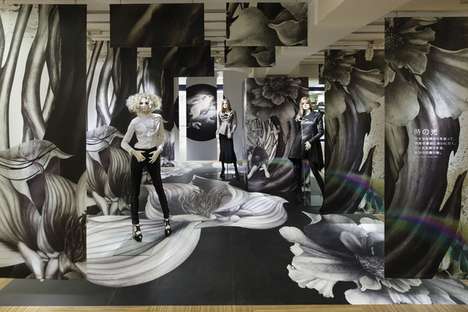 and then leaks into the store’s interior space. It’s black-and-white coloring contrasts vividly with the relatively vibrant clothing. The result might be considered overwhelming but it charmes the most adventurous shoppers.
On the opposite, the Valencia Munich store, de sign by Dear Design studio, is very minimal, yet very impressive. Its all white color, the complex X display structure, seem to expand the display surface at libitum, giving to the full range of Munich Shoes on diplay the deserved importance.
At the famous Merci store in Paris, Aesop has installed a creation 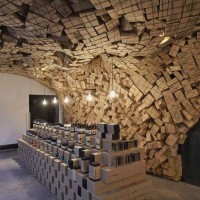 designed by the Melbourne-based March studio, which can not passed unnoticed. A wall of stacked Aesop cardboard boxes, held together by a black net, looks like a tornado which is going to wrap over the shopper.
These are only few examples, what is clear is that shoppers now need more stimuli: products are available almost everywhere, what differs is the shopping experience. And art can be the solution. (Credits: Trendhunter)
Need some customer interaction? Here it goes!
There are many ways to enhance customer experience..Let’s start from the window display, for istance. Technology is helping retailers a lot, and we have found some great examples that we would like to share with you. Not so much to add, just watch and enjoy – and maybe give us your feedback!
Interactive Window Concept made for the module Advanced Interface Design at Hyper Island hosted by North Kingdom
Project for an interactive display window for BNP Paribas, place de l’Opéra, Paris
The Interactive Apple Store in Berlin, Germany.
GoodGuide for Good Products for a more sustainable Retail
Yesterday I was reading a post concerning Levi Strauss & Co as the Top Jeans Brand, scoring a 7.4. The brand Prana was listed as the next highest, with a score of 6.3—followed by H&M (6.1), Banana Republic (6.1), and Old Navy (6.1).
I did not know what GoodGuide is – shame on me – so I checked out their very interesting website, which is said to be the world’s largest and most reliable source of information on the health, environmental and social impacts of consumer products. And I think it really is, rating over 95000 products, mainly available on the US market only: from food, toys, personal care to apparel, electronics and appliances. What is really striking is the scientific approach they have on their ratings, which are compiled from three sub-scores addressing Health, Environment and Society.
Each of these sub-scores are based on an analysis of a set of indicators that GoodGuide has determined are the best-available measures of performance in these areas. Their methodology differs from the product belonging to different categories, each and every one having its own scoring methodology. Amazing. Let’s talk about apparel for example.
Quoting the Good Guide site: “Until (apparel) companies do a better job of providing transparency into their supply chain, our ability to accurately score brands based on their relative performance will be subject to significant uncertainties Environment scores are assigned to apparel brands by combining GoodGuide’s standard company indicators of environmental performance (weighted at 50%) with brand-level environmental indicators that address issues that are specific to the apparel sector (weighted at 50%).(….) Social scores are assigned to apparel brands by combining GoodGuide’s standard company indicators of social performance (50%) with brand-level social indicators that address issues that are specific to the apparel sector (weighted at 50%).(…) Health scores are not assigned to apparel brands because this product category does not generally pose health risks to consumers.”
The Good Guide website is also very good at using the Web 2.0 tools to “spread the word” and improve the accuracy of the product information thanks to a “support product info” page which enables visitors to add further details.
It would be also very interesting to test the effect of this kind of structured and scientific information directly at the point-of-sale, to see how the consumer react when discovering that his/her favourite brand of pasta is not that “good”. Because thanks to GoodGuide mobile App this is possible: consumers can scan the product, check the GoodGuide database and then purchase, or decide to choose another brand.
With this detailed level of “scientific” information, producers and retailers have nothing to hide and their achieving a high/low score can have a boomerang effect on brand reputation which must not be ignored and will not be ignored by consumers. Sustainability pays, and it will pay even more in the future.
Retailers be aware: product customization might be the future – and it comes from the web
A very interesting article about a new trend which goes against the well-known rule of product massification: “One size fits all”. The article mentions several websites, mainly U.S based, offering to their  customers the chance to create their own unique product. Ranging from Art to Chocolate and Perfumes, just to count some. this new trend is going to become big, especially because many “co-created” goods undercut their top-tier competitors.
Searching what the Italian web offer is may be a little bit frustrating, because the search always reminds to non-Italian companies. The only great example of online product customization which is 100% Italian is Miraqo. The very clever website offer the chance to create your own chocolate adding a huge variety of high quality ingredients, which are also certified as being organic. If know of more Italian based companies which are offering online customization services to their products, just leave a comment or send us an email (Source: Smallbusiness.aol.com)
Is this the future of retail shops?
At the last National Retail Federation Convention, Intel showed an interactive, 7-foot-6-inch Intel® Intelligent Digital Signage Concept with an LCD display and holographic glass called adiVerse to demonstrate how technology can enhance the retail customer experience with a multi-touch, multi-user interface.
Intel partnered with Adidas to show off what the wall might look like, and the results are pretty sweet. Designed by U.K. shop Start Creative, the wall renders products in 3-D, and allows a shopper to spin and zoom in on the shoes, and call up specs from a touch-screen display. Particularly hot models, like the company’s F50 soccer shoe, have accompanying video and relevant information (like the fact that F50-clad feet scored 44 goals in last year’s World Cup).
Supplemented by a supply of actual shoes that can serve as fit models, the display wall allows retailers to deliver massive inventory in a relatively small space. “We’ve leveled the playing field for small retailers,” says Chris Aubrey, VP, Global Retail Marketing for Germany-based Adidas. “They can now act like a big flagship store in a town like New York.” Not to mention the fact that the installation turns flat walls into prime selling space.
Concept demonstrates how digital signage technology can provide retailers with a competitive advantage, and how it can impact customer loyalty by providing targeted, interactive content to consumers. (Source:Fastcompany)
 normancescut.com

