Category Archives: design

What is Masdar and why it is so important for our future?

Masdar is a familiar word to all of us who are concerned about the future of our dear planet Earth. But for the few of you who have never heard of it, please allow us the pleasure to introduce you this incredible project.

Masdar is first of all a company, notably a Mubadala – Abu Dhabi government owned company, based in Abu Dhabi, UAE. As stated in the company’s website ” Masdar is a commercially driven enterprise that operates to reach the broad boundaries of the renewable energy and sustainable technologies industry – there by giving it the necessary scope to meet these challenges.  Masdar operates through five integrated units, including an independent, research-driven graduate university (Masdar Institute, other units are Masdar Capital, Masdar Power, Masdar Carbon, Masdar City cfr.) and seeks to become a leader in making renewable energy a real, viable business and Abu Dhabi a global centre of excellence in the renewable energy and clean technology category. The result is an organisation greater than the sum of its parts and one where the synergies of shared knowledge and technological advancement provide this commercial and results-driven company with a competitive advantage that includes an ability to move with agility and intelligence within an industry that is evolving at great speed.
This holistic approach keeps Masdar at the forefront of this important global industry, while ensuring it remains grounded in the pursuit of pioneering technologies and systems that also are feasible. As a result, it delivers innovation to the market while deriving profits for its shareholders.”
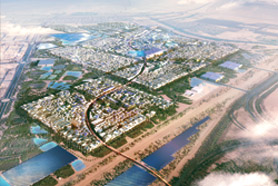
This huge project deals with all the aspects of sustainability: research, energy, finance, architecture, urbanism. Last but not least, retail. Because of its importance in the life of all the people who will live in Masdar City and for “its contribution to the city’s appeal as a renewable energy and clean-technology hub“, retail in Masdar “will provide valuable lessons regarding commercial activities (…) increasing our understanding of how retail activities can be conducted in a sustainable manner”. The list of the companies who have already been involved in the Masdar City retail project includes Caribou Coffee, health insurance provider Daman, telecom provider Etisalat, Sumo Sushi, express delivery company Aramex, Omeir Travel, Organic Foods & Cafe and National Bank of Abu Dhabi. The first commercial building, the Courtyard Building,  has been planned to be finished by 2012, therefore there is enough time for this list to become a very long one.

In the meanwhile, many are the people who are praizing the incredible urban project designed by Foster and Partners, but to be fair, there are also critics like New York Times journalist Nicolai Ouroussof  who wrote that “…its design also reflects the gated-community mentality that has been spreading like a cancer around the globe for decades. Its utopian purity, and its isolation from the life of the real city next door, are grounded in the belief — accepted by most people today, it seems — that the only way to create a truly harmonious community, green or otherwise, is to cut it off from the world at large“.

Our point of view and what we are always stressing in our ECOFFEE projects, is that sustainability is too important for our future and each and every project that has a little bit of sustainability in it is important to raise people awareness. To be too critical towards sustainability-related projects, requiring their perfection – which at this stage is quite hard to achieve – postpones any action and creates confusion among people, these two being the worst enemies of sustainability. (Picture credits: Masdar.ae)

A greener Novotel by 2012

PARIS Accor’s midscale Novotel brand is on pace to meet its goal of becoming 100% environmentally sustainable by next year, the group says.

To date, 78 of Novotel’s portfolio of more than 400 hotels have been certified as sustainable by EarthCheck, the organization formerly known as Green Globe. Novotel’s commitment to sustainable development has enabled the brand to achieve the following green results as of year-end 2010:

  • 98% of hotels apply and monitor the 65 actions in the Accor Hotel Environment Charter
  • 80% have installed energy-efficient light bulbs in areas that stay lit 24 hours a day
  • 92% have installed flow regulators on faucets and in showers
  • 89% recycle paper and cardboard packaging
  • 86% dispose of compact fluorescent tubes and light bulbs safely
  • 60% serve organic products
  • 60% offer nutritionally balanced meals for children.

EarthCheck certification is awarded after a preliminary assessment of a hotel’s performance and the deployment of an appropriate management system covering implementation of a sustainable development policy, water use, energy use, waste management, paper consumption, use of pesticides, use of cleaning and sanitation products, and commitments to the local community. At least 10 months are required for a hotel to receive certification, which is awarded by an independent outside auditor and is reevaluated every two years.

“Since 2008, Novotel teams have been actively involved in the EarthCheck certification program so that we can meet our goal of certifying the entire network by 2012,” says Pierre Lagrange, Novotel’s global marketing director. “Novotel’s commitment to the principles of sustainable development is an integral part of the brand’s promise of customer well-being (Source: Ghaward.ie)

Luxury and sustainability… a trend we will see more of in China

URBN Hotels & Resorts announced plans for URBN Hotel Pudong, a new green hotel that will become the first positive-impact hotel in China. The hotel is slated to open Spring 2012.

In collaboration with Vanke, China’s largest residential real estate developer, URBN’s 20,000 square metre boutique hotel is part of a larger commercial, retail and residential development in the Sanlin district of Pudong in Shanghai. They have tapped Fumihiko Maki, the world-acclaimed Japanese architect whose current works include the United Nations building and World Trade Center Tower 4 in New York City, to design the project.

The development, which is estimated to cost RMB 312 million (US$47 million), will include 55 hotel rooms, 50 URBN serviced residences, and 4,500 square metres of dining, wellness and art spaces.

URBN created China’s first carbon-neutral hotel, the chic and hip URBN Shanghai in the Jingan district. URBN Shanghai is passionately committed to the environment and is at the forefront of the growing consumer eco-movement in China. URBN tracks the hotel’s entire carbon footprint and offsets it by purchasing carbon credits or investing in local “green” energy development and emission reduction projects. The hotel provides guests the option to find out their footprint during their stay and by donating trees to Jane Goodall’s Roots and Shoots foundation to offset.

For the new URBN Hotel Pudong, Jules Kwan, Managing Director of URBN Hotels indicated that “the aim is to make this hotel go beyond sustainability … the hotel will increase the biodiversity of the site, and will discharge water that is cleaner than the water from the city’s water supply.” The hotel hopes to get LEED and China Green Star certifications. Also, URBN Hotel Pudong aims to surpass the 35% energy savings target hit by URBN Shanghai. (Source: Red-Luxury)

Need some customer interaction? Here it goes!

There are many ways to enhance customer experience..Let’s start from the window display, for istance. Technology is helping retailers a lot, and we have found some great examples that we would like to share with you. Not so much to add, just watch and enjoy – and maybe give us your feedback!


Interactive Window Concept made for the module Advanced Interface Design at Hyper Island hosted by North Kingdom


Project for an interactive display window for BNP Paribas, place de l’Opéra, Paris


The Interactive Apple Store in Berlin, Germany.

Innovative communication or design innovation: eyewear

Italy is famous for its eyewear giants, Luxottica first. If you have ever visited an eyewear retail store in Italy, you would have noticed that more or less they all look the same: neon lights, mirrors, traditional displays, sales people wearing a white coat.
Today we would like to show you two very different approach to this kind of point of sale: Salmoiraghi & Viganò at Piazza San Babila, Milan and Kirk Originals in London.

The first looks like a “traditional Italian” eyewear store, we might say the “deluxe” version of it but from the design point of view, nothing extremely different from the typical layout, displays included. What is “unusual” in this point of sales is the concept and the services offered: a very fast service for those who need new spectacles, culture, events and corners managed by several fashion brands.

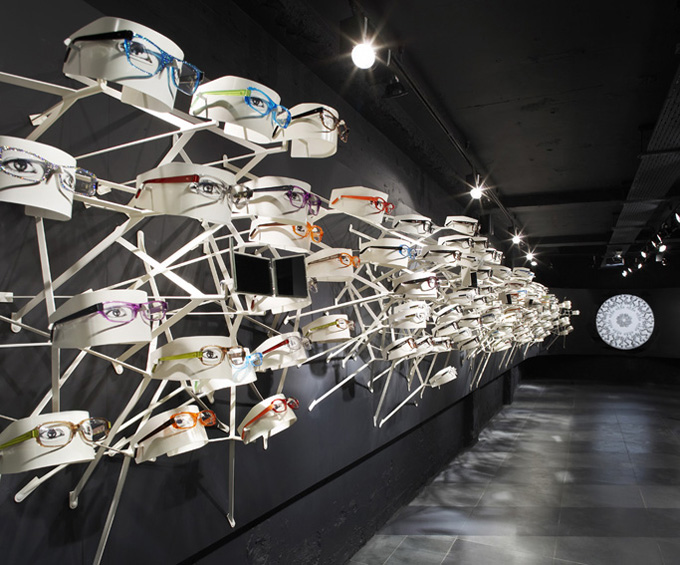
Kirk Originals flagship store, on the opposite, looks very unusual, and the only one eyewear wall with 187 “heads” for frames, and practically no furnishings ensure that customers will focus on the eyewear, not the trappings. Eye examinations and fitting take place in the basement, away from the main display space.

Two different, opposite concepts for the same product. Which one do you think will sell most? (Photo: courtesy of Salmoiraghi&Viganò, Luca Oliverio and TheCoolHunter).

NH Eco Conscious

Last January 10th, NH Hoteles, the leading Spanish chain of cool design hotels, has presented to the Italian market its Ecomeeting product, which is perfectly in line with the Company’s 2008 to 2012 Strategic Environmental Plan to reduce CO2 emission, water and energy consumption, waste generation by 20% within 2012.
The plan, principally a gathering of people for information exchange purposes, but also characterized by four distinguishing parameters:
•Efficiency in the usage of energy and water
•Low impact materials
•Fair-trade products
•carbon offsetting on client demand. Offsetting carbon strives to reduce greenhouse gas emissions. Companies’ offsets are typically achieved through financial support of projects that reduce the emission of greenhouse gases in the short or long term. For this purpose NH Hotels preferred choice and what they consider the best way is through renewable energy projects.

This is why NH hotels financially support a hydropower plant located in the Rôndonia, Brazil. This renewable energy river hydropower project reduces greenhouse gas emissions by displacing power from higher emission fossil fuel sources on the national electric grid.

NH Hotels clients can now choose to offset the emissions created as a result of their meeting, by including carbon offsetting in the Ecomeeting purchase agreement. The fixed extra cost is 1€ per person for low or medium travelling impacts, 2€ for meeting where attendees are coming from long distances and 3€ for transoceanic.

The client can also opt for a more detailed analysis of their meeting and the offsetting needed, NH Hoteles can calculate the offset required for the specific client. NH provides all this information for the client: client origin, destination and transportation used. Clients under this special purchase agreement will receive an official certificate issued by Carbon Clear, stating the specific amount of CO2 equivalent, compensated by the hydropower plant project (Source: NH hoteles)

A CONSCIOUS COLLECTION – SUSTAINABLE STYLE AT H&M

Sustainability is a long term trend at H&M and this April as part of the focus on sustainability H&M will introduce the Conscious Collection – The collection which is for women, men and children is made from enviromentally – adapted and greener materials such as organic cotton, Tencel® and recycled polyester. H&M’s designers have been inspired by different shades of white, one of the most important colours this Spring. A minimalist, tailored look is combined with romantic lace, Broderie Anglaise, frills and draping. The Conscious Collection will be on sale in all H&M stores from 14th April. “It’s not just about organic cotton any more, the possibilities for creating a complete fashion statement with eco smarter materials are huge now. By designing recurring Conscious Collections we have the opportunity to show in a variety of ways what’s possible using more sustainable fabrics,” says Ann-Sofie Johansson, H&M Head of design. “Shades of white are the season’s biggest fashion trend and it feels right for this collection. White creates a romantic feeling with lace and Broderie Anglaise, but is also the basic colour in a sporty, relaxed style and in a preppy tailored look for men.” Womenswear is inspired by an updated romantic style in which blouses, tunics and T-shirts with Broderie Anglaise are a key trend. Tiered dresses are perfect for day or more dramatic Grecian gowns for night. Long floaty skirts are key as are cut-off shorts. The collection also includes the perfect white blazer and pleated trousers for a more minimalist look as well as Broderie Anglaise and lace lingerie. Menswear takes on a preppy mood with a white two-button blazer, collarless shirts and T-shirts with Henley detailing at the neck. There are printed and striped T-shirts, as well as a tank top for layering and trousers are either five-pocket jeans or tailored. Meanwhile the Children’s collection is full of white pieces for both girls and boys. It’s all about tiered dresses, tops, skirts for girls, and for boys t-shirts and jeans. (Source: H&M press release, Photos: H&M)

Green roofs and gardens for sustainable shopping malls

I was recently reading about a shopping mall in Toronto that is going to expanSiam Paragon Shopping Mall green interior designd also including a sustainable food court and a green roof and I asked to myself: "Are there many shopping malls using green roof as a sustainable (and I think very stylish) way to control their energy consumption?" I made a quick search and I found that in 2008 in Upper Providence, Pennsylvania, a 400,000-square-foot shopping mall installed a 2.3 acre  green roof to prevent storm water runoff. It seemed to me centuries ago, and a very remote location for something that even in 2011 looks like science fiction.

But the most amazing example of a green shopping mall is the Siam Paragon Shopping Mall in Bangkok, Thailand, designed by the world known Patrick Blanc in 2005. The Siam Paragon shopping center in features a lush, rainforest-like cascade of ferns, vines, sedum and moss in various shades of green, yellow, red and purple. The greenery surrounds the building’s 6-story elevator shaft to dazzling effect, enjoying all the shopping mall visitors for a great sustainable shopping experience. (Image via: Pseangsong + pingmag)

Greencity International Convention welcomes ECOFFEE

DESITA and ECOFFEE have been invited to participate tgreencity_international_conventiono the Greencity International Convention, taking place at Cluster Grenelle (Paris) which aims at becoming a global reference centre for all activities concerning planning, building and managing the new sustainable city. Sustainable Architecture, Urban Quality Management, Renewable energy, New Technologies to create a new sustainable concept of living, working and entertaining in the city.

Zara 5000th store in Rome leads the way to a sustainable retail

Showing off its real aim to embrace the latest eco-trends from top to bottom, from heart to head, Inditex has just opened its 5000th Inditex store as the flagship of its 2011-2015 Sustainable Inditex Plan. Inditex new global benchmark in eco- efficiency is housed in the Palazzo Bocconi, a building whose history dates back more than 120 years.

Just some figures: this is a store which consumes 30% less energy with regard to the annual average consumption of a conventional store, saves 50% of water consumption and avoids the emission of over 150 toms of CO2 per year.

If the Inditex’s Strategic Environmental Plan 2007-2010 achieved various certifications in 3 of its stores including a first of its kind in Europe with Zara Barcelona being awarded LEED (Leadership in Energy and Environmental Design) certification, the new Zara, located at exclusive Via del Corso , reflects the 2011-2015 Sustainable Inditex Plan announced at the company’s most recent Annual General Meeting by the Group’s Deputy Chairman and CEO, Pablo Isla.

Isla set a strategic target of 2020 for all Inditex Group establishments to meet these criteria, which
are guiding the launch of the company’s newly-created locations. “Environmental issues are a key component of Inditex’s global strategy”, said Isla. “This project marks a turning point in how we think of retail space”.

The sustainability and energy efficiency measures established at Zara in Portal de l’Àngel 11-13 in Barcelona, are to be replied in every new store opened by Inditex worldwide and under every single one of the brands gathered in the group (Pull&Bear, Massimo Dutti, Stradivarius, Zara, Zara Home and Oysho) structured around the requirements set down in each one of the categories of the LEED certification system and contemplate actions regarding materials, installations and control systems
and processes.

This new concept of boutique hides behind a façade that makes use of three key elements: shop windows and geometric composition with big metal and glass squares, and a large-format logo. The new-look shop interior comprises an extensive range of grey tones which contrast with its black furnishings. The sales area is spread over five storeys. The company has indicated that the eco-friendly boutique would not have been possible without the previous experience acquired by Inditex’s team at the Zara Korai store in the Greek capital Athens, the group’s first eco-efficient store, which opened in December 2008.

Highlights of features contributing to the store’s eco-efficiency include automatic monitoring of the store’s indoor air quality (CO2 levels, humidity, light intensity, noise), to ensure the comfort of employees and shoppers; motion detectors to turn lights on and off in low-traffic areas and a an air curtain system at entrance doors, equipped with special sensors that continuously monitor outside temperatures to prevent abrupt indoor air temperature changes, thereby reducing the need to run heating/cooling systems. Besides and in order to lessen the nocturnal light pollution which plagues cities, the establishment’s lights are programmed to dim by more than 50% when the shop is closed. The interior makes generous use of LED lamps, which offer a much longer lifespan than that of conventional bulbs.

But Zara is not the only spoilt child within the group in terms of state of the art design and efficiency. In mid November, Pull & Bear launched its flagship store in Madrid, Spain, in terms of both its prominent location, and the eco-efficient efforts made by the format. With this store, Pull & Bear has the opportunity to become LEED certified, a certification which recognizes the environmental commitment of the company in the design of its points of sale. LEED is a US green building certification system and one of the most demanding in the market.