EVOS, Le Pain Quotidien and Pizza Fusion received the highest marks of any fast food restaurants in the latest ratings issued by Greenopia.
The three chains each received four green leafs, meaning they met at least 90% of the criteria across five categories: green building design, supply chain, recycling/take-back programs, stock and sustainability reporting.
Greenopia said EVOS is the “greenest burger chain in the US.” The company sells a variety of organic and fair trade products; incorporates green building design into its locations; uses recycled-content items; and purchases wind credits to offset its energy footprint.
Bakery and sandwich shop Le Pain Quotidien uses organic and local ingredients; incorporates green building design; composts food waste; and uses its spent food oil for biodiesel.
Pizza Fusion “tackled an incredible amount of green projects for a food chain” Greenopia said. All of its projects are LEED certified; their pizza is made with organic ingredients and delivered by hybrid delivery vehicles; employees wear organic cotton uniforms; and they have a take back incentive for their used pizza boxes.
Further down in the rankings Chipotle and Starbucks received three leafs, and McDonald’s improved to two leafs this year. With more than 32,000 stores worldwide other major chains should look to McDonald’s to see how to properly begin to incorporate green initiatives, Greenopia said.
Below is the full description of the company’s efforts and shortcomings, as cited by Greenopia:
Green Efforts:
McDonald’s has begun to incorporate some green elements into its culture. McDonald’s has 2 green stores, with more on the way. In fact, McDonald’s has been one of the more aggressive chains in incorporating green building designs into its locations. McDonald’s uses some recycled content in their packaging and has a comprehensive waste diversion program. It also only gets its beef from responsible sources (especially in regard to rainforest degradation) and has taken steps to green its seafood and coffee sourcing. Finally, McDonald’s has begun analyzing and scoring its supply chain to search for environmental efficiencies (as well as conducting audits) and publishes one of the better sustainability reports in the industry.
Green Issues:
In the green spectrum, McDonald’s is at least light green in every category. What we have listed above is good, but there is still room for improvement. For starters it would be nice to see natural and/or organic products offered and some more widespread and consistent green building design elements as well as some renewable energy sourcing. McDonald’s deserves to be applauded for what it has done (especially when compared with other major burger chains) and we hope to see improved commitment as time goes on.
Tag Archives: consumers
Retail, web 2.0 and sustainability:an analysis
A recent Zumer and Sustainable Life Media research is helping medium to small size retailers to better understand what is the connection among sustainability, consumers and web 2.0 tools.
The survey analizes the behaviour of 50 of the biggest companies leader in sustainability, at a worlwide level. Names such as Chevron, McDonald’s, PepsiCo, Coca-Cola, Campbell’s Soup, Microsoft, Toyota, Starbucks appear in the list of the companies whose online conduct on the three top social media, Facebook, Twitter and YouTube was analyzed for six weeks between December 2010 and January 2011.
We have found three key points that can be summerized as follows:
1. Authenticity: sustainability must permeate the whole company and must involve the company’s stakeholders so that ensure an authentic online communication, a more effective management of external reputation and brand perception. This is perfectly in line with the Cone research we have posted a while ago: consumers DO PUNISH not authentic communication about sustainability.
2. Sustainability helps acquiring new market share: almost three quarters of the professional interviewed stated that sustainability-themed social media are the channels to be in in order to get the attention of new market segment and reinforce the company’s position in the more traditional ones
3.Mix platforms to get the best results: although Facebook is still the most favourite platform among the big 50 companies in the survey, with investments rising in 2011 too. Tweeting about sustainability is becoming very common too -investments will double by 2015, as well as are CSR dedicated company’s websites, while YouTube actions are still fragmented. Blogging about sustainability might be a very powerful tool, not yet fully implemented by companies (1-2% of total blog posts).
Starbucks Launches 10th Global Responsibility Report
On April 18, 2011 Starbucks Coffee Company has announced the launch of its tenth annual Global Responsibility Report, which outlines fiscal 2010 performance in ethical sourcing, environmental stewardship and community involvement. The interactive report is now available online at www.starbuck.com/2010report
“Our ten years of reporting demonstrates not only commitment to global responsibility,  but also to transparency in our business practices,” said Vivek Varma, Starbucks executive vice president of Public Affairs.
The report shows that Starbucks has made significant strides towards the bold goals it set in 2008. In particular, Starbucks exceeded its goals in the following areas:
- Renewable Energy: Starbucks reached its goal to purchase renewable energy equivalent to half of the electricity used in its North American company-owned stores, by purchasing 58% in 2010; and has been named by the U.S. Environmental Protection Agency as the fourth-largest purchaser of renewable energy in the U.S. The company is raising its sights with a new goal to make 100% of the electricity used in global company-owned stores renewable energy equivalent by 2015.
- Youth Action Grants: Starbucks exceeded its 2015 community goal to engage 50,000 young people in community activities by engaging more than 53,600 in 2010.
“Starbucks has made significant and meaningful improvements in key areas, and recognizes the need for greater innovation, customer engagement, and policy leadership,” said Ben Packard, Starbucks vice president of Global Responsibility. “We will continue to set new performance standards, reach our ambitious goals and sharpen our focus on areas of greatest impact in communities and the environment.”
In 2010 Starbucks demonstrated progress toward reaching its long term coffee purchasing goals, bringing the company closer to achieving its long-term goal of purchasing 100 percent responsibly grown and ethically traded coffee by 2015.
The company made advances in three key areas:
- Coffee Purchasing: Increased purchases of coffee sourced under C.A.F.E. Practices from 81% to 84% in 2010.
- Farmer Support: Provided $14.6 million to organizations that make loans to coffee farmers, nearing its goal of $20 million by 2015.
- Forest Carbon Programs: Expanded pilots in coffee-growing communities in Chiapas, Mexico and Sumatra, Indonesia through Starbucks partnership with Conservation International to demonstrate how coffee farmers can adapt to and be a solution to addressing climate change while increasing their incomes.
Starbucks also made meaningful improvements in 2010 toward reaching its goals related to renewable energy purchases, recycling, water conservation, and green building. Starbucks is currently on track to reach goals in a number of key areas including:
- Recyclable Cup Solution: Making progress to develop comprehensive recycling solutions for its paper and plastic cups by 2012 by testing recyclability of cups in a New York pilot.
- Water Conservation: Reduced water consumption by 21.6% over 2008 levels, nearing the goal 25% reduction.
- LEED® Certified Stores: Completed pilot phase for the U.S. Green Building Council’s LEED® Volume Certification pilot program. It is the company’s goal to build all new, company-owned stores to achieve LEED® certification beginning in December 2010.
Although much progress has been made, the company still faces challenges in progress against some goals, and is working to achieve them:
- Community Service: Starbucks partners and customer around the world contributed more than 191,000 hours of community service in 2010. Although this is well short of the company’s 2015 goal of generating one million hours, Starbucks has put new structures in place to improve in 2011, and is dedicating April as a global month of community service in celebration of the company’s 40th anniversary.
- Front-of-Store Recycling: Starbucks continues to support local market testing and implementation to accelerate future front-of-store recycling.
- Reusable Cups: Although Starbucks served 6.4 million more beverages in reusable cups in 2010 than 2009, there is a need for considerable innovation and customer engagement to reach the 2015 goal of 25% of beverages made in reusable cups. Starbucks is working to increase awareness by offering a free cup of brewed coffee or tea at participating Starbucks in the U.S. and Canada to customers who bring in a reusable tumbler on Earth Day 2011.
- Energy Conservation: Starbucks did not achieve its goal to reduce energy consumption by 25% in company-owned stores by 2010. The company is now planning to achieve this goal for 25% energy reduction in 2015. (Source: Businesswire)
Mark’s and Spencer opens greenest store ever
On March 1st, 2010 Marks & Spencer announced a programme to be the world’s most sustainable retailer by 2015 launching 80 major new commitments under M&S’ eco and ethical plan, Plan A.
Plan A, started on 2007, had already proven its efficacy achieving these great results in 2009/2010:
• Cost savings of around £50m for M&S;
• New products and services, including 250,000 customers from M&S Energy;
• Cut CO2 emissions by 40,000t;
• Recycled 2 million used garments via Oxfam;
• Reduced 10,000 tonnes of packaging;
• Diverted 20,000 tonnes of waste from landfill;
• Saved 387 million food carrier bags;
• Used 1,500 tonnes of recycled polyester (equivalent to 37 million bottles);
• Saved 100 million litres of water;
• Recycled or re-used over 130 million clothing hangers;
• £15m for charities.
Yesterday, April 18th 2011, Marks & Spencer achieved a new great result opening the retailer’s “greenest-ever” store at Ecclesall Road in Sheffield.
The store is the first of a number of new ‘Sustainable Learning’ stores, that are part of M&S’ drive to become the world’s most sustainable major retailer by 2015.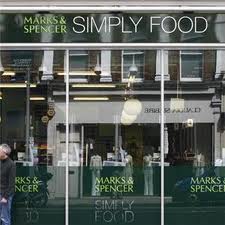
The new 12,400 sq ft Simply Food store, built from scratch on a former brownfield site, incorporates a host of sustainable design and construction features, including an LED screen giving real-time public transport information, electric car charging points and a green living wall to attract wildlife.
All the bricks used in the build have also been reclaimed from a local mill.
Marc Bolland said:
“We’re delighted to be opening M&S’ greenest-ever store, providing customers with top quality M&S food and drink products in such a convenient location.”
The store is “firmly on course” to achieve a BREEAM rating of Excellent, making it one of the most sustainable retail outlets in the UK.
Its carbon emissions will be 23% lower and energy usage 30% lower than a traditional similarly sized store.
Innovative features include:
- LED lighting, which is 25% more efficient than standard lighting, is used throughout the store, a first in the UK.
- Sun pipes bring natural lighting onto the shop floor;
- 100% of the timber used is FSC certified, a UK first;
- All the bricks have been reclaimed from an old local mill;
- Water costs will be reduced by up to 40%, compared with a traditional similarly sized store, by using harvested rainwater;
- Capturing heat expelled from the store’s refrigeration units to help heat the store;
- A living green roof of sedum plants and green living wall have created wildlife habitats, as well as insulating the store;
- Bird boxes have been placed around the perimeter wall of the site;
- In total, 62 different species of plants have been planted on or around the store;
- Polished concrete floors have removed the need for floor covering;
- 100% of the construction waste has been recycled.
All employees at the store have also been fully trained to understand its environmental features and will be encouraged to share this information with customers. (Source: The Food and Drink innovation Network)
Business Retail: a global view
Retail is big, but how big it is and is it equally distributed worldwide or are there countries where retail is at its best?
The last CB Richard Ellis Survey about the business of Retail, reveals how fluctuating this market is, measuring how the most important 323 retailers changed their strategies in 73 countries during the last year.
The survey findings are very interesting, showing us that Dubai is the most favorite city for both American (61%) and European (63%) retailers, while only 23% of retailers from the Asia-Pacific area are present in that city – not because of lack of interest, but just because the Asia-Pacific consumer market is the fastest growing, therefore retailers from those countries do not need to branch out abroad. 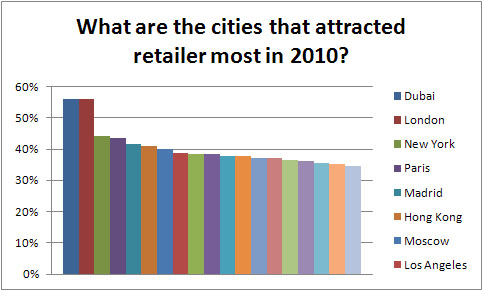
Retail expansion rate saw a decrease during 2010, only a 2%, compared with 4% in 2009 and 12% in 2008, with new target countries being India (8 new retailers) and Turkey (7). United Arab Emirates (UAE), Kuwait, Ireland, Romania, and Belgium all attracted six new retailers.
Online retail is becoming more and more important for retailers: 82% of the brands in the survey do have an online catalogue, even though only a smaller percentage (46%) offers to consumers the chance to purchase goods online, with Value&Denim being the most active (43%) followed by mid-range fashion (26%) and Luxury & Business Fashion (32%). To have an online retail shop is the favored choice by those brands who already have a physical store (46%), while in more advanced market such as the U.S.A., there is a slight percentage of online seller (24%) who do not have a physical store, and that are using online sales platform to test the market before opening a physical point of sale.
A greener wine for happier wine connaisseurs
Vinitaly 2011 ended with excellent results, an increase of 10% in visitors confirmed once again that good wine never goes out of fashion. Good wines, not only for the undisputed quality of the products, but also because of its being good for the environment and for the community. The bio wine, produced by following the precepts of organic agriculture, with no sulfur and, above all, free of chemical residues and pesticides, is not new thing on the market.
But what is innovative is that sustainability in the wine industry is becoming more and more popular and required by wine consumers. A recent WineNews / Vinitaly survey showed that “green” labelled wine, the one ensuring the environmental commitment of the winery, would be an added value for 55% of the interviewed. The survey results were collected in a sort of handbook of the sustainable wine drinking, whose must are: locally grown wine, organic and biodynamic viticulture, ISO 14001 or EMAS certified wineries, lighter bottles, recycled paper labels, use of recycled or recyclable packaging, low-impact in terms of carbon footprint of production.
There are several Italian producers who understand the importance of sustainability to adequately respond to consumer demands. Zonin for instance, is already eliminating herbicides, fertilizers and chemical treatments, using only those permitted by the organic or biodynamic agriculture. “Approaching a more sustainable production also requires us to use a more precise viticulture, an aspect that we can no longer overlook in the vineyards where we bring this new philosophy. A lot of attention is paid to the fertility of the soil which must not only be maintained but improved over time without the use of chemicals, “says Franco Giacosa, technical director of the Zonin company in Gambellara (Vicenza, Italy).
It is not a suprise to find the Zonin name amont the list of the 73 Italian companies participating to the Bayer CropScience Magis project for social and economic sustainability in the wine industry: from Caviro to Planeta, Barone Ricasoli and Castello Banfi, to name some of the companies appearing in the Magis list. The aim of the Magis project is to provide companies with a common objective and measurable parameters and elements of communication to meet the demands of industry and consumers in terms of sustainability.
Obviously, the added value of a wine produced accordingly to the Magis criteria, will be lost if the supply chain and bars, restaurants and hotels do not abide to the same sustainable and responsible criteria. And this is what the ECOFFEE project is working at!
The Coca Cola Company and the new PlantBottle® packaging: sustainability comes from sugarcane!
Beginning April 4, 2011 the first 100 percent recyclable beverage packages made with plants are readily available to people across the U.S. If you want to enjoy the fresh taste of DASANI, or a nourishing Odwalla beverage in a more environmentally responsible package made from plants, now you can. There’s no more waiting.
PlantBottle® packaging for both brands was developed with the planet in  mind by PlantBottle® Packaging Platform, The Coca Cola Company. Single-serve Odwalla packages are made from up to 100 percent plant-based materials with high-density polyethylene (HDPE) plastic. PET bottles for DASANI are made with up to 30 percent plant-based materials.
“It’s our goal to make traditional plastic bottles a thing of the past and ensure that every beverage we produce is available in 100 percent plant-based, fully recyclable packaging,” said Scott Vitters, General Manager, PlantBottle® Packaging Platform, The Coca-Cola Company. “The national launch of DASANI PlantBottle® packaging represents an important step toward reducing our carbon footprint, and the up to 100 percent plant-based, recyclable packaging used for Odwalla is the first of its kind in the beverage industry.”
Traditional PET bottles are made from petroleum and other nonrenewable fossil fuels. Incorporating a blend of petroleum-based materials with up to 30 percent plant-based materials allows PlantBottle® packaging for DASANI to reduce potential intrinsic carbon dioxide emissions when compared with PET plastic bottles
“DASANI is designed to make a difference by offering a better designed package for a more sustainable future,” said John Roddey, Vice President and General Manager, Water, Tea and Coffee, Coca-Cola North America. “Because DASANI PlantBottle® packaging is up to 30 percent made from plants and still 100 percent recyclable, it was designed with the planet in mind by helping to reduce the impact of our packaging on the environment.”
The plant-based materials for both DASANI and Odwalla PlantBottle® packaging are produced through a process that turns sugarcane into a key component for PET and HDPE plastic. Currently, PlantBottle® packaging is made using sugarcane ethanol from Brazil, the only source widely recognized globally for its unique environmental and social performance. Brazilian sugarcane is primarily rain fed and industrially grown on abundant, arable land using organic fertilizers. The plantations from which PlantBottle materials are sourced are located far away from Amazon rain forests, and their impact on biodiversity is reduced thanks to advanced farming practices and sound public policy.
Unlike other plant-based plastics, PlantBottle® packaging is entirely recyclable and can be processed through existing systems. This ensures PlantBottle® packaging can be repeatedly used, recycled and reused. In addition, there are no differences in shelf life, weight, composition or appearance between traditional PET plastic bottles and PlantBottle® plastic bottles.
In late 2009, PlantBottle® packaging was launched in the western U.S. and eight other markets around the world. To date, PlantBottle® packaging is estimated to have eliminated the equivalent of 30,000 metric tons of carbon dioxide, or three million gallons of gasoline used to produce PET plastic bottles. Currently, The Coca-Cola Company is working to further technology so other plant materials can be used in future PlantBottle® packaging. The ultimate long-term goal is to turn waste into a resource, resulting in a carbon neutral, 100 percent renewable, responsibly sourced bottle that is fully recyclable.
“Several approaches to a PET package made entirely from plants have been successfully demonstrated in laboratory testing. We’re working to advance this breakthrough science to ensure it is commercially viable,” said Vitters. “PlantBottle® packaging means only good things for everybody. We welcome others in the industry joining us in advancing the science behind packaging made from plants.”
The technology used to make PlantBottle® packaging already has been adopted by Heinz, which recently announced it will begin packaging its ketchup using that technology this summer under license from The Coca-Cola Company.
The rollout of PlantBottle® packaging for DASANI will be supported by a national television spot breaking in April. Additional executions will include enhanced packaging graphics, as well as out-of-home, print, digital and point-of sale-advertising to build awareness for PlantBottle® packaging. Odwalla’s marketing program includes coupons, print advertising, digital programs and new labeling Point-of-sale materials for in-store displays will feature attention-grabbing messages such as “Paper or Plastic? Try Plant!” (Source: Businesswire)
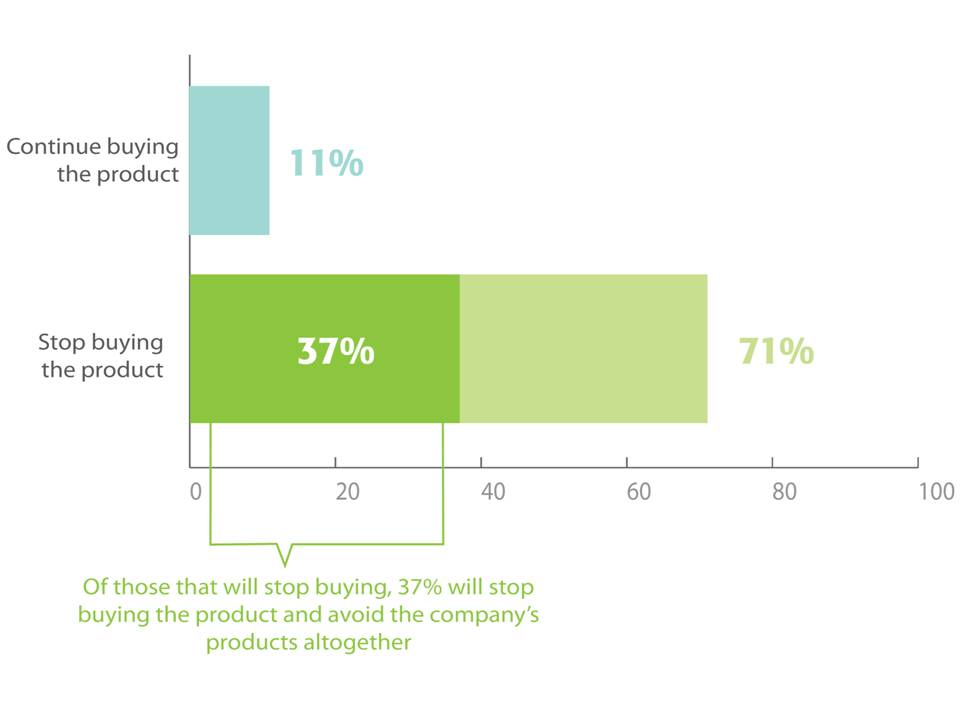
American consumers punish greenwashing practices, a survey says
“Nearly three-quarters of consumers (71%) will stop buying a product if they feel misled by environmental claims”
Two days ago an ECOFFEE prospect tried to convince us that sustainability is just a marketing word, and that consumers are not able to understand whether the retail product/store is really sustainable or it is just greenwashing.
We have already dealt with this kind of prospect – and many became enthousiast ECOFFEE customers and sustainability advocates. Data and market analysis are the only way to convince the sustainability skeptical about the counter effects of greenwashing practices.
That day, we showed to our prospect the Cone Inc. Trend Tracker recent analysis about U.S consumers and their behaviour towards greenwashing practices, dated March 24 2011.
Results are very interesting – and very motivating for those of us who believe in real sustainable business practices.
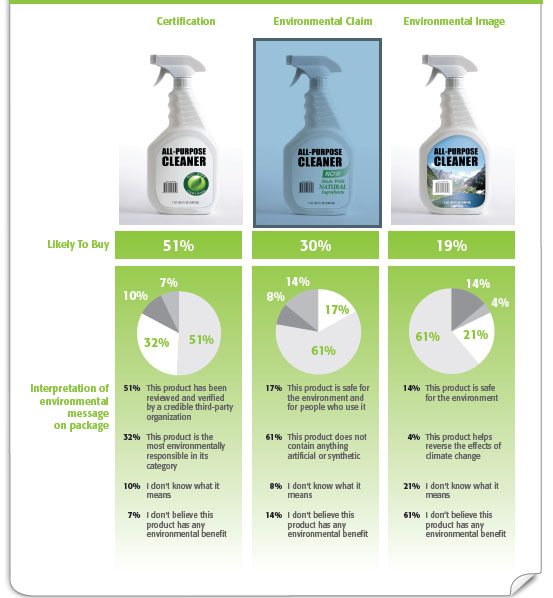
When consumers discover a claim to be misleading, they will take the following actions:
Three mock cleaning products were showed to consumers, who were asked to “purchase” the one they believed to be the most environmentally responsible. They were also required to indicate what they think the certification, claim or image on each package represents.
The results are as follow:
 Another very interesting survey finding concerns the inaccurate interpretation by U.S. consumers when it comes to words such as “green” and “environmental friendly”. More than two-in-five Americans (41%) erroneously believe these terms mean a product has a positive (i.e., beneficial) impact on the environment. Only 29 percent understand that these terms more accurately describe products with less environmental impact than previous versions or competing products.
Last but not least, 59% say it is only acceptable for marketers to use general environmental claims when they are backed up with additional detail and explanation:
-23% say vague environmental claims should never be used.
-79% want detailed information readily accessible on product packaging.
-75% wish companies would do a better job helping them understand the environmental terms they use.
It is not necessary to add other comments to the above survey results, but if you are interested to know more, you can download the whole survey linking to the Cone Inc. website.
China retail luxury: a long-term insight
China: a market that is continuously growing, a very rich but still unknown to the many. What is clear is that China is set to become the most powerful economy in the world, and this will happen in a very short time. Many are the companies that have already sucessfully entered the Chinese market, luxury good brands being the pioneers.
A McKinsey survey over 1.500 Chinese luxury consumers during spring 2010, shows interesting trends which are basically telling to the world that the “consumer culture” is changing at a very high speed, following the changes in the society and urban landscape. For those who are interested, the whole report can be downloaded here, but three are main facts:
- “Rapid increases in wealth, and shifting social mores that sanction the display of that wealth, are driving a growing infatuation for luxury goods among Chinese consumers.”
- “Access to an explosion of information on the Internet, an increasing penchant for overseas travel, and first-hand experience purchasing and consuming luxury goods are contributing to a substantial rise in sophistication among luxury consumers in China. Contrary to popular belief, a growing number of Chinese luxury consumers are exhibiting a noticeable trend away from overt displays of wealth, and towards more understated forms of luxury consumption.”
- “Rapid urbanization and growing wealth outside of China’s largest cities is driving the emergence of several new geographic markets with sizable pools of luxury goods consumers. Over the next 5 years, [McKinsey] expects that the number of such cities will double from 30 to 60.”
Other key findings are social-demographics related. Not only traditional luxury brands consumers, but also 13 million upper-middle-class households (earning $15,000 to $30,000), which are stretching their budgets to buy luxury watches, jewelry, handbags, shoes and clothing. This segment represented 12% of Chinese luxury consumption in 2010, but is expected to reach 22% by 2015.
The survey also shows that approximately 73% of luxury consumers in China are under age 45, significantly younger than their counterparts in western nations or even nearby Japan.
All these findings essentially reinforce the widespread idea that if this trend is going to be followed in 2011 too, China will become the biggest retal luxury market in the close future. (Source: McKinsey, Picture credits: TheChinaObserver)
Online retail: how to turn a negative consumer feedback into a positive one
Retailers who are going to open online shops often fear about negative feedbacks from online shoppers. “What if I receive a negative feedback? Should I ignore it or answer?” The most common retail behaviour is to ignore it, hoping it will be ignored by other consumers too. But this is a great misconception. 
Retailers have an opportunity to fight back and use social media to turn unhappy customers into brand advocates, says the Retail Consumer Report, commissioned by RightNow and conducted online by Harris Interactive in January 2011 among 1,605 online US adults. The report shows how retailers are using social media to win back customers and drive buying decisions.
- 68% of consumers who posted a complaint or negative review on a social networking or ratings/reviews site after a negative holiday shopping experience got a response from the retailer. Of those, 18% turned into loyal customers and bought more.
By listening and proactively responding on the social web, says the report, retailers have a chance to turn disgruntled customers into social advocates.
After a positive shopping experience, half of consumers cited great customer service and/or a previous positive experience as influencing their decision to buy from a specific online retailer.
Social advocacy can also help drive sales, the survey found:
- Nearly a third of consumers researched what customers said on social networking and reviews websites while shopping online.
For those consumers that had a positive holiday shopping experience with an online retailer during the past holiday shopping season:
- 21% recommended the retailer to friends.
- 13% posted a positive online review about the retailer.
The survey found that 38% of consumers turned to the retailer’s website for information or support with online shopping. However, one of the top frustrations consumers had when shopping online was a lack of consistent information from retailers. Specifically, 22% of consumers were frustrated by information that was inconsistent between the retailer’s website and customer service agents.
For further research on how customer experiences impact the bottom line, including the fact that 85% of consumers said they would be willing to pay anywhere between 5-25% over the standard price to ensure a superior customer experience, RightNow makes the Customer Experience Impact Report 2010 available to download. (Source: MediaPost)
 normancescut.com