Category Archives: retail fashion

Biometrics and retail marketing: the future is now

Biometrics, methods for uniquely recognizing humans based upon one or more intrinsic physical or behavioural traits, is very important when evaluating the efficacy of a retail store design or display and assessing counter actions to make the retail environment more customer friendly. According to NY Times, IBM is currently testing a revolutionary biometrics method in two location in downtown Milan – a fashion company flagship’s store and an electronic store. Biometrics the future of retail marketing
The I.B.M. solution, involves tracking biometrics through a mini camera in a mannequin’s eye or placed somewhere in a store and the collected data will be aggregated so that not to be traced to any individual.

“We started with fashion because it is a creative and innovative industry, but it’s clear that people have to be educated so they know their privacy will not be compromised,” said Enrico Bozzi, the manager of I.B.M. Forum Milano, the department that developed the technology. “It is a question of changing people’s perception.”

 The IBM biometric test is already showing its first results. At the pilot in the Milan fashion store, for example, the client noticed that almost all Asian customers enter the store through one particular door, even though five are available. “We thought it was a mistake, but we checked it out and it was right and it continues to happen,” Mr. Bozzi said. “We don’t know why yet but, in the meantime, the store is considering positioning products by that door that are known to appeal particularly to Asian shoppers.”

I.B.M.is now also working on software that will let clients try on jewelry and makeup wirelessly thanks to a mobile phone or computer, with an iPad application likely to debut soon.

Innovative communication or design innovation: eyewear

Italy is famous for its eyewear giants, Luxottica first. If you have ever visited an eyewear retail store in Italy, you would have noticed that more or less they all look the same: neon lights, mirrors, traditional displays, sales people wearing a white coat.
Today we would like to show you two very different approach to this kind of point of sale: Salmoiraghi & Viganò at Piazza San Babila, Milan and Kirk Originals in London.

The first looks like a “traditional Italian” eyewear store, we might say the “deluxe” version of it but from the design point of view, nothing extremely different from the typical layout, displays included. What is “unusual” in this point of sales is the concept and the services offered: a very fast service for those who need new spectacles, culture, events and corners managed by several fashion brands.

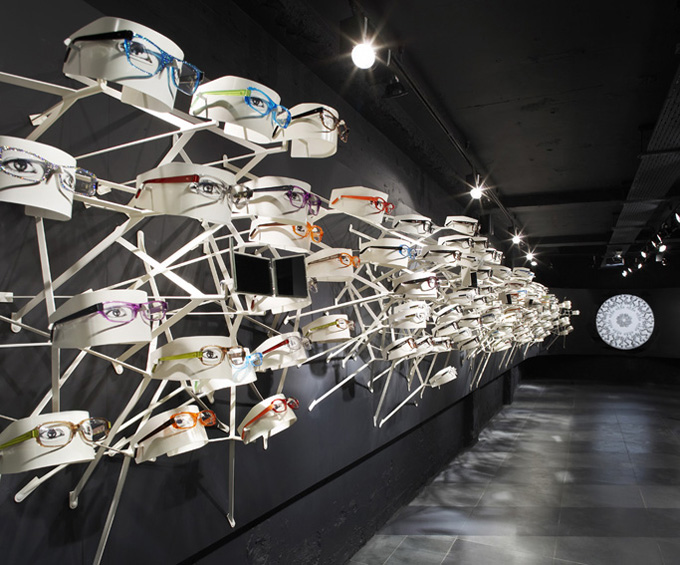
Kirk Originals flagship store, on the opposite, looks very unusual, and the only one eyewear wall with 187 “heads” for frames, and practically no furnishings ensure that customers will focus on the eyewear, not the trappings. Eye examinations and fitting take place in the basement, away from the main display space.

Two different, opposite concepts for the same product. Which one do you think will sell most? (Photo: courtesy of Salmoiraghi&Viganò, Luca Oliverio and TheCoolHunter).

Benetton keeps getting greener

Six hundred fewer tons of plastic in the environment in 2011:  this is the green result that Benetton Group will achieve by introducing innovative, lightweight liquid wood clothes hangers – 100% biodegradable and recyclable – in place of the plastic hangers usually used to display garments. The eco-hangers, developed in partnership with the Fraunhofer-Institut für Chemische Technologie in Pfinztal-Berghausen (Germany), will gradually replace their plastic predecessors throughout the worldwide network of Benetton stores.

The liquid wood hangers are just part of a far broader eco-sustainable business plan launched by Benetton in a context of attention to social issues – and environmental respect in particular – always an important aspect of our corporate identity. Benetton’s green journey includes two other tangible environmental sustainability programmes, involving organic cotton garments and eco-friendly paper shopping bags.

In the Benetton children’s collections, organic cotton already accounts for over 30% of all cotton apparel, and with the spring-summer 2011 collection, organic cotton garments will reach a total of 13 million across the Group’s various brands. These products are all certified according to the GOTS (Global Organic Textile Standard) ethical and environmental criteria, a worldwide benchmark that guarantees adherence to key organic standards in fibre production.

The GOTS standard focuses on ethical and environmental sustainability (ensuring that products are GMO-free and come from low-impact farming). Benetton performs a constant cycle of controls to ensure that the CaMV 35S promoter, indicative of the presence of GMO cottons, is not found within the fibres.

Furthermore, since January 2010, customers buying from United Colors of Benetton stores have been taking their purchases home in a craft-white eco-friendly paper shopping bag, processed using water-based inks only, and sourced from an FSC certified paper factory, ensuring products are made using timber from forests that are controlled and managed according to the principles of social and environmental sustainability. (Benetton Group Official Press Release)

GoodGuide for Good Products for a more sustainable Retail

Yesterday I was reading a post concerning Levi Strauss & Co as the Top Jeans Brand, scoring a 7.4. The brand Prana was listed as the next highest, with a score of 6.3—followed by H&M (6.1), Banana Republic (6.1), and Old Navy (6.1).

I did not know what GoodGuide is – shame on me – so I checked out their very interesting website, which is said to be the world’s largest and most reliable source of information on the health, environmental and social impacts of consumer products. And I think it really is, rating over 95000 products, mainly available on the US market only: from food, toys, personal care to apparel, electronics and appliances. What is really striking is the scientific approach they have on their ratings, which are compiled from three sub-scores addressing Health, Environment and Society.


 Each of these sub-scores are based on an analysis of a set of indicators that GoodGuide has determined are the best-available measures of performance in these areas. Their methodology differs from the product belonging to different categories, each and every one having its own scoring methodology. Amazing. Let’s talk about apparel for example.

Quoting the Good Guide site: “Until (apparel) companies do a better job of providing transparency into their supply chain, our ability to accurately score brands based on their relative performance will be subject to significant uncertainties Environment scores are assigned to apparel brands by combining GoodGuide’s standard company indicators of environmental performance (weighted at 50%) with brand-level environmental indicators that address issues that are specific to the apparel sector (weighted at 50%).(….) Social scores are assigned to apparel brands by combining GoodGuide’s standard company indicators of social performance (50%) with brand-level social indicators that address issues that are specific to the apparel sector (weighted at 50%).(…) Health scores are not assigned to apparel brands because this product category does not generally pose health risks to consumers.”

The Good Guide website is also very good at using the Web 2.0 tools to “spread the word” and improve the accuracy of the product information thanks to a “support product info” page which enables visitors to add further details.

It would be also very interesting to test the effect of this kind of structured and scientific information directly at the point-of-sale, to see how the consumer react when discovering that his/her favourite brand of pasta is not that “good”. Because thanks to GoodGuide mobile App this is possible: consumers can scan the product, check the GoodGuide database and then purchase, or decide to choose another brand.

With this detailed level of “scientific” information, producers and retailers have nothing to hide and their achieving a high/low score can have a boomerang effect on brand reputation which must not be ignored and will not be ignored by consumers. Sustainability pays, and it will pay even more in the future.

Two social media tools for retailers: local buzzing with enterprise control.

We often talk about social media, buzz marketing and online reputation. Big corporations can find it quite difficult to control and “direct” all the related online communication, especially when this is done at local level – agents, retailers, franchises. But now there are platforms that can help corporations achieve great results with just a couple of clicks.

Yesterday I stumbled upon an interesting Tweet by Mashable, regarding a new startup, Hearsay, whose product – Hearsay Social- is a social media management platform, that gives companies with a national presence and local agents or franchises the ability to manage all of their social media in one place. Hearsay calls organizations that fit this mold “corporate/local.” Hersay Social is a web-based software that a corporation and its local branches can use to coordinate their social media efforts. The dashboard gives local agents or franchises the ability to manage their own local Twitter, Facebook and LinkedIn accounts. It also also gives corporations the ability to monitor local engagement. Not only can they access detailed analytics for all of their agents, they can also catch when they step out of line. Hearsay clients list includes State Farms whose case study is availaible online.  Here’s an interesting video about the product features.

Another software that can help companies achieve the same result: Expion. Expion provides Social Media Management Software that enables large Enterprises to publish and aggregate social media conversations that can scale to hundreds of local based Facebook pages, Twitter accounts, and YouTube channels, etc. This software allows maximum employee social reach within a company’s defined social guardrails, allows for employees across all your locations or departments to deliver coordinated and consistent brand appropriate messaging. At the same time Expion’s unified database aggregates and tracks all employee and customer social interactions. This centralized intelligence will profile customers, identify advocates and critics, track behaviors and create best employee practices, while measuring effectiveness of messaging for continued optimization. Expion is already used by Coldwell Banker Advantage, Applebees’s Restaurants and Mark’s among the many

Green Marketing 3.0: what is it about?

Marketing, as you all know, is what enables product to be seen and purchased by consumers. For those who are in the retail business, marketing is a science to master in order to reach success and profit – I add: for more than a year!

Something I always read to those retailers that are entering the world of “green”, is a very interesting article about Green Marketing written by Jeff Dubin a couple of months ago. For those who are interested in reading the full version, you can find it at Jacquie Ottman’s Greenmarketing.com blog. Here a few key sentences by Jacquie: “To really succeed on a wide scale in America, green products either need to establish their superiority on conventional, non-green product features such as effectiveness or price, or make green more relevant to people’s everyday lives….

If green marketers can build the case for how their products are healthier for baby and Mommy and Daddy and Grandma and.., then the greenness of a product becomes a primary benefit rather than a secondary one and the higher hanging fruit now becomes more attainable. That’s Green Marketing 3.0.”

I do agree with that, and you?

Does sustainability pays? Yes

Whenever I talk with a client about sustainability, a question arises “Does sustainability pay?”. The answer is with no doubt YES! There are researches available online showing that when customers are offered a choice, they do prefer eco-friendly products and “punish” not so sustainable brands asking a much lower price. Obviously, what companies willing to invest in sustainability must understand is that a sustainable strategy goes hand in hand with a communication strategy – otherwise consumers will not perceive the added value during the purchasing process.

A recent survey conducted by the Uk consumer organisation “Which?” showed that between 74% and 96% of the people surveyed were unaware of the big names behind 10 popular ethical brands. And, once they found out, of those whose opinion changed, more had a negative reaction than a positive one. “Consumers are being misled,” said one respondent while another commented: “I feel conned.” One reason behind this negative reaction is that interviewed were worried about large companies being more concerned with profits than ethics.

What manufacturers must really understand is that consumers are willing to buy sustainable products but at the same time are going to punish any non-ethical behaviour by asking for a very reduced price. The future of retail and of sustainability lies in the ability of producers to understand this and to act accordingly.

Fashion Retail: is Green cool? A IUM research insight

A new research carried out at IUM shows that “green fashion” is more appealing to North Americans than to Europeans. This is largely due to North Americans’ perception that green fashion consumers are young, trendy and self-confident and not unsophisticated, as Europeans see these same consumers.Gear Patrol: green fashion is not just a colour

Researchers found that environmental protection, health impact and ethical concerns most motivate consumers to purchase green fashion although the interest is merely moderate.
 
“Although consumers are ready to pay a premium to purchase organic food, they do not yet see the interest in organic fashion,” said Sandrine Ricard, Vice-President of IUM and part of the research team. “There is a need to better inform consumers about the nature of organic fashion and to continue ‘glamorizing’ both the communication and the products.”
 
Researchers found that North Americans perceive green fashion more favorably, in part because eco-clothing brands have been launched by celebrities, such as the brand, Edun, run by Bono and his wife. North Americans associate green fashion with a woman in her 20’s, simple but sexy, who wears organic shoes and clothing.
 
On the other hand, European respondents perceive organic fashion consumers as unglamorous. A typical consumer would be a simple woman in her 40’s, wealthy, having a healthy lifestyle but unsophisticated. Because organic products are more expensive, Europeans associate organic with social status and showing-off.
 
The research team also concluded that the concept of green fashion is not clear to the majority of respondents. Consumers seem lost in the exact meaning of green fashion and lack information on norms and processes. In Europe, green fashion must become more attractive to the young generation to be a viable consumer option. (Image courtesy of  Gear Patrol blog)

Zara 5000th store in Rome leads the way to a sustainable retail

Showing off its real aim to embrace the latest eco-trends from top to bottom, from heart to head, Inditex has just opened its 5000th Inditex store as the flagship of its 2011-2015 Sustainable Inditex Plan. Inditex new global benchmark in eco- efficiency is housed in the Palazzo Bocconi, a building whose history dates back more than 120 years.

Just some figures: this is a store which consumes 30% less energy with regard to the annual average consumption of a conventional store, saves 50% of water consumption and avoids the emission of over 150 toms of CO2 per year.

If the Inditex’s Strategic Environmental Plan 2007-2010 achieved various certifications in 3 of its stores including a first of its kind in Europe with Zara Barcelona being awarded LEED (Leadership in Energy and Environmental Design) certification, the new Zara, located at exclusive Via del Corso , reflects the 2011-2015 Sustainable Inditex Plan announced at the company’s most recent Annual General Meeting by the Group’s Deputy Chairman and CEO, Pablo Isla.

Isla set a strategic target of 2020 for all Inditex Group establishments to meet these criteria, which
are guiding the launch of the company’s newly-created locations. “Environmental issues are a key component of Inditex’s global strategy”, said Isla. “This project marks a turning point in how we think of retail space”.

The sustainability and energy efficiency measures established at Zara in Portal de l’Àngel 11-13 in Barcelona, are to be replied in every new store opened by Inditex worldwide and under every single one of the brands gathered in the group (Pull&Bear, Massimo Dutti, Stradivarius, Zara, Zara Home and Oysho) structured around the requirements set down in each one of the categories of the LEED certification system and contemplate actions regarding materials, installations and control systems
and processes.

This new concept of boutique hides behind a façade that makes use of three key elements: shop windows and geometric composition with big metal and glass squares, and a large-format logo. The new-look shop interior comprises an extensive range of grey tones which contrast with its black furnishings. The sales area is spread over five storeys. The company has indicated that the eco-friendly boutique would not have been possible without the previous experience acquired by Inditex’s team at the Zara Korai store in the Greek capital Athens, the group’s first eco-efficient store, which opened in December 2008.

Highlights of features contributing to the store’s eco-efficiency include automatic monitoring of the store’s indoor air quality (CO2 levels, humidity, light intensity, noise), to ensure the comfort of employees and shoppers; motion detectors to turn lights on and off in low-traffic areas and a an air curtain system at entrance doors, equipped with special sensors that continuously monitor outside temperatures to prevent abrupt indoor air temperature changes, thereby reducing the need to run heating/cooling systems. Besides and in order to lessen the nocturnal light pollution which plagues cities, the establishment’s lights are programmed to dim by more than 50% when the shop is closed. The interior makes generous use of LED lamps, which offer a much longer lifespan than that of conventional bulbs.

But Zara is not the only spoilt child within the group in terms of state of the art design and efficiency. In mid November, Pull & Bear launched its flagship store in Madrid, Spain, in terms of both its prominent location, and the eco-efficient efforts made by the format. With this store, Pull & Bear has the opportunity to become LEED certified, a certification which recognizes the environmental commitment of the company in the design of its points of sale. LEED is a US green building certification system and one of the most demanding in the market.