Category Archives: retail

Retailers, get ready for tablet computer shopping revolution!

Shopping search engine Shopzilla recently published a research showing that the “tablet revolution”, as online shopping via iPads and similar tablet devices is set to climb high in popularity, just as it has done in the US.
 
The research reveals that although the iPad was only launched 12 months ago, 6% of European shoppers already own a tablet and a further 20% are considering buying a device in the next year. The majority of owners said it was as easy to use for online purchases as a personal computer.
 
This trend is set to mirror the US where the iPad is driving a revolution in e-commerce.  A recent US Shopzilla study showed that 12% of consumers now have a tablet device, and a further quarter plan to buy one in the next year. In the European survey, an overwhelming 5-to-1 ratio name the iPad as their tablet of choice.

The Shopzilla research was conducted in Europe’s three largest online retail markets: the UK, France and Germany.  It also revealed that almost 80% of current tablet owners view their device as an addition to their technology arsenal rather than as a replacement for an existing device.
 
The research by Shopzilla of almost 5,000 online shoppers, also revealed:
 
– Nearly two thirds (61%) of iPad or tablet users said it was as easy to shop online with their hand-held device as it was with their personal computer;
– The majority, 71%, had bought or would buy online using their device;
– Dual-screen technology meant 70% of tablet users even watch TV while browsing shopping sites simultaneously, which is really interesting from a cross-platform marketing point of view;
– 53% of iPad or tablet users surveyed used their device to browse shopping sites and share shopping experiences with friends, showing that social shopping has extented its power in real life too;
– 27% of online shoppers currently used a smartphone to browse shopping sites with friends

Rachel Smith, business services senior director at Shopzilla, said:
“Since their launch in April last year, an astonishing 25 million iPads have been sold worldwide, and with one in five online shoppers telling us they plan to buy a tablet in the next 12 months, this is clearly set to be a huge trend for UK  shoppers.”
 
Smith added: “The year of mobile commerce, which has been predicted for some time, is finally here. With the explosion of the tablet market we are seeing a seismic change, and the opportunity will be for the retailers who are first to get it right.” (Source: The Retail Bulletin, image courtesy of The Belton Group)


A new shop concept by DESITA and …ECOFFEE

I am glad to announce that DESITA is planning a shop concept for the new image of the Saadeddin pastry shops chain located in many states and cities of the Arabian peninsula, whose first restyling project has been planned for one of its Riyadh branches.

After having spent a couple of months briefing with the client in Italy and in Saudi Arabia and after having visited the shop location in Riyadh, we are now defining its layout following the client wishes and our already confirmed inputs about the sale process. The chain’s new brand image will be a young, fresh, trendy and European one.

The pastry shop project will be developed over an area of about 350 square meters and will include an innovative sale formula, for the Saudi habits, which we are sure will generate great interest and attention not limited to the Arab area only.

Thanks also to our fortnightly experience in the foodservice business, to our knowledge of the Arab culture and customer behavior and to the unlimited trust from our Client, we will merge the local traditions and habits into a new shop concept, designing innovative interiors and also a new way to intend the coffee shop area along the “single” (reserved to men only) and the “family” rooms areas.

It is in fact required in Saudi Arabia that food shops with catering facilities have specifically reserved entrances, men-only sitting rooms and other ones for women and families.

Furthermore, in agreement with the client, the concept is going to be developed following, where possible, the ECOFFEE guidelines as per the use of materials, equipment, products and sustainable solutions.

This important client has been collaborating with us for many years and his trust has always been rewarded allowing his company to be a trendsetter one in his area of business. His willingness to embrace sustainability in this new sales formula will grant him a sure competitive advantage. It is a honor for us to collaborate with such of farsighted and open minded client.

The combination of the new business formula and of the ECOFFEE guidelines applied to this first pastry shop will be next used in all the other chain branches, so that to make it a point of reference for the sustainability trend in a geographical area more and more sensitive to this issue.

Whole Foods, Trade Joe’s and Apple ranked in the U.S. top 10

Trader Joe’s took the No. 5 slot with Apple coming in at No. 9. Other top 10 brands were Tom’s of Maine, Burt’s Bees, The Walt Disney Company, S.C. Johnson, Dove and Starbucks and Microsoft, which tied for No. 10. Consumers said that what makes a green brand is its commitment to green products, corporate actions and values. Other top attributes of green companies is the offer good value, are responsible and reliable, are trustworthy and care about their customers.

“When we analyzed the approach of the top ten brands companies, using our Esty Environmental Scorecard, it was clear that the winners achieve a product-value-information trifecta,” said Amy Longsworth, partner at Esty Environmental Partners. “The top brands offer clear price value through co-benefits: a great innovative product that meets my functional needs plus green attributes that meet my values needs. These companies also tend to have robust life-cycle insight and complete sustainability strategies across their value chains, which enable them to draw from rich experience and data for their consumer communications.”

The seventh annual Green Brands study polled more than 9,000 people in eight and was conducted by WPP agencies Cohn & Wolfe, Landor Associates and Penn Schoen Berland Associates, as well as independent sustainability strategy consulting firm Esty Environmental Partners.

The study also found that consumers’ appetite for green products has increased significantly over the past year, with special interest around environmental products in the auto, energy and technology sectors.

When it comes to current usage of green products or services, the 2011 study reveals that the household products and grocery categories have the highest consumer adoption rates in all countries except China, where packaged goods/beverages and personal care are the most used categories.

“We’re seeing a shift in the ‘In Me, On Me, Around Me’ mentality when it comes to purchasing green products,” said Russ Meyer, Chief Strategy Officer of Landor Associates. “Consumers have a good understanding of how green choices in personal care, food and household products directly affect their families, and they are now seeing benefits like costs savings that attract them to higher cost items like cars and technology.” (Source: GreenRetail decisions)

A comparative analysis about Multichannel Retail in US and UK

Last month Econsultancy surveyed 2,000 consumers in the UK and 2,000 consumers in the US, to unearth attitudes to multichannel shopping and service.

The majority of consumers would find it useful to have a choice of retail channels, and a significant 33.5% felt this was very important. The results were very similar for both US and UK respondents, so the charts show aggregated data.

How important is it to be able to purchase from a retailer using different channels?

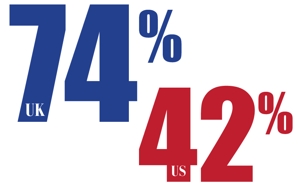
Quite a difference between US and UK consumers, with the latter far more likely to reserve items for in-store collection. Many of the biggest multichannel retailers in the UK are offering this service, (Argos, John Lewis, Halfords etc) with some success. For example, Argos’ multichannel sales grew to £1.9bn in the year up to February 26 2011, representing almost half (46%) of its total sales. The reserve and collect iPhone app accounted for 1% of total sales.

Do you reserve products online before collecting them from an offline store?

The use of mobile when shopping offline represents a growing challenge for retailers, as these stats show.

Use of Mobile Websites

US consumers are slightly more likely to use barcode scanners and compare prices via mobile, but a significant minority of US and UK respondents are using mobile as an offline shopping aid. Multichannel returns The vast majority of both US and UK respondents expect to be able to return items bought online to a local store.

However, as Snow Valley’s recent Online Returns Report found, just half of the multichannel retailers studied allow customers to do this. 

If you buy something online, do you expect to be able to return it to a local store?

Use of catalogues Percentage of customers that have used catalogues at least once in the past year before buying online or in store – aggregated US and UK results. (Source: Econsultancy)

A more sustainable coffee begins with a more sustainable water use

Coffee is one of the world’s most valuable commodities, and global annual sales reach up to $70bn (£43bn). The small green bean that has its origins in Ethiopia has long been the brew of choice throughout Europe. Across the pond, office workers clutching towering cups of coffee are a routine morning sight throughout the US.

Even in places known for their tea culture, coffee has transformed social life. Coffee requires only two ingredients – ground roasted coffee beans and water – but in the coming years, the latter ingredient will vex companies that source and market the product.

Coffee is both a labour – and resource-intensive crop to grow. The Dutch NGO Water Footprint Network estimates that a standard European cup of coffee or espresso (125 ml) requires 140 litres of water – which is to say that one part of coffee consumes 1100 parts of water. Meanwhile, droughts in Brazil and Colombia, two of the world’s largest coffee producers, could spark price increases that, in the short term, may contribute to profits, but in the long term will force companies to develop programmes that ensure water conservation throughout their supply chains and especially at the source: farms.

Much of coffee’s water footprint results from the beans’ cultivation. To that end, NGOs such as Rainforest Alliance and Fair Trade USA engage farmers across the globe to work together on reforestation projects. While “shade grown” coffee makes for fancy labelling, Rainforest Alliance’s work both preserves the watersheds that provide drinking water while preventing erosion. These programmes provide farmers modest financial returns that encourage them to plant more trees – and reverse the deforestation that resulted in part from the expansion of massive coffee plantations. Companies, like Kraft Foods, with its brands of coffee that includes Kenco, Gevalia, and Maxwell House, have promised to source more sustainable coffee certified by Rainforest Alliance and other third-party certification groups.

Companies that rely on coffee sales to boost their bottom line have responded in kind by becoming engaged at the source. Nestlé UK, for example, funds responsible farming practices in Ethiopia. Coffee farmers in the village of Hama, 310 miles south of Addis Ababa, for years struggled financially and faced declining yields even though the quality of their coffee beans was high. A Nestlé team realised one issue was a wasteful process that separated coffee beans from their pulp. The pulp was a potentially valuable source of compost for the farmers, but instead the farmers discharged it into the local river – where the pulp became a toxin that polluted local water supplies. A pulping machine from South America separated the lucrative bean from the pulp and provided farmers a source of compost, while slashing the ratio of litres of water to kilogram of coffee from 60-1 to 3-1.

Meanwhile, the global giant coffee retailer Starbucks has focused on its water performance within its stores. Three years ago the Seattle-based chain committed to a 25% reduction in water use throughout its stores by 2015. So far the company has reported a decrease in stores’ water consumption by 22%. Much of that decrease has resulted from discontinuing the use of dipper wells, fixtures that constantly stream water to clean utensils and eliminate food residues. That move alone cut Starbucks’ water consumption by about 100 gallons (378 litres) of water per day, per store.

Despite Starbucks’ success, however, companies must work on more efficient coffee sourcing processes throughout their supply chains. Pilot projects like those of Nestlé’s and of Rainforest Alliance’s are templates from which companies can learn if they want their future coffee businesses to not only be sustainable and profitable, but also survive as the global demand for water surges. (Source:Leon Kaye/GuardianUK – Image by © Royalty-Free/Corbis)

How to engage consumers?

Dealing with customer engagement has never been easy – especially today when customers are all inter-connected and receive all kind of information from all kind of media. This is why the rules that apply to old media such as TV and press can not work with nowadays  consumers.

CDJ by McKinsey

McKinsey devised a model, the Consumer Decision Journey (CDJ), whose simple four steps can be applied to companies belonging to different fields, retail too. Its implementation is not easy but as stressed by McKinsey, rewards can be worth the effort.

But let’s get into the four CDJ steps a little deeper, quoting the McKinsey study which can be fully downloaded on their website.

“Align: Invest marketing resources where consumers spend their time. In most cases, this will involve shifting resources from the “consider” and “buy” stages of the CDJ to the “evaluate” and “advocate” stages. Many companies will also have to shift their investments from paid media (channels owned by other companies, such as print or online newspapers) to self-owned media (such as the brand’s Web sites) and earned media (customer-created channels, such as communities of brand enthusiasts).

Link: Make sure that your messages reinforce each another. Given the proliferation of channels, this can be challenging and many companies have been disconcerted to discover that information about their products— including model numbers, descriptions, images, and promotions—isn’t the same across online channels and even within their stores. Coordinating your message might require new techniques. Apple, for example, took steps to eliminate jargon, align product descriptions, create a rich library of explanatory videos, and institute off-line Genius Bars to ensure consistency, accuracy, and integration across touchpoints.

Lock: Keeping your customers’ attention is key. To do so, companies need to develop direct, opt-in channels, such as e-mail promotions, Twitter and Facebook feeds, and apps. One good example comes from Nike, which progressed from simply exhorting consumers to “just do it” to helping them act on its motto. Nike+ gear records and transmits customer workout data, holds global fund-raising races, and provides customized online training programs. For its part, McDonald’s has enticed millions of Japan’s mobile-savvy consumers to sign up for mobile alerts with discount coupons, contest opportunities, special-event invitations, and other brand-specific content.

Loop: Mine content created by consumers and experts for insights into customers and the brand, and use data collected about customers to create content that will engage them. Consumer-generated content is particularly valuable because it reveals their wants and needs. A classic example comes from Amazon, which allows customers to rate products, and makes these ratings available to shoppers. Amazon doesn’t stop there, though; it also uses this data to decide how it presents its products. This creates an information-rich loop—from data to content and back to data—that strengthens Amazon’s value chain and contributes to product development and customer support. Data loops can also help companies personalize communications, thus deepening the customer relationship.”


Tailoring local retailing is the trend

The UK retail industry has been on the receiving end of a lot of criticism over recent years, particularly with regard to the role it has played in homogenising Britain’s high streets and creating a nation of so-called ‘identikit’ towns.

However, Marks & Spencer chief executive Marc Bolland announced last month that the retailer was on a mission to redesign its stores to suit local preferences, based on factors such as affluence, demographics, local competition as well as regional and ethnic differences, rather than on store size.

Tailoring ranges for local demographics is, of course, nothing new, particularly within grocery. Asda, for example, redesigned its Hounslow store in 2009 to better cater for the 70% of shoppers there who were of Asian, Mediterranean, Polish or Afro-Caribbean descent. More retailers are similarly starting to realise that catering for local tastes is critical for success.

James Daunt, incoming managing director of Waterstone’s, appointed after new owner Alexander Mamut bought the chain from HMV Group last month, has implied that the bookseller’s 300-strong chain will be adopting a tailored approach to retail, with ‘bookshops that mirror the tastes of customers as closely as possible’.

Ian Thurman, vice-president of location at data consultancy CACI, which has recently completed a store-segmentation project for footwear brand Clarks, says retailers are putting a bigger focus on locality – and not just in terms of the differences between big cities and the provinces.

‘The demographic differences between a Middlesbrough and a Guildford have become wider over the past few years, even for a retailer such as M&S,’ he says.

In its drive to better appeal to local preferences, M&S will use data from an array of sources, such as attitudinal insights gleaned from focus groups and information from online purchases, all of which will paint a much more detailed picture of who is buying what and where.

Bolland says work on segmentation has already been completed. ‘All stores have been grouped into clusters using several criteria including affluence and age,’ he said when M&S revealed its results last month. ‘In the autumn, we will begin to catalogue pilot stores according to one of these segments.’

Thurman says he is surprised that M&S did not adopt a segmentation approach years ago. Daunt, who joins Waterstone’s next month, is equally adamant that all retailers must prioritise the issue.

‘The best have done it,’ he says. ‘The degree to which they do so is dependent upon what they sell. Starbucks, with 50 products, can differentiate only so much; a supermarket with 20,000 lines much more; a bookshop that can draw from a million titles lies at the extreme end of this scale.’

Nonetheless, the fact that many retailers, including less salubrious ones, have made inroads into segmentation begs the question: why has it taken until now for M&S to adopt a store-segmentation approach?

A spokeswoman for the retailer says it is a case of evolution. ‘Over the past five to six years, we have a made a lot of progress in terms of the logistics of our stores,’ she says, referring to redesigned stores, new structures and layouts.

‘The new chief executive presented his business strategy in November. A big part of that focus is on UK operations, to look at stores and inject further inspiration into them. We’re not looking at ceilings and floors again, we’re looking at the way stores are shopped by customers.’

Beware bespoke

While creating tailored ranges for every store would appear to be the goal for retailers, Tim Greenhalgh, chief creative officer at retail consultancy Fitch, warns that ‘going local’ is not right for every brand.

‘Consumers don’t want everything to be local,’ he says. ‘People get quite excited about what the likes of Zara or Urban Outfitters have coming into their stores. The local thing does work particularly well when you touch people’s everyday lives.’

Mark Dickens, retail innovations consultant at customer communications specialist Wanda Communications, says that consumers should not expect to notice dramatic differences at their local M&S.

‘You might see changes, but they will be subtle,’ he says. ‘The trick is to ensure customers don’t notice. Put simply, customers aren’t interested in brand – they’re interested in buying stuff.’

And customers buying more stuff is what Bolland hopes will be the result of his strategy. If it is, and more retailers follow suit, could such moves reinvigorate the ailing high street?

‘Yes,’ says Daunt. ‘Nothing is more dull than the identikit parade of multiple retailers. Localism within these same retailers would reintroduce the sense of discovery that a diverse high street offers.’ (Source: Ben Bold for Marketingmagazine.co.uk)

Groceries stores getting greener with roof hydroponic gardens

This great idea comes directly from the United States – and it is the best way for selling REAL locally grown products in grocery stores.


It’s in fact no secret that most produce purchased in grocery stores is far from “green,” grown in far away states and countries and transported hundreds, even thousands of miles, adding costs and carbon footprint along the way.

A New York City start-up called BrightFarms hopes to changes all that, one grocery store rooftop at a time. The company plans to design, build, finance and operate hydroponic greenhouse farms on supermarket rooftops, eliminating time, distance and cost from the food supply chain.

“It’s better food, better for the environment and better for business,” CEO Paul Lightfoot told Greener Design during a recent interview. “The idea of growing veggies on the roof of a supermarket struck me as cute, but what I wanted to know was whether it could become a real business, with scale. One of my reservations about local food is that small farms (and most farms near cities are small) can’t compete on price with big ones. So food at many farmer’s markets tends to be a pleasant indulgence for those of us who can afford it.”

 The business premise is that BrightFarms can deliver better, fresher, more nutritious produce. Secondarily, Lightfoot said, it is better for the environment. The hydroponic greenhouses (which uses only water and nutrients, no soil) would focus on high-volume vegetables such as lettuces, tomatoes, herbs, cucumbers and peppers, typically at a cheaper cost.

“In some instances, we’re actually selling for less,” Lightfoot said. “We can pretty much match the market’s wholesale tomato costs. We can beat the market’s loose leaf lettuce costs.”

Although he would not reveal which grocers BrightFarms is currently speaking to about installing the rooftop greenhouses, Lightfoot said seven large retailers have signed letters of intent, noting that he expects a few of them to be built before the end of the year.

BrightFarms grew out of New York Sun Works (WYSW), a non-profit organization set up in 2006 by environmental engineer and urban farming visionary Dr. Ted Caplow. Its mission was to design and promote ecologically responsible systems for the production of energy, water and food in the urban environment. In 2007 NYSW launched the renowned Science Barge, prototype urban farm.

Last month, BrightFarms announced the completion of another round of financing through private investors, however it did not disclose the amount of money raised. (Source: GreenRetailDecisions)

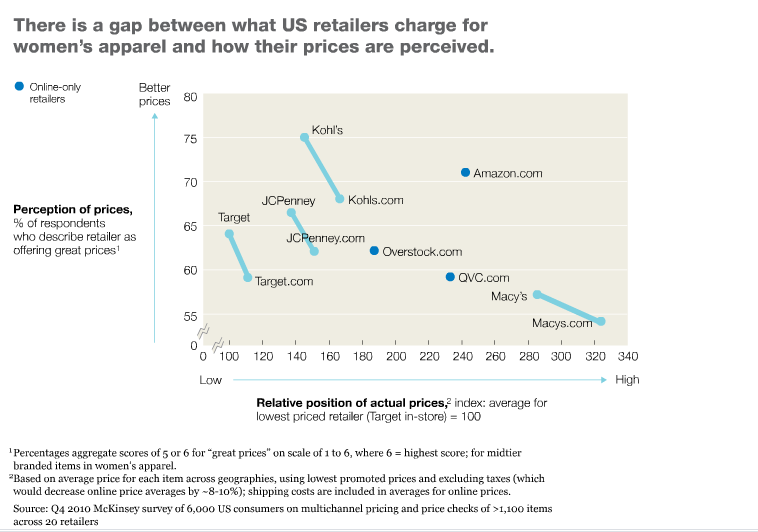
Multichannel marketing and value proposition: how do customers perceive value?

I was reading a very interesting article by McKinsey about the value proposition to offer to multichannel retail customers: it does not only competitive price but also the degree of trust they have in a retailer, its product assortment, and their previous buying experiences. The article goes on presenting two exhibits, both related to a U.S. based research whose results I think can be easily applied to many other other Western culture countries. 

Essentially, what McKinsey researchers state is that:
– multichannel retailers can use certain pricing moves to play the value card, applied to key value items, priced competitively to create a public perception that a retailer offers good value across the many retail channels a consumer uses: stores, the Web, or catalogs;
-retailers also can carefully craft product assortments in ways that influence value perceptions;
– value “heroes” with low price points should be overrepresented in online, in-store, and external marketing;
– tactics such as free shipping, in-store pickup, generous return policies, and price-match guarantees are critical drivers of value perceptions.

Where are Retail’s Hottest Emerging Markets?

Wondering whether to open your new fashion store in China or in Brazil but you don’t have any clue? The annual A.T. Kerney’s Retail Index  provides you with a detailed list of the most emerging countries for apparel retail.

The A.T. Kearney Global Retail Development Index (GRDI)™ ranks the top 30 emerging countries for retail development and identifies windows of opportunity for global retailers to invest in developing markets. The GRDI is unique because it doesn’t just identify which markets are bigger or richer, but rather which markets are hotter and bursting with opportunity. The full annual report can be read at this link, but let’s take a quick look at what the report shows.


China ranks as the most attractive emerging market for apparel retailers according to a study by global management consulting firm A.T. Kearney. Its first place ranking was driven by the country’s large population and the growing disposable income of the middle class. With its compound annual growth rate of more than 20 percent in recent years, apparel retail in China has grown at a rapid pace, and this trend is expected to continue for the next five years.

China was followed in the ranking by two Middle East Countries, U.A.E. and Kuwait, then by Russia and Saudi Arabia.

The United Arab Emirates holds the second position in the 2011 Apparel Index, driven by a population with a high disposable income and immense fashion consciousness. The expatriate populace and tourism in particular are driving forces of consumption in this market. Additionally, the UAE is a regional commerce center in the Middle East, and is a preferred market for entering the Middle East as well as testing new products and retail formats.

Kuwait is ranked #3 in the Apparel Index. Key factors driving retail growth in Kuwait are a favorable long-term economic outlook, a sophisticated consumer base with high levels of disposable income and fashion awareness, more women entering the workforce, and a significant expansion in retail real estate. The gross leasable retail space in Kuwait has expanded from 345,000 square meters in 2006 to 1.15 million square meters in 2010.

The remaining top ten markets in the 2011 A.T. Kearney Retail Apparel Index are Russia, Saudi Arabia, India, Brazil, Turkey, Vietnam and Chile. (Source: A.T.Kerney)