Category Archives: retail

Tesco and RSPB to protect rainforests around the world

UK retailer Tesco has formed a partnership with Europe’s largest wildlife conservation charity – the Royal Society for the Protection of Birds (RSPB) – that aims to protect rainforests around the world.

In addition to raising funds, the “Together For Trees” campaign includes a competition to identify a “Rainforest Reporter,” who will travel to one of the projects in the RSPB’s rainforest program and experience first-hand the efforts to slow deforestation.

Together For Trees aims to raise over £1million for the RSPB in its first year. Every time a Tesco customer brings in a re-usable shopping bag, he or she will be able to donate the vouchers or points Tesco awards through its green Clubcard membership. Additionally, customers have the option to donate cash, and Tesco will contribute £75,000 from the sale of its new Together For Trees reusable bags.

Funds raised by the partnership will support conservation work such as the replanting of native trees in areas damaged by illegal logging, providing equipment for researchers and conservationists, and helping local, forest-dependent people to improve their livelihoods in a sustainable way.

“Our customers will trust this scheme because it brings together the UK’s most popular retailer with the UK’s most popular conservation organization,” said David North, Tesco UK Corporate Affairs Director.

The money raised by Together For Trees will be spent on the RSPB’s rainforest projects across the world, including Harapan Rainforest in Indonesia, Gola Rainforest in West Africa and Centre Hills National Park in Montserrat, a UK Overseas Territory in the West Indies. Rainforests such as these are home to more than two thirds of the planet’s land-based creatures, three quarters of all endangered bird species and have more than one billion of the world’s poorest people depending on them to survive.

In the search for the Rainforest Reporter, Together for Trees has partnered with Amazon explorer and European Adventurer of the Year, Ed Stafford. (Stafford participated in a live web chat Thursday morning, hosted by The Guardian.) People can apply to be the Rainforest Reporter on the Together for Trees website.

Tesco has set a goal to become a zero carbon business by 2050. In 2011, the Carbon Disclosure Project named Tesco the top retailer in the world for its efforts in tackling climate change. However, last month, Tesco abandoned its industry leading effort to place carbon labels on all of its products

via Tesco Raises Funds for RSPB, Opens Competition for ‘Rainforest Reporter’ | Sustainable Brands.

A more natural Coles for healthier consumers

Despite extensive research conducted by the Food Standards Australia proving there are no adverse affects to consuming products with added MSG (monosodium glutamate) and artificial colourings, Coles has removed both ingredients in direct response to consumer concerns.

Lydia Buchtmann, communication adviser at Food Standards Australia, told FoodNavigator-Asia that the government food regulator has conducted “rigorous safety reviews of MSG and colours showing that they are safe for the general population.”

She added that it is possible a few consumers may experience intolerances but that they would not be life threatening like major allergies.

The retail giant’s private label range is now entirely free from artificial colours and MSG, following a five-year project to reformulate all of its own food and beverage brands.

‘Listening to our consumers’
“Our customers are clearly concerned by food additives and the effect they believe they have on their health. A significant number have indicated that they or their children have experienced reactions to artificial colours and MSG,” Jackie Healing, quality manager for Coles said.

This move is simply a reaction to this, Healing added.

The supermarket noted that research showed 91% of customers were worried about consuming products with added MSG and artificial colours, with 76% avoiding such products.

Vanessa Walles, marketing manager at natural ingredients supplier Chr Hansen Australia, said “Coles are being pro-active by taking this stance, it is not because they have to,” and consumers will appreciate this.“It certainly sends a very positive message that Coles is listening to consumer needs and moving with the market expectation of natural colours,” Walles said.

Natural moves
There are no laws against the use of MSG and artificial colourings in food and beverage products in Australia.

Food manufacturers are just required to label a food when MSG is added, either by name or by its food additive code number 621. Walles noted however, that consumer pressure fuelled by media focus on artificial colours and MSG has created a market demand for products free from these additives.

“Natural is the way the colours market is moving”, Walles said.

Add to this, the Southampton Six ruling in the EU where manufacturers using artificial colours have to provide the warning label, ‘may have an adverse effect on activity and attention in children’, and there is a burgeoning pressure towards natural products, she said.

Similarly Aldi’s removal of artificial colours may have been an influencing factor, she added.

“Many branded products have already made the switch from artificial to natural colours, however there are still many products to follow suit,” Walles said.

via Coles ‘goes natural’ for consumers.

Social Commerce and Curated Content for Retailers 2.0

Recently published as part II of a previous part I published on January 31st, this Retail Touchpoints article deals with Social Commerce with a stronger emphasis on social curation, a must to know for all retailers. Enjoy!

“In Part I of this Social Commerce feature, Walmart toldRetail TouchPoints: “The first generation e-Commerce sites brought the store to the web. We think the next generation will be about building a multichannel experience that integrates the store, the web and mobile seamlessly, with social identity being the glue,” Ravi Raj, VP of @WalmartLabs, stated.

Charlie Cole, VP of Online Marketing for Lucky Brand, also shared his viewpoints on social commerce with RTP: “Social commerce is important to us because it allows for a revenue event directly at the point of social interaction. The approach is integral to our other channel strategies: Across social sites we want to make sure we are tracking not only direct revenue attribution but also understanding the ‘view through’ component of the interaction.  Ideally, we want people to interact with products on their own terms and by doing so we heighten the brand relationship.”

However, Cole said he believes social at its core will be a “top of funnel” driver, more so than a direct response vehicle, “but it could be that integrated shopping experiences change that trend in the long term.”

Underscoring Raj’s and Cole’s comments, Facebook’s recent IPO to raise $5 billion, as well as its reported 65% boost in 2011 net income, emphasize that social networking and e-Commerce are fusing to present significant opportunities for retailers to further engage with brand advocates and loyal shoppers on a more intimate level.

In Part II of the Social Commerce Report, several retailers share their social commerce success stories and  insights about its future.


Social Reviews, Curation and Gamification Grab Consumers’ Attention
Social ratings and reviews are key to improving the online shopping experience and subsequent conversion rates at Ice, an online jewelry retailer. Though not a new strategy, Dave Haber, Senior Director of Social Media, told RTP that “Ice continues to focus here because allowing our customers to rate, review and better educate onsite visitors has been one of our most powerful forms of social engagement.

“In fact, we see customers that create, read or share ratings or reviews converting at 2.5-times the rate of an average site visitor ― that’s a 250% improvement in the conversion rate,” he noted.

Another area of social commerce Haber’s team is focusing on is the idea of social curation ― the ability for people to curate selections of products, brands, imagery, etc., in order to create their own personal lens of shopping needs and experiences. Haber points to a site called Pinterest.com, which allows participants to organize web clippings onto a virtual bulletin board and share them with friends. For example, for Valentine’s Day, visitors can create a board called “Jewelry Gift Ideas,” and attach (or “pin”) a necklace or earrings from Ice. Pinterest users can click through “pinned” items to access the product detail page at the Ice homepage and ultimately make a peer-recommended purchase.

Haber also sees online gaming as a huge social commerce opportunity that can impact the ways consumers interact with online retailers and brands. The NRF’s “Social Retailing Blueprint” study looks at “gamification,” defining it as the use of game play mechanics and dynamics for non-game applications, products and related services. This tactic is used in consumer-driven web sites and mobile applications to encourage sustained engagement or incentivize other behaviors.

Gamification in the context of retail operations and social marketing tactics helps drive customer transactions. Online shoe retailer Shoebuy.com, for example, tapped gamification to double advertisement click-throughs and boost share rates via Facebook by 50%. DKNY was among the retail initiators of social gaming. Today that group includes Best Buy, CafePress, Gilt Groupe, H&M, Nike, Rue LaLa, Simon Malls, Sport’s Authority, Valentino and many others.


Telling Stories, Gifting and Social Sweepstakes Win Big
The opportunities for social commerce tactics continue to branch out. In January 2012, Facebook announced 60 new web partners that will appear in the site’s users’ Timeline offering. Timeline is a new profile that gives users an easy way to “share and highlight your most memorable posts, photos and life events on your timeline. This is where you can tell your story from beginning, to middle, to now,” according to Facebook.com.

A number of merchants have recently introduced new social commerce sites and apps:

  • Fab.com — One of the 60 new Facebook partners is Fab.com, an e-Commerce marketplace for design. In a recent blog about its social commerce innovations, Fab.com’s CEO Jason Goldberg, revealed: “Fab is thrilled to be among the first to launch a timeline app. To get started, you can opt-in on Fab to add the app to Facebook Timeline, your future purchases will be shared on your Timeline, and you’ll be able to discover the items most popular among your friends through the Facebook News Feed and ticker. Clicking through on the Fab Member’s username then shows that user’s Fab Profile, which displays all of the items the member has purchased, faved, or added to the Fab Inspiration Wall. [This] Social Shopping launch is just the start. We’ll be continuing to forge ahead and innovating at the intersection of social and commerce,” said Goldberg.
  • @WalmartLabs — @WalmartLabs launched an app on Facebook called Shopycat last December, which recommends gifts for friends and family based on their likes and tastes. Earlier in January it launched Get on the Shelf (getontheshelf.com), “which allows us to crowd source the next great product to carry on our shelves,” Raj told RTP. “Both these initiatives have been off to a great start in terms of usage. You can expect to see more innovative social products from @WalmartLabs in 2012,” he said. “Our scale at Walmart with retail stores, combined with social commerce, positions us well to succeed in the new generation of e-commerce.”
  • Brookstone — Bill Wood, CIO at Brookstone, said the chain’s recent partnership with SWAGG, a gift management app extended Brookstone’s reach into the mobile social commerce space. It did this by allowing consumers to give and redeem gift cards via their mobile device, as well as access offers and promotions from any smartphone. He described the strategy during his presentation entitled “Technology-Enabled Social Media” at the Social Commerce Strategies Convention in Las Vegas late January.

Woods told RTP: “Social commerce is proving to be a valuable tool to enhance storefront appeal. This holiday season, Brookstone conducted a Foursquare promotion offering a $10 discount for check-ins at our retail locations, which blended our online strategies with our brick and mortar consumer engagement.”

  • SquareTrade — A service provider of extended warranties for consumer electronics, SquareTrade leveraged social commerce to promote its services in conjunction with the release of the iPhone 4S. Looking for a cost effective way to spread and track word-of-mouth, SquareTrade launched a hybrid of Social Referral and Social Sweepstakes products. Coupling the two products added a viral aspect to the referral campaign, which was promoted via email and Facebook. The campaign included two offers: $10 for every referral, and $100 for every five referrals, with referrers getting $5 off their warranties as an incentive to buy one. SquareTrade also gave away “50 iPad 2’s in 25 Days,” a program allowing referrers to enhance their chances of winning by sharing, since both the chosen winner and the individual that referred them received an iPad 2.

In the first 10 days of the campaign, more than 10,000 SquareTrade brand advocates were identified. Advocates shared with an average of five friends, and the campaign generated more than 60,000 social shares across Facebook, Twitter and email. Referrals drove 500 new customers, each purchasing a $100 product.

“We wondered whether people would still be sharing after the sweepstakes ― and they did,” reported Will Spencer, Marketing Manager for SquareTrade. “Thousands of organic shares continued when the campaign ended. The sweepstakes and its aftermath succeeded in validating that social commerce is a strategy in which our customers are willing to participate. On the strength of that data and the success we achieved, social commerce will most likely become a bigger part of our overall strategy in 2012, with more product categories eligible and a wider range of customers participating,” reported Spencer” (Source: Retail Touchpoints)
Dozens of vendors have recently entered the social commerce space, including Adgregate, Baynote, Bazaarvoice, 8th Bridge, Extole, IBM, Moontoast, Oracle, Payvment, ShopIgniter, 360i and TurnTo, all helping to distinguish social commerce as the new era of e-Commerce.

Bringing nutritional advice directly to consumers’ table: Tanita Shokudo

In Tokyo, Tanita Shokudo offers a way to bring nutritional advice directly to consumers’ tables.

The brainchild of Japanese health device manufacturer Tanita Corp, Tanita Shokudo provides expert culinary information about all items on the menu, aiming to help those wanting to eat out without compromising their diet plans.

Each table is fitted with a weighing scale to ensure healthy portions can be measured out, while a timer tells the diner when the optimum duration of 20 minutes for completing their lunch is over. Professional dieticians are also on hand to provide free advice on eating regimes in a special counselling room.

Tanita Corp has tried and tested the concept in its office cafeteria and it has proven successful enough among its employees to roll out to the public. Lunch options come from the company’s successful cookbook, which first introduced Japanese food lovers to healthy set meals of 500 calories or less.

Consumers are becoming ever more health conscious and nutrition transparency in restaurants is a trend that has grown around the world, but the mix of a good-for-you lunch alongside professional dietary advice takes these services to another level. Could this be picked up in other countries?

via Japanese cafeteria offers diners in-depth advice on health and nutrition | Springwise.

Leadership and Innovation in Retail Sustainability: a Research

“As one of the leading industries to embrace sustainability, it is becoming a core consideration for the retail industry,” said Adam Siegel, RILA vice president of sustainability and retail operations. “Retailers are working to incorporate sustainability into their strategy, operations, workforce engagement, and connection to consumers and communities. This report is a first look at the broader industry’s accomplishments, challenges, and future directions. It lays a foundation to determine where we can go from here.”

The following are four key trends identified in the report.

Retailers are:

  • Working across sectors to achieve sustainability goals. Because expertise is not yet available within their respective organizations, retailers are reaching out to nonprofits, academics, and governments, as well as suppliers, consumers and investors to accelerate sustainable innovation.
  • Turning from sustainability as a cost- and risk-reduction measure to an opportunity for business growth. Retailers leading the sustainability charge recognize that the benefits extend well beyond achieving business efficiencies. Sustainability programs are increasingly viewed as a source of innovation and differentiation and a platform for new product and market development.
  • Developing systems for continuous improvement. As retailers build sustainability programs, they have developed management, measurement and IT systems for continuous improvement. Such mechanisms include environmental management systems, supplier “scorecarding” and management training, employee training and engagement, energy and waste reduction goals and sustainability reporting.
  • Fostering transparency in operations and the supply chain. Opportunities for risk mitigation, coupled with increased public scrutiny, are driving the need for additional disclosure. Reporting on financial information alone can no longer articulate the complexities and intricacies of retail operations and global supply chains.

Data for the report was collected from 2011 sustainability reports of 30 RILA member companies, including grocery and drug stores, general merchandise and department stores, and spanning both large and small formats. Information was also compiled through multiple industry surveys, industry meetings, and company interviews, across all segments of retail. Business for Social Responsibility (BSR) was a key partner in the development of the report.

“RILA’s first sustainability report is an important step forward for the retail industry,” Ted Howes, director of advisory services for Business for Social Responsibility. “Our hope is that RILA’s efforts will inspire retailers around the globe to take action and engage in sustainability more deeply and strategically — to ensure a healthier bottom line as well as a healthier planet. BSR looks forward to collaborating with industry leaders to ensure that sustainability stays top of mind in the years to come.”

RILA members were also invited to submit case studies for the report, and interviews were conducted with 20 companies – Belk, Best Buy, Gap Inc., H-E-B, The Home Depot, Ikea, J.C. Penney, Lowe’s, Meijer, Petco, PetSmart, Publix, Safeway, Sears, Staples, Target, VF Corporation, Walgreen, Walmart and Whole Foods Markets.

The following are future directions retailer’s say they will explore over the next five to 10 years:

  • Sustainability will become integrated into all aspects and departments of the business;
  • The drive to manage supply chain impacts will transform retailer-supplier relationships;
  • Industry collaboration will become the standard; and
  • Business models will evolve as consumption habits change.

Retailers identify many benefits while pursuing more sustainable operations and products including efficiency, risk mitigation, new innovations, a way to recruit and retain top talent, a means to develop new product and enter new markets, as well as improved reputation with customers and industry stakeholders.

“One of the biggest takeaways from the report is that creating lasting change in retail sustainability is not something the industry can do alone,” Siegel said. “Retailers are reaching out to nonprofits, academics, and governments as well as to their suppliers, consumers, investors, and communities to provide their diverse perspectives and partnerships and help accelerate sustainable innovation for all.” Author: Adam Siegel

via Research Identifies Retail Sustainability Leadership and Innovation – Green Retail Decisions.

SAPORE Trade Expo: a Tasting Experience

The next event in our hectic February agenda is SAPORE Tasting Experience (at Rimini Fiera from 25th to 28th February) is more than a trade expo. It is the event dedicated to all those wanting to know the future of foodservice for eating out.

At its disposal, there are eight halls of the west wing of the Rimini expo centre for updating on tastes, rites and trends in a world with a continuously changing demand. The inauguration ceremony is scheduled for 10.30 am on Saturday 25th in the south foyer. Maurizio Melucci, Emilia Romagna Regional Councillor for Tourism, will take part in the ribbon-cutting ceremony.

Two important events will follow: the assignment of the 2012 Innovation Awards for the most innovative products on the market and the appointment with the inauguration conference organized by Fipe Confcommercio. Business unit manager Patrizia Cecchi confirms, ´Rather than a showcase, SAPORE will be a real… tasting experience, thanks to the new products on show and the countless appointments to innovate the Horeca channel´s business (show cooking with award-winning chefs, Sapore University courses, guided tasting sessions of wine and Italian craft beers, fresh and dry pasta and brewery specialities from all over the world, as well as conferences to analyze the latest trends and the presentation of interesting successful cases in the foodservice world.´

The expo therefore features a complete showcase of products and technologies from the world of catering, pasta, beer, seafood, pizza, oil, wine, regional specialities and frozen produce. Each of these sectors will be represented by the excellence of the enterprises and their proposals, alongside events and opportunities for discovering first-hand new experiences of business formats. Approximately 400 foreign buyers are awaited at the exhibition, where they will meet exhibitors according to an agenda scheduled online during the days before the expo.

This is a very effective innovative system for increasing opportunities for business between companies and foreign markets, as well as optimizing buyers´ visits to the expo. Among the key events, the Large-scale Distribution Buyers´ Day scheduled for Monday 27th and dedicated to the new trend ´AYCE´ All You Can Eat – the format with which restaurants charge a fixed price for access to food, then allow customers to consume as much as they want at no additional charge) and the debut of the Sapore Chef Grand Prix Contest

SAPORE 2012 will be held with the patronage of the Ministry of Agriculture, Food and Forestry Policies, Emilia-Romagna Regional Government, Rimini Provincial Government and CNA Alimentare.

And if you had already planned to visit the SAPORE exhibition, please  know that we will be there the whole time meeting prospects and clients. It will be a great pleasure to meet you in person: just send us an email at norman|at|desita|dot|it to set up an appointment.

Freshly-baked baguettes when bakeries are closed? YES!

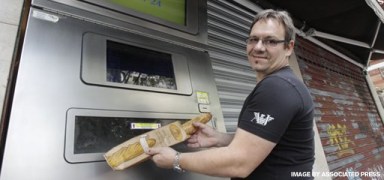
Vending machines are usually associated with long-life and processed packaged foods, to be conveniently purchased at any time. However, an entrepreneurial French baker recently rolled out 24-hour automated baguette dispensers next to his two bakeries in Paris and Hombourg-Haut, which ensure he can sell his baguettes even after his shops have closed.

Jean-Louis Hecht came up with the idea when, living above his boulanger, he was disturbed countless times by people wanting to buy bread after he had closed shop. The bread is partially cooked before being put into the machine — which cost EUR 50,000 — and finished off when a customer orders; delivering a hot, freshly-baked baguette within seconds. Each stick costs EUR 1, and when the machine debuted in January the baker sold 1,600 baguettes, reaching sales of 4,500 in July. Hecht told the Associated Press “This is the bakery of tomorrow. It is answering a real need. People who work at night or early in the morning can get their fresh bread. To me it’s a public utility.” The video below demonstrates how the baguette dispensers work:

Hecht puts himself at a financial advantage to his competitors, who close over public holidays and after business hours. Is there a demand for similar fresh convenient food in your area?

via Vending machine dispenses freshly-baked baguettes | Springwise.

Lack of co-operation may kill Retail Sustainability Projects

In 2007, Tesco’s CEO Sir Terry Leahy pledged to track and put carbon labels on all the chain’s products as part of a “green revolution,” but has backed off the plan

In February 2011, Leahy called on governments around the world to work more efficiently with private companies to ensure that low-carbon growth innovation is not unnecessarily hindered by bureaucratic red tape. Now it seems, the lack of cooperation among companies to help defray the costs of carbon labeling contributed to killing the program.

Tesco told the U.K. trade magazine The Grocer it planned to discontinue the program after and wind down the project after finding research for each product involved months of work. Currently 500 of Tesco’s products have carbon labels while more than 1,000 have been researched.

“We expected that other retailers would move quickly to do it as well, giving it critical mass, but that hasn’t happened,” Tesco’s climate change director, Helen Fleming told The Grocer. But other retailers failed to get involved or share information to help reduce the costs of the program, making it to costly to continue.

Tesco was named the best U.K. company for its efforts in tackling climate change by the FTSE 350 Carbon Disclosure Project in 2011 and was awarded top retailer globally for two years running. The retailer opened its fourth zero carbon footprint store in January.

The chain may be backing off the labeling program for now, but hasn’t given up its commitment to the concept. “There are an enormous amount of companies that research the carbon footprints of their products,” Fleming told The Grocer. “But how do you ramp that up to the top level? We now need to make the right long-term decision and we’re talking about what we do next.”

via Tesco Gives Up On Carbon Labeling – Green Retail Decisions.

Shipping Containers: a new Solution to Food Deserts?

A group of Seattle entrepreneurs has come up with one solution to the urban food desert problem, and it doesn’t involve adding traditional supermarkets to underserved areas. Their new venture, Stockbox Grocers, is taking the favorite building block of the green-building movement—the shipping container—and adapting it into a miniature food emporium, packed from floor to roof with fresh produce and other staples.

“Our goal is to bring food back to communities, and focus on communities that don’t currently have good access to food and are heavily dependent on public transportation,” says founder and owner Carrie Ferrence. This week, Stockbox celebrates the opening of a 160-square-foot prototype store in a parking lot in a neighborhood where corner stores are the only source of food. Up to five customers can shop at once, said Ferrence, and only one person is needed to staff the operation.

This first store—housed in a temporary structure that’s actually smaller than a shipping container—is intended as a six-to-eight-week experiment to feel out the needs of the community and gather feedback. “A lot of people who come in are breaking down the myth that people of low income and mixed income don’t want access to organic or natural food,” Ferrence says.  By the end of next year, she and partner Jacqueline Gjurgevich hope to have four permanent shipping container stores up and running.

“Everyone’s really excited to have a grocery store in the community,” Ference says. “The community’s been asking for years.”

via Stockbox Grocer’s Food Desert Solution: The Shipping Container – Lifestyle – GOOD.

A ScenSational discovery allows you smell the aroma right from the packaging

Patent-pending innovation EncapScent, which has been developed by US-based ScentSational Technologies, will enable food and drink companies to add food grade flavours to packaging to convey the brand aroma, the company has claimed.

The coating, which can be added in-line, can be engineered to release an aroma at different stages; when picked up from the shelf, during handling, opening, use or consumption.

The intensity of the activated scent, which is intended as short-term aroma, can also be adjusted based on the client’s preferences, ScentSational Technologies added.

The company is working closely with flavour houses to make custom flavours for individual applications. Food and Drug Administration (FDA)-approved flavours are then applied to the packaging outer-surface and remain dormant until activated by the consumer.

Scented coating

“A scented micro-encapsulated coating (MEC) is applied to the outside of the packaging, after filling or assembly,” ScentSational chief technological officer Steven M. Landau told FoodProductionDaily.com.

“The aroma is protected by a microscopic cell, that when handled ruptures and releases the scent. There are millions of cells on each packaging application so cells can be ruptured and the scent released over and over again.”

“The coating can be applied on the production line. So with beverages we can apply it to the bottle, the cap, the label. It can be applied to any shape on the filling line.”

The development is safe for use with food, beverage and pharmaceutical products. It is not directly exposed to product ingredients and is compliant with food packaging regulations, Landau added.

“For food we are only using FDA approved flavours. These will not interact directly with food. If applied on the outside of packaging, it can improve and enhance aromatically.”

Client ‘wish list’

The innovation, can also be used to enhance the taste of the product during use or consumption, was developed in response to client requests for an inexpensive way to convey product aroma.

“We had our customers coming to us with a wish list. That was the origin of the development,” Landau said.

“We have been asked for many years to develop technology like this. We have tested it and it can even be adapted to ice cream. It’s a real game changer for frozen foods.”

“Until just recently, the sense of smell has been the most neglected sense in brand marketing strategies. Of the five senses, smell is the most powerful in driving consumer preference, conjuring up memories and creating purchase intent. As a result, our customers have been asking for a lost cost technology to deliver aroma from the shelf,” Landau added.

via ‘ScentSational’ packaging coating delivers food or drink aroma.