Category Archives: fashion retail

The Art of display: enhancing customer experience

More businesses are incorporating artful accents to their shops, realizing that customers are more likely to enter and spend more time in a store with artistic retail displays than one with basic white walls and grid-like shelves. Everything from oversized art installations to crafty storefronts are giving retailers attention-grabbing elements that are simply too eye-catching for a customer to ignore.

Created by Kahori Maki, ‘Moon Princes’ begins with the window display and then leaks into the store’s interior space. It’s black-and-white coloring contrasts vividly with the relatively vibrant clothing. The result might be considered overwhelming but it charmes the most adventurous shoppers.

On the opposite, the Valencia Munich store, design by Dear Design studio, is very minimal, yet very impressive. Its all white color, the complex X display structure, seem to expand the display surface at libitum, giving to the full range of Munich Shoes on diplay the deserved importance.

At the famous Merci store in Paris, Aesop has installed a creation designed by the Melbourne-based March studio, which can not passed unnoticed. A wall of stacked Aesop cardboard boxes, held together by a black net, looks like a tornado which is going to wrap over the shopper.
These are only few examples, what is clear is that shoppers now need more stimuli: products are available almost everywhere, what differs is the shopping experience. And art can be the solution. (Credits: Trendhunter)

Preparing for the consumer economy of 2020

In a recent super session at Retail’s BIG Show, Ira Kalish, Director of Global Economics for Deloitte Research, gave an all-encompassing overview on the state of the global retail industry ten years from now, as well as his take on what the consumer of the future will look like.
Kalish kicked off with a run through of recent developments in global retailing, noting that it’s always useful to think about the future by reviewing the past.
In particular, Kalish highlighted some of the paths that lead towards the economic crisis of 2008 and 2009 and the lessons that were learned from that crisis: massive consumer leveraging in the U.S., U.K. and Spain; the collapse of the asset price bubble; emerging currencies rising; U.S. consumers paying down debts and saving more; housing no longer being seen as a source of economic growth; China’s move towards consumerism and consumer spending rising as a source of GDP; and the challenges faced in Europe due to imbalances between countries like Germany and Portugal, Ireland and Spain.

As for what retailers can expect in the consumer economy of 2020, Kalish pointed to a number of challenges and opportunities retailers should certainly have on their long term radar, such as the massive increase in emerging middle classes and the disproportionate share of growth in emerging areas of the world like Indonesia, Colombia and Africa.

The effects of an aging population in an increasingly affluent world will also be a key consideration for retailers of all shapes and sizes, while hot markets with younger demographics (India, Middle East and Africa) will also keep global retailers on their toes.

Kalish also noted, the impact of obesity, changing global food market dynamics, an ever-increasing focus on sustainability and the possibility of a social media revolution could play a heavy role within the consumer economy of 2020.

So what can retailers do to prepare for this new consumer outlook? Kalish believes that aligning company values with those of consumers will be critically important, as will leading and listening to customers. Taking care of your brands, your people and your investments will also pay dividends when it comes to engaging with consumers, something that will be fundamental for 2020’s consumer – and not a bad idea for 2011. (Source: NRF)

MENA: retail sales are still growing

Retail sales in the MENA region jumped 13.2 percent last year, making it the only region in the world to post double digit growth, accountancy firm Deloitte has said.

In its latest retail report, Deloitte said emerging markets were the most promising for consumer sales and marked the Middle East as a stand-out region.
“While global economic growth is on the mend, most of it is taking place in emerging markets, many of which are experiencing rapidly increasing consumer spending,” said Nasser Sagga, audit partner at Deloitte and Touche.
“Within the Middle East there is a number of emerging economies that meet the criteria of strong growth prospects and good demographics – Egypt and Turkey being two such examples.”

The report identified the 250 largest retailers around the world in 2010, more than 11 percent of which were based in the MENA region.
Despite seeing a significant drop in trade and tourism during the financial crisis, the Gulf remains a key a market for retailers.

A report last year by real estate consultancy CB Richard Ellis found Dubai ranked second only to London in terms of the number of global brands with a presence in the city.
In a ranking of 294 of the world’s top retailers, more than half had a presence in Dubai. “Despite continued uncertainty for some retailers across the world, luxury brand retailers have remained active and were responsible for the most new store openings,” said Peter Gold, head of Europe, Middle East and Africa cross-border retail at CBRE. (Source: ArabianBusiness.com, Photo: hadiyahrewardnetwork.com)

Need some customer interaction? Here it goes!

There are many ways to enhance customer experience..Let’s start from the window display, for istance. Technology is helping retailers a lot, and we have found some great examples that we would like to share with you. Not so much to add, just watch and enjoy – and maybe give us your feedback!


Interactive Window Concept made for the module Advanced Interface Design at Hyper Island hosted by North Kingdom


Project for an interactive display window for BNP Paribas, place de l’Opéra, Paris


The Interactive Apple Store in Berlin, Germany.

Biometrics and retail marketing: the future is now

Biometrics, methods for uniquely recognizing humans based upon one or more intrinsic physical or behavioural traits, is very important when evaluating the efficacy of a retail store design or display and assessing counter actions to make the retail environment more customer friendly. According to NY Times, IBM is currently testing a revolutionary biometrics method in two location in downtown Milan – a fashion company flagship’s store and an electronic store. Biometrics the future of retail marketing
The I.B.M. solution, involves tracking biometrics through a mini camera in a mannequin’s eye or placed somewhere in a store and the collected data will be aggregated so that not to be traced to any individual.

“We started with fashion because it is a creative and innovative industry, but it’s clear that people have to be educated so they know their privacy will not be compromised,” said Enrico Bozzi, the manager of I.B.M. Forum Milano, the department that developed the technology. “It is a question of changing people’s perception.”

 The IBM biometric test is already showing its first results. At the pilot in the Milan fashion store, for example, the client noticed that almost all Asian customers enter the store through one particular door, even though five are available. “We thought it was a mistake, but we checked it out and it was right and it continues to happen,” Mr. Bozzi said. “We don’t know why yet but, in the meantime, the store is considering positioning products by that door that are known to appeal particularly to Asian shoppers.”

I.B.M.is now also working on software that will let clients try on jewelry and makeup wirelessly thanks to a mobile phone or computer, with an iPad application likely to debut soon.

Sustainable Apparel Coalition: what is it?

In the last days there has been a lot of buzz about the Sustainable Apparel coalition, officially launched on March 1st. But what is it?

The Sustainable Apparel Coalition (SAC), which includes* Nike, Gap Inc, H&M, Levi Strauss, Marks & Spencer, and Patagonia, will work to lead the apparel industry towards developing improved sustainability strategies and tools to measure and evaluate sustainability performance. 

The Coalition’s purpose at a higher level has two goals.  First, the member organizations will develop plans to soften the apparel industry’s impact on water and industry consumption, while making commitments to improved waste diversion and the reduction in the use of chemicals. To that end, the Coalition’s members will work with industry peers and supply chain partners to achieve the fullest possible life cycle transparency for clothing. Meanwhile, the SAC seeks to ensure that workplaces throughout the apparel industry adopt fair employment practices and a safe working environment, while eliminating any exposure to toxic chemicals.

Second, the Coalition will develop a metrics-based tool that will assist companies in the measurement of their environmental and social impacts.  For now described as the Version 1.0 Apparel Index, the tool works similarly to Nike’s Apparel Environmental Design Tool and the Outdoor Industry Association’s Eco Index.  Besides offering an assessment on companies’ usages of energy, water, and chemicals, the index will also evaluate products’ entire life cycles.  Companies will be able to measure their performance, compare them to their peers, and receive guidelines and resources for how they can improve their performance all such metrics.  The Apparel Index is slated to launch next month.(Source: Triplepundit Photo: Treehugger)
*Founding members of the Sustainable Apparel Coalition are based in North America, Asia, Europe and the U.K. They include Adidas, Arvind Mills, C&A, Duke University, Environmental Defense Fund, Esprit, Esquel, Gap Inc., H&M, HanesBrands, Intradeco, JC Penney, Kohl’s Department Stores, Lenzing, Levi Strauss & Co., LF USA, a division of Li & Fung Limited, Marks & Spencer, Mountain Equipment Coop, New Balance, Nike, Nordstrom, Otto Group, Outdoor Industry Association, Patagonia, Pentland Brands, REI, TAL Apparel, Target, Timberland, U.S. Environmental Protection Agency, Verité, VF Corp, and Walmart.

Innovative communication or design innovation: eyewear

Italy is famous for its eyewear giants, Luxottica first. If you have ever visited an eyewear retail store in Italy, you would have noticed that more or less they all look the same: neon lights, mirrors, traditional displays, sales people wearing a white coat.
Today we would like to show you two very different approach to this kind of point of sale: Salmoiraghi & Viganò at Piazza San Babila, Milan and Kirk Originals in London.

The first looks like a “traditional Italian” eyewear store, we might say the “deluxe” version of it but from the design point of view, nothing extremely different from the typical layout, displays included. What is “unusual” in this point of sales is the concept and the services offered: a very fast service for those who need new spectacles, culture, events and corners managed by several fashion brands.

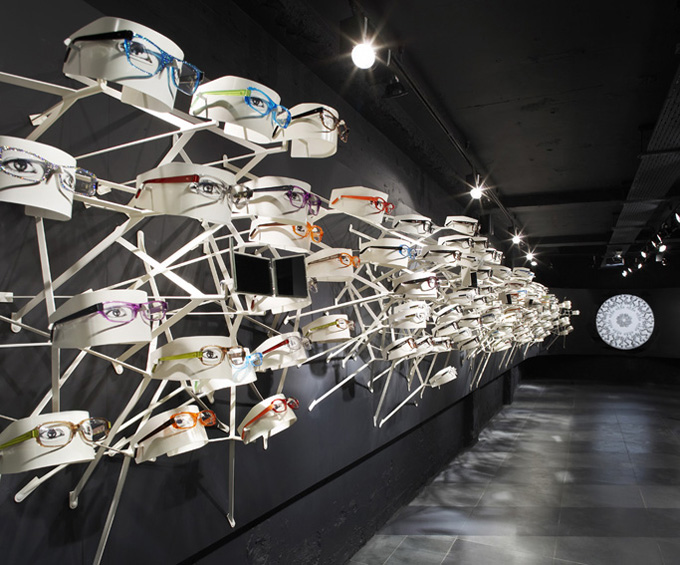
Kirk Originals flagship store, on the opposite, looks very unusual, and the only one eyewear wall with 187 “heads” for frames, and practically no furnishings ensure that customers will focus on the eyewear, not the trappings. Eye examinations and fitting take place in the basement, away from the main display space.

Two different, opposite concepts for the same product. Which one do you think will sell most? (Photo: courtesy of Salmoiraghi&Viganò, Luca Oliverio and TheCoolHunter).

Benetton keeps getting greener

Six hundred fewer tons of plastic in the environment in 2011:  this is the green result that Benetton Group will achieve by introducing innovative, lightweight liquid wood clothes hangers – 100% biodegradable and recyclable – in place of the plastic hangers usually used to display garments. The eco-hangers, developed in partnership with the Fraunhofer-Institut für Chemische Technologie in Pfinztal-Berghausen (Germany), will gradually replace their plastic predecessors throughout the worldwide network of Benetton stores.

The liquid wood hangers are just part of a far broader eco-sustainable business plan launched by Benetton in a context of attention to social issues – and environmental respect in particular – always an important aspect of our corporate identity. Benetton’s green journey includes two other tangible environmental sustainability programmes, involving organic cotton garments and eco-friendly paper shopping bags.

In the Benetton children’s collections, organic cotton already accounts for over 30% of all cotton apparel, and with the spring-summer 2011 collection, organic cotton garments will reach a total of 13 million across the Group’s various brands. These products are all certified according to the GOTS (Global Organic Textile Standard) ethical and environmental criteria, a worldwide benchmark that guarantees adherence to key organic standards in fibre production.

The GOTS standard focuses on ethical and environmental sustainability (ensuring that products are GMO-free and come from low-impact farming). Benetton performs a constant cycle of controls to ensure that the CaMV 35S promoter, indicative of the presence of GMO cottons, is not found within the fibres.

Furthermore, since January 2010, customers buying from United Colors of Benetton stores have been taking their purchases home in a craft-white eco-friendly paper shopping bag, processed using water-based inks only, and sourced from an FSC certified paper factory, ensuring products are made using timber from forests that are controlled and managed according to the principles of social and environmental sustainability. (Benetton Group Official Press Release)

GoodGuide for Good Products for a more sustainable Retail

Yesterday I was reading a post concerning Levi Strauss & Co as the Top Jeans Brand, scoring a 7.4. The brand Prana was listed as the next highest, with a score of 6.3—followed by H&M (6.1), Banana Republic (6.1), and Old Navy (6.1).

I did not know what GoodGuide is – shame on me – so I checked out their very interesting website, which is said to be the world’s largest and most reliable source of information on the health, environmental and social impacts of consumer products. And I think it really is, rating over 95000 products, mainly available on the US market only: from food, toys, personal care to apparel, electronics and appliances. What is really striking is the scientific approach they have on their ratings, which are compiled from three sub-scores addressing Health, Environment and Society.


 Each of these sub-scores are based on an analysis of a set of indicators that GoodGuide has determined are the best-available measures of performance in these areas. Their methodology differs from the product belonging to different categories, each and every one having its own scoring methodology. Amazing. Let’s talk about apparel for example.

Quoting the Good Guide site: “Until (apparel) companies do a better job of providing transparency into their supply chain, our ability to accurately score brands based on their relative performance will be subject to significant uncertainties Environment scores are assigned to apparel brands by combining GoodGuide’s standard company indicators of environmental performance (weighted at 50%) with brand-level environmental indicators that address issues that are specific to the apparel sector (weighted at 50%).(….) Social scores are assigned to apparel brands by combining GoodGuide’s standard company indicators of social performance (50%) with brand-level social indicators that address issues that are specific to the apparel sector (weighted at 50%).(…) Health scores are not assigned to apparel brands because this product category does not generally pose health risks to consumers.”

The Good Guide website is also very good at using the Web 2.0 tools to “spread the word” and improve the accuracy of the product information thanks to a “support product info” page which enables visitors to add further details.

It would be also very interesting to test the effect of this kind of structured and scientific information directly at the point-of-sale, to see how the consumer react when discovering that his/her favourite brand of pasta is not that “good”. Because thanks to GoodGuide mobile App this is possible: consumers can scan the product, check the GoodGuide database and then purchase, or decide to choose another brand.

With this detailed level of “scientific” information, producers and retailers have nothing to hide and their achieving a high/low score can have a boomerang effect on brand reputation which must not be ignored and will not be ignored by consumers. Sustainability pays, and it will pay even more in the future.

A CONSCIOUS COLLECTION – SUSTAINABLE STYLE AT H&M

Sustainability is a long term trend at H&M and this April as part of the focus on sustainability H&M will introduce the Conscious Collection – The collection which is for women, men and children is made from enviromentally – adapted and greener materials such as organic cotton, Tencel® and recycled polyester. H&M’s designers have been inspired by different shades of white, one of the most important colours this Spring. A minimalist, tailored look is combined with romantic lace, Broderie Anglaise, frills and draping. The Conscious Collection will be on sale in all H&M stores from 14th April. “It’s not just about organic cotton any more, the possibilities for creating a complete fashion statement with eco smarter materials are huge now. By designing recurring Conscious Collections we have the opportunity to show in a variety of ways what’s possible using more sustainable fabrics,” says Ann-Sofie Johansson, H&M Head of design. “Shades of white are the season’s biggest fashion trend and it feels right for this collection. White creates a romantic feeling with lace and Broderie Anglaise, but is also the basic colour in a sporty, relaxed style and in a preppy tailored look for men.” Womenswear is inspired by an updated romantic style in which blouses, tunics and T-shirts with Broderie Anglaise are a key trend. Tiered dresses are perfect for day or more dramatic Grecian gowns for night. Long floaty skirts are key as are cut-off shorts. The collection also includes the perfect white blazer and pleated trousers for a more minimalist look as well as Broderie Anglaise and lace lingerie. Menswear takes on a preppy mood with a white two-button blazer, collarless shirts and T-shirts with Henley detailing at the neck. There are printed and striped T-shirts, as well as a tank top for layering and trousers are either five-pocket jeans or tailored. Meanwhile the Children’s collection is full of white pieces for both girls and boys. It’s all about tiered dresses, tops, skirts for girls, and for boys t-shirts and jeans. (Source: H&M press release, Photos: H&M)