GoldRun is a new platform for retailers that matches mobile, Augmented Reality and social. Enjoy this video, comments are welcomed!
Category Archives: marketing
New Technologies for internet sales of beauty products
Irina Barbalova, Head of Beauty and Personal Care research at Euromonitor, explains how the beauty industry spreads its message using new technology. As internet sales of beauty and personal care (BPC) products increase, companies are looking for new ways to interact with consumers. With consumers sharing their experiences all across the web on social networking sites, some companies are more receptive to social interaction than others. A fear of negative reaction is keeping some companies off of sites such as Facebook and Twitter. However, smaller niche brands have accepted social networking as a means to spread their brand when marketing budgets are small. (Source: Euromonitor)
How to implement grocery retaling and e-tailing in India
We found this article by Avinder Batra, published on IndianRetailer.com very interesting because of its very detailed approach to the implementation of a home delivery service for those small groceries retailers that are facing the competition with by multinational like Wal-Mart. This is also a business model which is very sustainable, by lowering CO2 transportation emissions and by mainting vital the traditional small retail grocery business.
Batra identifies a big trend in the grocery business- home delivery- due to two main reasons:
-High fuel price: Indian families are not interested in spending time on these products
-Families want more leisure time for themselves: Since both the partners are working, shoppers find this activity as waste of time to collect groceries in weekends
“When most of the big retailers are fighting for larger space, opportunities can be foreseen where you do not have compact space and can still run successfully through Etailing the Grocery model” Batra says.
The solution could be a mix of website, mobile, IVR.
High rental costs have made the retail business cumbersome for the independent players. As told by Ragib Hussain, VP, Vice President Strategy at e.Soft Technologies, “This type of model does not need much of investments. Etailing models (having virtual shop) can help retailers in expanding the business thus by covering larger area & reap good volumes.”
Small independent retailers need to increase their customer base: Online services and then home deliveries would fetch revenues only when you have large customer base. Margins are the rewards which an investor gets and this is what he has to work on to have with minimum liable cost.
Develop tie-ups/partners: Developing partnership agreements with the kirana shopkeepers and others nearby shops in the area that would reach the consumers through home delivery systems. This should be the initial step of building a strong network in the areas concerned you want to cover.
Also, it would decrease the liability on the retailer—warehouse cost, maintenance cost, procurement cost, etc.
Develop your own site and make a strong viable back-end system for smooth functioning of the business model: either by creating your own hosted website or by opting for cloud services, this is a very important step. Cloud services would play a vital role to make updated connections with your suppliers, logistics suppliers, CRM updates and drop shipping suppliers. Because time is a critical factor, efficient distribution is of utmost importance. Technology plays a key role in enabling an efficient dairy distribution model.
This is the back bone of the whole concept when the business starts working and it is the most challenging part of the business to make real-time connectivity with them.
Home delivery services: By tying up with the partners in the local areas, investor can direct the orders to those shops and through delivery boys; the task can be executed smoothly. This would even increase the revenue prospects of the local partners.
If the business model is churning profits, there is no harm in having your own warehouses and company owned shops in the localities. This could be the way to expand your business model and make it stronger.
Each small outlet should be centrally connected to the warehouse to record the sale and updates are on real time basis. This would help to replenish the goods which are going out of stock.
Delivery system: Tempos and other mini trucks can be used to provide deliveries in the located areas if orders come in bulk in particular area. (Source: IndiaRetailer.com)
A Pop-up revival in retail marketing
Over the past 12 months, a growing number of brands has turned to pop-up activity to provide a burst of PR activity and another reason for consumers to interact with their brand – hopefully ensuring that the effect of these events are going to last even after the shutters come down. The last news about a pop-up store is related to Marni, the Italian fashion brand, located at the Ocean Centre in Hong Kong and featuring the whole Marni Edition.
The pop-up phenomenon dates back 2004, when fashion brand Comme des Garcons opened a guerrilla store in Berlin, followed by a long list of known brands, such as ony Ericksson, Levi’s, Breil, Uniqlo or the most recent ones of Apple, Nokia, and Adidas Originals. 
The pop-up strategy allows brands to tap into new markets at low cost, as rents are cheap and the ‘concept store’ strategy creates a buzz without investing in advertising.
Even thought they are an excellent way to deliver a brand experience there is a question over their reach, as they engage only those consumers who actually visit. Jeremy Rucker, head of Hotel Retail, experiential agency RPM’s pop-up and retail division, says the growth of pop-up activity is partly in response to the levels of empty retail space on high streets. ‘With so many brands turning to online-only channels, pop-up activity helps bring excitement back to the high street,’ he adds.
The big question for brands is how to drive investment beyond the life span of the pop-up store and the PR generated at that time. ‘Data capture is fundamental, but creating engaging ways for the brand to interact with the consumer that can a develop a life of their own should be considered,’ says Owen Cato, creative director of retail agency Live & Breathe. ‘Extending activity in the pop-up store online and into social-media activity would work well.’
Claire Stokes, managing director of experiential agency The Circle Agency, adds: ‘Previously, when brands have talked about experiential, it has been all about being in the live space. Now it is about building new digital layers to ensure the halo effect of any given event stretches beyond just one single event.’ For example, when EA Games promoted its key Christmas video-game releases in shopping centres, it encouraged consumers to ‘check in’ to win titles. More than 3000 consumers took part, promoting the event far beyond the boundaries of the event venue.
However, industry experts warn against investing in digital at the expense of the core event. Trevor Hardy, founder of creative agency The Assembly, contends that pop-up activity should be viewed as another marketing channel. ‘The more sensory and multichannel the experience, the better it becomes,’ he adds. ‘The risk is that interactive and social media may dilute the experience – 100% of the efforts should be dedicated to ensuring the experience is the best it can be.’
However, the fact that even retail brands with a consistent high-street presence are turning to pop-up activity perhaps suggests that brands should be creating the excitement of a pop-up shop in their existing retail space every day. Hardy argues that this is not possible, as the ‘focus is on getting the maximum return per square foot’.
Caroline Wurfbain, client services director at experiential agency Jack Morton Worldwide, predicts that more brands will launch pop-up activity over the next 12 months. ‘The challenge is that if ideas don’t change, there is a risk that the market will become saturated and consumers will get bored,’ she adds.
Many of the most successful pop-up launches and events of recent years have not been the work of commercial brands, but independent chefs and artists. As a result, a raft of brands has attempted to mimic the halo effect of organic movements such as Hidden Kitchen, a private supper club that serves 16 people a seasonal 10-course tasting menu paired with wines. However, if these brands fail to offer consumers a compelling reason to interact with them, their experiential strategy risks being dangerously insubstantial (Source: Marketing Magazine)
Italians and sustainability in the retail business: the buzz is online!
Italians speak about sustainability online.This is the result of a recent survey led by Blogmeter from October 1st, 2010 to January 31st, 2011 recording approximately more than 9 thousand post about environmental sustainability related to the major retail chains. Social media proved to be the ideal and most followed communication tool to promote eco- initiatives, facilitating the construction of a real “green image” for the retail business sector.

When it comes to environmental sustainability Coop and Ikea and are the most discussed with over 40% of the citations. This happened for example with the Sportello Ambiente initiative, a collaboration between Ikea and Legambiente to offer advice to consumers about home energy efficiency, and with the Coop campaign to promote the consumption of tap water in place of the bottled one.
In general, web users are showing an increaside sensitivity to organic and low-
environmental impact products: in the online communities dedicated to women, users positively report about the presence of automatic distributors to refill detergents inside the supermarket. Retailers brands are the most mentioned ones, most widely quoted and commented by users because always available on the shelf – like Esselunga Bio, Bio of Auchan, Coop Viviverde. Lidl, for example, is particularly discussed for its range of ecological detergents W5 (on 42 over 199 posts mentioning the retailer) considered to be of good quality and highly recommended among users.
The network also tells us that attention to a more responsible consumption is steadily increasing and influencing the purchase process in different ways: users are more sensitive to labels and the presence of the Ecolabel certification is considered increasingly important for those who are looking for products with a low environmental impact.
The research also showed that a balanced relationship between quality and price of organic and /or eco products is a key criterion in the buying process: very often consumers who are interested in green products do desist because selling prices are too high. (Source: GDO Week)
Brand Reputation: Italy’s best ones are Ferrero, BMW and Barilla
Ferrero, followed by BMW, and Barilla, are the company whose brand reputation has been rated the best one in Italy by the last “Reputation Pulse 2011″survey, the most important and extensive national research about company reputation conducted by the Reputation Institute in partnership with Doxa. The Reputation Institute, the main structure at a worldwide level dealing with issues such as corporate branding and reputation management, has been helping in the last 15 years more than 200 companies to measure, understand and enhance their potential in terms of reputation.
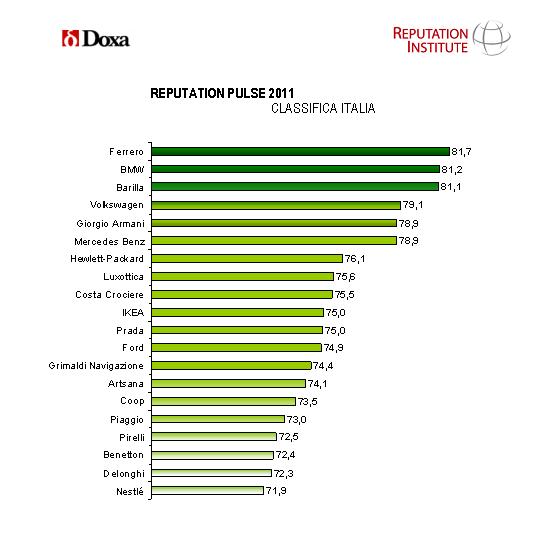 Every year the Institute carries out a research at a global level about company reputation and the factors affecting it, surveying more than 1500 companies from 32 countries. The Reputation Pulse Italy is produced in partnership with Doxa and examines more than 120 companies operating in Italy ranking them following a reputation criteria, with a score ranging from 1 to 100. The survey had been carried during the first three months of 2011, with more than 3,000 people interviewed.
So this year is Ferrero standing at the top step of the podium (with a score of 81.68), closely followed by BMW (81.19) and Barilla (81.16), with only three companies achieving a score of ” reputation of excellence “(over 80). Further down the rankings there are companies like Armani (78.90) ranked fifth, Luxottica (75.56) eight, Coop (73.54) fifteenth, Pirelli (72.55) 17th, followed immediately by Benetton (72.42), 18th. The “top 20” companies outweigh the positive threshold of 70 points, the remaining companies are hardly reaching that level: of the 124 firms surveyed, only 30% are showing a score higher than 70.
The 2011 survey considered only the companies amont the 100 rated in Mediobanca’s annual report about the “Leading Italian Companies”. The Pulse Reputation Italy survey has also expressed an evaluation in terms of gain or loss of reputation as compared to year 2010: Alitalia sees the highest score reputation increase (+12.8 points), followed by Intesa Sanpaolo (+ 7.1) and Unipol (+6.5). Mediaset (-10.7) with Lottomatica (-10.6) and Mediolanum (-10.2) are the protagonists of the worst loss of reputation, with a drop of about 10 points compared to 2010.
“Corporate reputation – said Michele Tesoro-Tess, head of the Reputation Institute in Italy (Advice dept.) – has a primary strategic importance for companies: when positive, can be a source of value, but if it is weak or negative it can make the company vulnerable. ” “We analyzed – adds Guido Argieri responsible for the Reputation Institute in Italy (Research dept.) – that in Italy more than 50% of the public has a favorable attitude toward the first three companies in our ranking, leading to consumers to be more willing to accept any increase in prices or tariffs applied to these three companies products.” (Source: Purpleandnoise)
The Coca Cola Company and the new PlantBottle® packaging: sustainability comes from sugarcane!
Beginning April 4, 2011 the first 100 percent recyclable beverage packages made with plants are readily available to people across the U.S. If you want to enjoy the fresh taste of DASANI, or a nourishing Odwalla beverage in a more environmentally responsible package made from plants, now you can. There’s no more waiting.
PlantBottle® packaging for both brands was developed with the planet in  mind by PlantBottle® Packaging Platform, The Coca Cola Company. Single-serve Odwalla packages are made from up to 100 percent plant-based materials with high-density polyethylene (HDPE) plastic. PET bottles for DASANI are made with up to 30 percent plant-based materials.
“It’s our goal to make traditional plastic bottles a thing of the past and ensure that every beverage we produce is available in 100 percent plant-based, fully recyclable packaging,” said Scott Vitters, General Manager, PlantBottle® Packaging Platform, The Coca-Cola Company. “The national launch of DASANI PlantBottle® packaging represents an important step toward reducing our carbon footprint, and the up to 100 percent plant-based, recyclable packaging used for Odwalla is the first of its kind in the beverage industry.”
Traditional PET bottles are made from petroleum and other nonrenewable fossil fuels. Incorporating a blend of petroleum-based materials with up to 30 percent plant-based materials allows PlantBottle® packaging for DASANI to reduce potential intrinsic carbon dioxide emissions when compared with PET plastic bottles
“DASANI is designed to make a difference by offering a better designed package for a more sustainable future,” said John Roddey, Vice President and General Manager, Water, Tea and Coffee, Coca-Cola North America. “Because DASANI PlantBottle® packaging is up to 30 percent made from plants and still 100 percent recyclable, it was designed with the planet in mind by helping to reduce the impact of our packaging on the environment.”
The plant-based materials for both DASANI and Odwalla PlantBottle® packaging are produced through a process that turns sugarcane into a key component for PET and HDPE plastic. Currently, PlantBottle® packaging is made using sugarcane ethanol from Brazil, the only source widely recognized globally for its unique environmental and social performance. Brazilian sugarcane is primarily rain fed and industrially grown on abundant, arable land using organic fertilizers. The plantations from which PlantBottle materials are sourced are located far away from Amazon rain forests, and their impact on biodiversity is reduced thanks to advanced farming practices and sound public policy.
Unlike other plant-based plastics, PlantBottle® packaging is entirely recyclable and can be processed through existing systems. This ensures PlantBottle® packaging can be repeatedly used, recycled and reused. In addition, there are no differences in shelf life, weight, composition or appearance between traditional PET plastic bottles and PlantBottle® plastic bottles.
In late 2009, PlantBottle® packaging was launched in the western U.S. and eight other markets around the world. To date, PlantBottle® packaging is estimated to have eliminated the equivalent of 30,000 metric tons of carbon dioxide, or three million gallons of gasoline used to produce PET plastic bottles. Currently, The Coca-Cola Company is working to further technology so other plant materials can be used in future PlantBottle® packaging. The ultimate long-term goal is to turn waste into a resource, resulting in a carbon neutral, 100 percent renewable, responsibly sourced bottle that is fully recyclable.
“Several approaches to a PET package made entirely from plants have been successfully demonstrated in laboratory testing. We’re working to advance this breakthrough science to ensure it is commercially viable,” said Vitters. “PlantBottle® packaging means only good things for everybody. We welcome others in the industry joining us in advancing the science behind packaging made from plants.”
The technology used to make PlantBottle® packaging already has been adopted by Heinz, which recently announced it will begin packaging its ketchup using that technology this summer under license from The Coca-Cola Company.
The rollout of PlantBottle® packaging for DASANI will be supported by a national television spot breaking in April. Additional executions will include enhanced packaging graphics, as well as out-of-home, print, digital and point-of sale-advertising to build awareness for PlantBottle® packaging. Odwalla’s marketing program includes coupons, print advertising, digital programs and new labeling Point-of-sale materials for in-store displays will feature attention-grabbing messages such as “Paper or Plastic? Try Plant!” (Source: Businesswire)
Vinitaly opens its doors with interesting data
Vinitaly focus on export and on the Italian market decline.
How to seize the new opportunities coming from abroad, particularly from Asian markets, and how to support the internal Italian market are the two main themes of the 2011 Vinitaly, the most important Italian Wine exhibition, which is taking place in Verona (Italy), and will end on April 12 .
The Italian wine business is quite a big one, worth € 13.5 billion plus a €2 billion deriving from induced activities. But there are lights and shadows. For example, on the exports side, 2010 experienced a growth reaching a +12% equal to 3.93 billion euro, while domestic consumption is decreasing.
For the first time, reports Coldiretti (the Italian association of Agriculture farmers), 2010 showed a stagnation in the internal sales, now at € 3.89 billion.
Riello, the President of Veronafiere, has stressed even more the wine business critical situation, the decline in domestic consumption, which continues, “was between 100 liters per capita in the Seventies, up to 45 liters in 2007, about 40 liters per person nowadays” showing a “further decreasing trend by 2015. ” The problem, recently highlighted by Giuseppe Martelli, director general of Assoenologi (the Italian Association of oenologists), is that “an oenology structured like the Italian one, cannot rely only on export.”
A couple of data: “in Australia only ten companies produce more than 90% of the wine exported, in Chile of 120 wineries, 100 are working only for export. In Italy, however, companies are more than 450 thousand, with an average size that is below the three hectares, compared to 300 in Chile and Australia. ”
Even a survey Vinitaly Winenews-emerges as foreign markets are critical to revenue growth, a situation that can cope with the larger companies, but few compared to many small enterprises that characterize the Italian production scenario and still have turnover rather weak.
A Vinitaly-Winenews survey on 50 companies among the most representative of the Italian business, show that 2010 ended with an average revenue increase of 8%, driven in particular by exports (+14%). As per 2011, the report show a degree of optimism: 75% of the interviewed said to be quite positive, 15% positive while a 10% of wineries that still feels the situation to be critical. The most critical points highlighted by the survey are economy instability, weak consumption, the loss of international competitiveness, the hars internatioanl competition.
The boom in exports, according to Coldiretti, is due largely to the U.S., which in 2010 became the country with the highest consumption of wine in the world. The American market, which is worth about $ 30 billion, is covered for 61% of production in California, but Italian wines are the most consumed ones, growing in value by 11%.
The most important destination of Italian wines are Germany, +4% in 2010, China – exports to this country doubled in 2010 – India, +65%, and Russia, +58%, equal to €104 million.
Coldiretti also analyzed the important value of the employment world of wine: the 250,000 Italian companies create jobs for for 1.2 million people. There are about half a million owners of vineyards, which have about 210,000 employees, of which over 50,000 are young and 30,000 are foreigners. And the wine business does not end in the vineyard, opportunities being in adjacent sectors like trade and catering, glass, cork, label and packaging, as well as research, publishing, finance, wine tourism, health, bio-energy. (Source:manageronline.it)
Online retail: how to turn a negative consumer feedback into a positive one
Retailers who are going to open online shops often fear about negative feedbacks from online shoppers. “What if I receive a negative feedback? Should I ignore it or answer?” The most common retail behaviour is to ignore it, hoping it will be ignored by other consumers too. But this is a great misconception. 
Retailers have an opportunity to fight back and use social media to turn unhappy customers into brand advocates, says the Retail Consumer Report, commissioned by RightNow and conducted online by Harris Interactive in January 2011 among 1,605 online US adults. The report shows how retailers are using social media to win back customers and drive buying decisions.
- 68% of consumers who posted a complaint or negative review on a social networking or ratings/reviews site after a negative holiday shopping experience got a response from the retailer. Of those, 18% turned into loyal customers and bought more.
By listening and proactively responding on the social web, says the report, retailers have a chance to turn disgruntled customers into social advocates.
After a positive shopping experience, half of consumers cited great customer service and/or a previous positive experience as influencing their decision to buy from a specific online retailer.
Social advocacy can also help drive sales, the survey found:
- Nearly a third of consumers researched what customers said on social networking and reviews websites while shopping online.
For those consumers that had a positive holiday shopping experience with an online retailer during the past holiday shopping season:
- 21% recommended the retailer to friends.
- 13% posted a positive online review about the retailer.
The survey found that 38% of consumers turned to the retailer’s website for information or support with online shopping. However, one of the top frustrations consumers had when shopping online was a lack of consistent information from retailers. Specifically, 22% of consumers were frustrated by information that was inconsistent between the retailer’s website and customer service agents.
For further research on how customer experiences impact the bottom line, including the fact that 85% of consumers said they would be willing to pay anywhere between 5-25% over the standard price to ensure a superior customer experience, RightNow makes the Customer Experience Impact Report 2010 available to download. (Source: MediaPost)
How to deliver customized in-store offers to shoppers?
One of the in-store marketing biggest issues ever is how to reach customers with customized offers while they are shopping. U.S.A retailers and consumers are going to have a solution handy in the next future: Shop O’Lot. 
Shop O’ Lot is a self service platform which makes major retailer participation very easy. The model is based on a predictive analysis engine, that builds a customer’s shopping profile, then allows retailers to reach these customers in real-time while they are shopping, offering them customized discount coupons.
The app uses GPS and bar-code scanning for delivering the content and will be released on the iPhone and Android OS platforms.
Bob Pack, CEO says, “major retailers are now competing with product search and comparison apps that can actually drive a customer to buy from a competitor, a practice known as “scan and scram.” We have a complete solution to really help drive retail purchases, this goes well beyond mere Geo- location and focuses on individual target marketing. Once we understand the shoppers tastes, delivering them customized product deals only by the store they are in, will help keep shoppers loyal.”
Shop O’ Lot is still in the testing phase and plans a 2011 launch and retailers and consumers, can sign up now to be part of our beta program directly on Shop O’Lot website. (Source: americanbankingnews.com)
 normancescut.com