Category Archives: trends and forecasts

Green Certification Awarded to French Supermarket in China

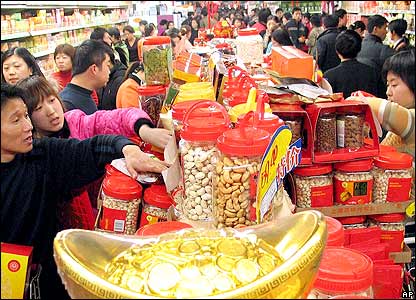
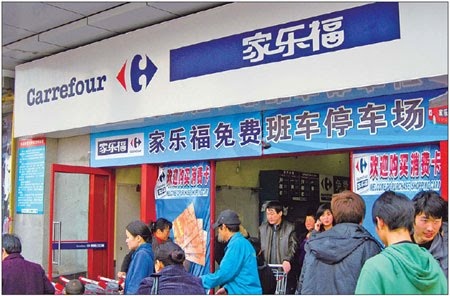
China Certification & Inspection Group has reportedly issued the Green Market Certification to Carrefour’s six stores in Beijing, making the French supermarket one of the first retailers to gain the certification in the Beijing region.

20110607-135536.jpg

Liu Shengming, chairman of CCIC, told local media that the Green Market Certification has been fully launched in the retail sector of Beijing. Green Market Certification is a national certification system co-developed by the Ministry of Commerce together with the Certification & Accreditation Administration of China. Organizations that have obtained the Green Market Certification are allowed to use the uniform certification board. The Green Market Certification logo can be used in their marketing materials or other relevant information.

Luc Vandevelde, chairman of the Supervisory Board of Carrefour, has revealed the plan for Carrefour’s first green shopping center, where rainwater and energy can be recycled. Compared with a regular architecture, the green shopping center can save up to 30% in water and energy. In addition, it will use efficient materials to reduce the consumption of resources.

China Certification & Inspection Group, Shenzhen Company Ltd. operates a wide network of over 300 offices and laboratories which are located in major ports and cargo distribution centers around the world. With over 20 years’ experience in the inspection and certification field, CCIC has established cooperation relationships with more than 120 inspection and certification companies in over 60 countries and regions, including foreign organizations such as UL, CSA, and TUV Rhineland.(Source: China Sourcing News)

Low-carbon products: when there will be a mass mass-market demand for them?

As stated in the last CBI report about UK consumers and low-carbon products, three quarters of the UK’s greenhouse gas emissions either directly or indirectly attributable to consumer actions. Companies are taking action to drive up standards and setting up pilot initiatives for green products. Energy efficiency and carbon labels and descriptions currently adorn many of our shopping shelves, increasing transparency. But many consumers do remain skeptical about sustainability being a MUST for our future.

The report shows that there is no trade-off between sustainability and profitability but, as we are always stressing in our ECOFFEE communication projects,”(Many business leaders acknowledge that) it is not sufficient to operate in a sustainable way – they also have a responsibility to inform consumers about green choices”. Business cannot boost demand for low-carbon products without the appropriate communication. Let’s take for instance Procter & Gamble’s successful Turn to 30 campaign with Ariel linked the financial benefits to consumers of washing at lower temperatures with the positive environmental impact. This campaign successfully create a link between a product, a consumer personal behaviour and the resulting more sustainable impact on environment.
Once a company has created a demand for its green products, gains arrive very fast.

Philips’ success in energy efficient lighting is an excellent example: the strategic decision to develop the energy efficient lighting side of its business led to successful positioning
at the forefront of innovation.

Retail plays a very important role in raising awareness among consumers and empower them to make greener choices. Tesco for example has worked to highlight the carbon
footprint of its products to help consumers understand the impact of their purchasing decisions. And it worked great.

Now the question is: why there is not such a mass-market demand for green products? It seems that there is a missing link between the consumer and the environmental impact of purchasing a green product versus a not-so green one. When asked about the top three or four factors shaping their choice of purchase, UK consumers top rated one is cost to buy, followed by quality and reliability and brand. The environmental impact is ranked 10 (8%). It seems that there is a disconnection between consumers and the environmental impact of their choices, especially when carbon emissions are concerned. Nearly half (48%) of survey respondents could see the link between low-carbon and helping to tackle climate change, whereas less than a third (30%) identified the link between climate change and energy efficiency.

Labelling plays an important role in raising consumers’ awareness and A-G labelling has been a particular success, being well recognised among those aged between 35-64 (76%) and those earning over £25,000 a year (83%). It is no coincidence that products where the energy efficiency story is most developed for consumers tend to be those where the A-G label is displayed, such as fridges.

To answer to the question “When there will be a mass-market demand for green products?”, it all relies on clear communication and on educating consumers about the impact of their shopping and daily habits on the environment.

LVMH Group to fund India’s Ready-to-Wear Fashion Retail

The world’s largest luxury goods conglomerate, LVMH Group, will launch its private equity fund in India, in an attempt to tap the burgeoning disposable income and rising aspirations of the country’s urban population, especially women.

L Capital, present in New York, Madrid, Milan, Shanghai and Singapore, will invest in India from its fourth fund, which is dedicated to Asia and has a corpus of $650 million. It also will focus on economies such as China, Malaysia, Indonesia and Thailand.

“We are looking at investing in companies in the lifestyle arena in Asia, primarily from the aspirational segment, meaning people who are moving from mass-produced goods to the next layer up,” said Ravi Thakran, managing partner of L Capital. “We are not keen on top-end luxury in India. We may look at that, but that is not our main focus.”

Mr. Thakran said Indian high-end designers are missing out on the real growth story in fashion by focusing on couture, which caters to the richest 500 families, and the wedding apparel business. The opportunity, he said, is in the ready-to-wear segment.

Mr. Thakran–who previously worked at the Swatch Group and helped launch Indian jewellery brand Tanishq in the U.K.–also, is betting on discretionary spending gaining pace in India.

“Today the world is moving towards a new center stage, which is certainly Asia, but China and India are two pillars of that,” he said. “This was the case pre-crisis but post-crisis it is even more so.”

However, India lags behind China when it comes to scalable brands and businesses. “In China, there are already at least 10 businesses we might be interested in which are worth $200 million to $250 million, whereas in India none of the (best known) designers have even reached the $100 million scale,” Mr. Thakran said.

L Capital is looking to bring in expertise on operational improvements in areas such as product design, logistics, store design, visual merchandising, talent search and training and development. Assistance in these areas for an early stage growth company is more important than capital, Thakran said.

He will be looking for deals in shoe, apparel and wine businesses, makers of lifestyle furniture, beauty brands, apart from skincare centers and spas.

“This is where the new consumption is rising in India,” Mr. Thakran said. “When aspirations and disposable incomes rise, consequently consumption in new arenas, our targeted sectors, also rises.”

Fashion designer J.J. Valaya, in an e-mail response, defended the prevalent focus on couture and wedding dresses, citing “lack of infrastructure, distribution and adequate capital.” He added that ready-to-wear is profitable only if it achieves volume.

“At present the top names in the country are not prepared to reach those numbers single-handedly,” Mr. Valaya said. “In the West too, a Louis Vuitton or a Jimmy Choo achieved reach through strategic corporate associations.” According to Mr. Thakran, Indian fashion businesses suffer because the creative force, the designer, is forced to look after operations due to lack of resources.

This shortage of resources has prevented recognized Indian businesses from transforming themselves into brands with greater economic value, he said. “If the creative guy is busy sorting out the accounts and logistics, and looking after the retail store, he cannot focus on the creative part,” Mr. Thakran said. “If you can bring to them knowhow in these areas and to build that front end, these brands can really unleash their potential.” (Source: Online WSJ.com)
How to implement grocery retaling and e-tailing in India

We found this article by Avinder Batra, published on IndianRetailer.com very interesting because of its very detailed approach to the implementation of a home delivery service for those small groceries retailers that are facing the competition with by multinational like Wal-Mart. This is also a business model which is very sustainable, by lowering CO2 transportation emissions and by mainting vital the traditional small retail grocery business.

Batra identifies a big trend in the grocery business- home delivery- due to two main reasons:

-High fuel price: Indian families are not interested in spending time on these products
-Families want more leisure time for themselves: Since both the partners are working, shoppers find this activity as waste of time to collect groceries in weekends

“When most of the big retailers are fighting for larger space, opportunities can be foreseen where you do not have compact space and can still run successfully through Etailing the Grocery model” Batra says.

The solution could be a mix of website, mobile, IVR.

High rental costs have made the retail business cumbersome for the independent players.  As told by Ragib Hussain, VP, Vice President Strategy at e.Soft Technologies,  “This type of model does not need much of investments. Etailing models (having virtual shop) can help retailers in expanding the business thus by covering larger area & reap good volumes.”

Small independent retailers need to increase their customer base: Online services and then home deliveries would fetch revenues only when you have large customer base. Margins are the rewards which an investor gets and this is what he has to work on to have with minimum liable cost.

Develop tie-ups/partners: Developing partnership agreements with the kirana shopkeepers and others nearby shops in the area that would reach the consumers through home delivery systems. This should  be the initial step of building a strong network in the areas concerned you want to cover.

 Also, it would decrease the liability on the retailer—warehouse cost, maintenance cost, procurement cost, etc. 

Develop your own site and make a strong viable back-end system for smooth functioning of the business model: either by creating your own hosted website or by opting for cloud services, this is a very important step. Cloud services would play a vital role to make updated connections with your suppliers, logistics suppliers, CRM updates and drop shipping suppliers. Because time is a critical factor, efficient distribution is of utmost importance. Technology plays a key role in enabling an efficient dairy distribution model.

 This is the back bone of the whole concept when the business starts working and it is the most challenging part of the business to make real-time connectivity with them.

Home delivery services: By tying up with the partners in the local areas, investor can direct the orders to those shops and through delivery boys; the task can be executed smoothly. This would even increase the revenue prospects of the local partners.

 If the business model is churning profits, there is no harm in having your own warehouses and company owned shops in the localities. This could be the way to expand your business model and make it stronger.

Each small outlet should be centrally connected to the warehouse to record the sale and updates are on real time basis. This would help to replenish the goods which are going out of stock.

Delivery system: Tempos and other mini trucks can be used to provide deliveries in the located areas if orders come in bulk in particular area. (Source: IndiaRetailer.com)

Cosmetics industry faces sustainability

We always talk about sustainability in the retail sector dealing with products such as food and apparel, but what about cosmetics? There has been increased interest from the cosmetics industry toward sustainability, the reason why a  Sustainable Cosmetics Summit, is going to be held in New York from May 12 – 14.

In the cosmetics business too, sustainability has become very important to help companies to steer their way out of the recession and tap into the big opportunities that are likely to arise over the next five years.

As stated by Irina Barbalova, head of beauty and personal care for Euromonitor, the four key trends in the cosmetic industry include focusing on the ever-growing emerging markets, new media in western markets, offering better value for money to consumers who continue to be hard hit by the economic downturn in western markets and communicating sustainability through brands.

As stated by Aveda‘s VP, Chuck Bennet “The environmental footprint of a cosmetic, or any product, must account for the full ‘life cycle’ of the product. This includes many factors such as energy and water consumption, emissions to the environment. It can significantly misrepresent the actual footprint of a product if the focus is limited to, for example, manufacturing only.”

According to market researcher Accenture, co-operation with packaging suppliers in efforts to reduce the overall carbon footprint of products. Pressure to reduce environmental impact, and to reduce costs generally, is forcing companies to take sustainable packaging seriously. A supply chain view of packaging provides the breadth of vision required to develop optimal solutions: for example, the recycling of some packaging materials and the switch to reusable packaging. To address sustainability, Accenture recommends companies scan their supply chains to determine the true value proposition of different strategies to reduce, reuse, and recycle.

The research firm estimates that companies can save 3 to 5 percent in supply chain costs by adopting green packaging initiatives, in addition to the revenue uplift from green consumers.

In the US, L’Oreal for example made inroads to reduce the environmental impact of its beauty product packaging by introducing two new assessment tools to its package design process, while Unilever has looked to reduce the amount of waste used in the packaging of a product, yet maintain protection. Unilever has minimised the packaging on its stick deodorants as well as making them more lightweight, to reduce the impact of transporting the goods.

In France, Clarins has built an alternative model, such as agreeing long term Fairtrade contracts with producers of katafray in Madagascar, offering 5% of the sales price from relevant brands to help local communities. “I believe consumers today are more knowledgeable than before, thanks to the media, so they can see through companies that greenwash,” said Yvette James, head of Clarins‘ responsible development division. (Source: CosmeticDesign.com, warc.com. Picture credits: Americanspamag)

Chinese consumers are willing to pay for sustainability

We have already talked about China as one of the fastest growing markets in terms of customer awareness towards sustainability: Chinese do appreciate and search for sustainability.

A study released on April 18th by global advertising and international marketing firm Ogilvy & Mather answer to the question that our customers usually ask: “Do consumers are willing to pay more for sustainable products?”. The study shows that the answer is “Yes, Chinese consumers are willing to pay a small premium for environmentally friendly products”, but they place responsibility to fix China’s environmental woes on the government.

Convenience is the main factor driving shopping decisions for more than half of the 1,300 Chinese consumers across China, but 71 percent said they would pay up to 10 percent more or higher for some “green” products.

“Within about a 15 percent price band, if two items have comparable brand image, people will go for the sustainable option,” Kunal Sinha, the lead author of the study and head of the company’s sustainability practice in China, told Reuters.

“But if you were going to sell it purely on its sustainability credentials, it wouldn’t fly,” he said, referring to the range of green products and sustainable behaviors covered in the study, from toiletries to food and vacations.

Shoppers were willing to open their wallets the widest for sustainably produced milk, at premiums of 17 to 20 percent, the study said, an indication of how severely scandals involving tainted milk have damaged China’s dairy industry.

The study noted large gaps between the sustainable behavior Chinese consumers profess to and their actual consumption habits, a trend that also exists in developed markets such as the United States.

One measure of their optimism: more than 90 percent of those surveyed said they thought the sustainability movement was growing. But fewer than a fourth or respondents said they felt empowered to solve environmental problems on their own, and instead looked to the government to fix the country’s environmental woes.

Chinese consumers have long been hesitant to loosen their purse strings, more so than consumers in other countries at a similar stage of development. But domestic consumption is picking up quickly and many analysts think it has reached a turning point.

That means Chinese consumers’ buying power may be out-pacing their green ethos. The survey said the concept of sustainable living is not yet mainstream, with respondents saying those leading the movement in China are seen as idealists.

Joel Backaler, a director at the consulting firm Frontier Strategy Group who blogs on Chinese consumption trends, says mainstream Chinese consumers are focused on aspirational purchases in the short to medium-term and will not begin focusing on green and sustainable consumption for years.

“The vast majority of China’s middle class are for the first time learning how to spend and join the consumption phenomenon that their counterparts in the U.S. and Western Europe have long enjoyed,” he told Reuters in an email. (Source: Reuters)

Brand Reputation: Italy’s best ones are Ferrero, BMW and Barilla

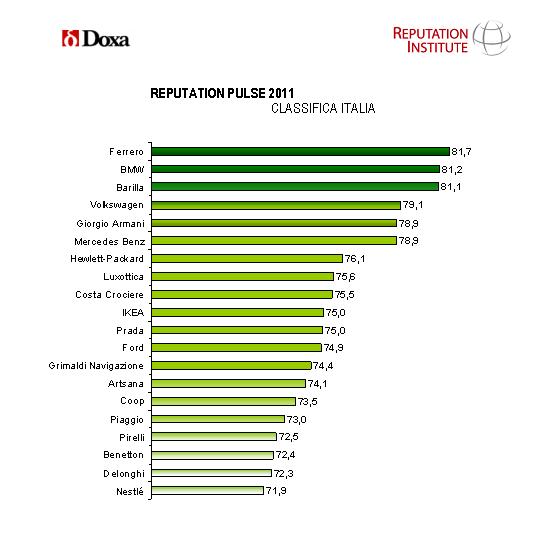
Ferrero, followed by BMW, and Barilla, are the company whose brand reputation has been rated the best one in Italy by the last “Reputation Pulse 2011″survey, the most important and extensive national research about company reputation conducted by the Reputation Institute in partnership with Doxa. The Reputation Institute, the main structure at a worldwide level dealing with issues such as corporate branding and reputation management, has been helping in the last 15 years more than 200 companies to measure, understand and enhance their potential in terms of reputation.

Every year the Institute carries out a research at a global level about company reputation and the factors affecting it, surveying more than 1500 companies from 32 countries. The Reputation Pulse Italy is produced in partnership with Doxa and examines more than 120 companies operating in Italy ranking them following a reputation criteria, with a score ranging from 1 to 100. The survey had been carried during the first three months of 2011, with more than 3,000 people interviewed.

So this year is Ferrero standing at the top step of the podium (with a score of 81.68), closely followed by BMW (81.19) and Barilla (81.16), with only three companies achieving a score of ” reputation of excellence “(over 80). Further down the rankings there are companies like Armani (78.90) ranked fifth, Luxottica (75.56) eight, Coop (73.54) fifteenth, Pirelli (72.55) 17th, followed immediately by Benetton (72.42), 18th. The “top 20” companies outweigh the positive threshold of 70 points, the remaining companies are hardly reaching that level: of the 124 firms surveyed, only 30% are showing a score higher than 70.

The 2011 survey considered only the companies amont the 100 rated in Mediobanca’s annual report about the “Leading Italian Companies”. The Pulse Reputation Italy survey has also expressed an evaluation in terms of gain or loss of reputation as compared to year 2010: Alitalia sees the highest score reputation increase (+12.8 points), followed by Intesa Sanpaolo (+ 7.1) and Unipol (+6.5). Mediaset (-10.7) with Lottomatica (-10.6) and Mediolanum (-10.2) are the protagonists of the worst loss of reputation, with a drop of about 10 points compared to 2010.

“Corporate reputation – said Michele Tesoro-Tess, head of the Reputation Institute in Italy (Advice dept.) – has a primary strategic importance for companies: when positive, can be a source of value, but if it is weak or negative it can make the company vulnerable. ” “We analyzed – adds Guido Argieri responsible for the Reputation Institute in Italy (Research dept.) – that in Italy more than 50% of the public has a favorable attitude toward the first three companies in our ranking, leading to consumers to be more willing to accept any increase in prices or tariffs applied to these three companies products.” (Source: Purpleandnoise)

QATAR FOUNDATION to develop local luxury brands

Qatar Luxury Group (QLG), the first venture of Qatar Foundation in the luxury segment, will unveil a series of all-new Qatari brands this year in the fashion, hospitality and lifestyle sectors. Gregory Couillard, Chief Executive Officer of Qatar Luxury Group, said that two years after the Group started it is creating a structured portfolio of culturally informed high-end brands that offer exclusive experiences and timeless products.

The press release posted in the CPP website does not mention whether the Qatar Luxury Group will embrace sustainability and responsibility- a big must now in the Middle East countries, as shown by the Masdarcity  and the many project requests ECOFFEE receive everyday. We will investigate about and keep you updated.

CPP-Luxury, an online business magazine, adds that the Group is currently active in two main sectors — fashion and hospitality. Fashion represents the core activity of the Group, which has invested heavily in world-class design and engineering equipment for in-house development of product lines. Prototyping units on jewellery, luxury ready-to-wear apparel, shoes, leather goods and accessories are all located at the QLG’s headquarters and soon a manufacturing facility will be opened for mass production of the unique product lines which is not only meant for the local market but for the international sphere as well.

The first initiative of the Group will be the launch of a restaurant later this year in collaboration with an internationally recognised 3-star Michelin French chef, two more restaurants in 2012 and one luxury fashion brand alongside the Group’s development of projects in the lifestyle sector. Couillard is optimistic QLG will contribute considerably in the country’s thrust toward diversifying its economy. The Group has a strong team with members from 14 nationalities including designers from Belgium, Chile, Qatar and US.

The press release posted in the CPP website does not mention whether this huge project will embrace sustainability and responsibility- a big must now in the Middle East countries.

Retail, web 2.0 and sustainability:an analysis

A recent Zumer and Sustainable Life Media research is helping medium to small size retailers to better understand what is the connection among sustainability, consumers and web 2.0 tools.

The survey analizes the behaviour of 50 of the biggest companies leader in sustainability, at a worlwide level. Names such as Chevron, McDonald’s, PepsiCo, Coca-Cola, Campbell’s Soup, Microsoft, Toyota, Starbucks appear in the list of the companies whose online conduct on the three top social media, Facebook, Twitter and YouTube was analyzed for six weeks between December 2010 and January 2011.

We have found three key points that can be summerized as follows:

1. Authenticity: sustainability must permeate the whole company and must involve the company’s stakeholders so that ensure an authentic online communication, a more effective management of external reputation and brand perception. This is perfectly in line with the Cone research we have posted a while ago: consumers DO PUNISH not authentic communication about sustainability.

2. Sustainability helps acquiring new market share: almost three quarters of the professional interviewed stated that sustainability-themed social media are the channels to be in in order to get the attention of new market segment and reinforce the company’s position in the more traditional ones

3.Mix platforms to get the best results: although Facebook is still the most favourite platform among the big 50 companies in the survey, with investments rising in 2011 too. Tweeting about sustainability is becoming very common too -investments will double by 2015, as well as are CSR dedicated company’s websites, while YouTube actions are still fragmented. Blogging about sustainability might be a very powerful tool, not yet fully implemented by companies (1-2% of total blog posts).

Business Retail: a global view

Retail is big, but how big it is and is it equally distributed worldwide or are there countries where retail is at its best?  

The last CB Richard Ellis Survey  about the business of Retail, reveals how fluctuating this market is, measuring how the most important 323 retailers changed their strategies in 73 countries during the last year.

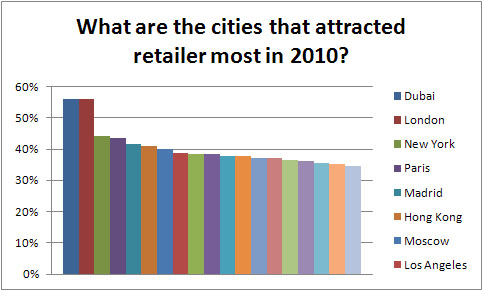
The survey findings are very interesting, showing us that Dubai is the most favorite city for both American (61%) and European (63%) retailers, while only 23% of retailers from the Asia-Pacific area are present in that city – not because of lack of interest, but just because the Asia-Pacific consumer market is the fastest growing, therefore retailers from those countries do not need to branch out abroad.

Retail expansion rate saw a decrease during 2010, only a 2%, compared with 4% in 2009 and 12% in 2008, with new target countries being India (8 new retailers) and Turkey (7). United Arab Emirates (UAE), Kuwait, Ireland, Romania, and Belgium all attracted six new retailers.

Online retail is becoming more and more important for retailers: 82% of the brands in the survey do have an online catalogue, even though only a smaller percentage (46%) offers to consumers the chance to purchase goods online, with Value&Denim being the most active (43%) followed by mid-range fashion  (26%) and Luxury & Business Fashion (32%). To have an online retail shop is the favored choice by those brands who already have a physical store (46%), while in more advanced market such as the U.S.A., there is a slight percentage of online seller (24%) who do not have a physical store, and that are using online sales platform to test the market before opening a physical point of sale.