Category Archives: food retail

Social responsibility, food and Government: the responsibility deal

The responsibility deal signed by the UK governement, backed by 170 companies such as Tesco, Unilever, Sainsbury’s, Carlsberg and Mars and Diageo, is going to rise a lot of controversy for a long time.

A key pledge outlined in the deal is the development of a new sponsorship code on responsible drinking while McDonald’s, Pizza Hut and KFC have agreed to place calories on their menus from September this year.

Other pledges include:
– Reducing salt in food so people eat 1g less per day by the end of 2012
– Removal of artificial trans-fats by the end of the year
– Rolling out Change4Life branding to 1,000 convenience stores

Achieving clear unit labelling on more than 80% of alcohol by 2013 is also pledged but this was a commitment made last year by drinks brands under work initiated by the last government.

Health secretary Andrew Lansley said: ‘Public health is everyone’s responsibility and there is a role for all of us, working in partnership, to tackle these challenges.’ He claimed that regulation is ‘costly and is often only determined at an EU-wide level anyway’.

ISBA’s director of public affairs Ian Twinn also adds “It has also been inclusive – businesses have volunteered to reinforce public health through their product development and marketing and health pressure groups have pledged to contribute through their campaigning activities.

The responsibility deal seems a great step toward the introduction of a more socially responsible fast-food industry, but not all the companies do have the same advise. Cafe Rouge, Bella Italia and Strada are expected to follow Subway and PizzaExpress by not signing up to the government’s health initiative. Subway, which already provides calorie counts on in-store posters, said the scheme was unsuitable for its stores. It is conducting a trial intended to establish the most effective way of displaying the information.

Meanwhile, a PizzaExpress source argued that displaying calorie levels is not consumer-friendly and clutters its menus.

One factor that will no doubt deter businesses, particularly smaller inde-pendents, is the costs involved. London restaurant chain The Real Greek says that, on average, it costs about £100 to test and certify each dish.

Being one of the first to make a move has its risks, not least the fear of being criticized in the press for selling high-calorie-content food. On the other side, being part of a movement that gives consumers greater transparency can deliver positive press coverage.

Toby Southgate, managing director of branding agency The Brand Union, believes the risks are worth taking. ‘Those brands that adopt early could win out, provided they handle the move carefully,’ he says.

Southgate cites McDonald’s, which has made efforts to ‘re-educate’ its con-sumers about healthier eating, arguing that disclosing calories on its menu board could provide incentive to consumption. (Source: BrandRepublic)

How to implement grocery retaling and e-tailing in India

We found this article by Avinder Batra, published on IndianRetailer.com very interesting because of its very detailed approach to the implementation of a home delivery service for those small groceries retailers that are facing the competition with by multinational like Wal-Mart. This is also a business model which is very sustainable, by lowering CO2 transportation emissions and by mainting vital the traditional small retail grocery business.

Batra identifies a big trend in the grocery business- home delivery- due to two main reasons:

-High fuel price: Indian families are not interested in spending time on these products
-Families want more leisure time for themselves: Since both the partners are working, shoppers find this activity as waste of time to collect groceries in weekends

“When most of the big retailers are fighting for larger space, opportunities can be foreseen where you do not have compact space and can still run successfully through Etailing the Grocery model” Batra says.

The solution could be a mix of website, mobile, IVR.

High rental costs have made the retail business cumbersome for the independent players.  As told by Ragib Hussain, VP, Vice President Strategy at e.Soft Technologies,  “This type of model does not need much of investments. Etailing models (having virtual shop) can help retailers in expanding the business thus by covering larger area & reap good volumes.”

Small independent retailers need to increase their customer base: Online services and then home deliveries would fetch revenues only when you have large customer base. Margins are the rewards which an investor gets and this is what he has to work on to have with minimum liable cost.

Develop tie-ups/partners: Developing partnership agreements with the kirana shopkeepers and others nearby shops in the area that would reach the consumers through home delivery systems. This should  be the initial step of building a strong network in the areas concerned you want to cover.

 Also, it would decrease the liability on the retailer—warehouse cost, maintenance cost, procurement cost, etc. 

Develop your own site and make a strong viable back-end system for smooth functioning of the business model: either by creating your own hosted website or by opting for cloud services, this is a very important step. Cloud services would play a vital role to make updated connections with your suppliers, logistics suppliers, CRM updates and drop shipping suppliers. Because time is a critical factor, efficient distribution is of utmost importance. Technology plays a key role in enabling an efficient dairy distribution model.

 This is the back bone of the whole concept when the business starts working and it is the most challenging part of the business to make real-time connectivity with them.

Home delivery services: By tying up with the partners in the local areas, investor can direct the orders to those shops and through delivery boys; the task can be executed smoothly. This would even increase the revenue prospects of the local partners.

 If the business model is churning profits, there is no harm in having your own warehouses and company owned shops in the localities. This could be the way to expand your business model and make it stronger.

Each small outlet should be centrally connected to the warehouse to record the sale and updates are on real time basis. This would help to replenish the goods which are going out of stock.

Delivery system: Tempos and other mini trucks can be used to provide deliveries in the located areas if orders come in bulk in particular area. (Source: IndiaRetailer.com)

A Pop-up revival in retail marketing

Over the past 12 months, a growing number of brands has turned to pop-up activity to provide a burst of PR activity and another reason for consumers to interact with their brand – hopefully ensuring that the effect of these events are going to last even after the shutters come down. The last news about a pop-up store is related to Marni, the Italian fashion brand, located at the Ocean Centre in Hong Kong and featuring the whole Marni Edition.

The pop-up phenomenon dates back 2004, when fashion brand Comme des Garcons opened a guerrilla store in Berlin, followed by a long list of known brands, such as ony Ericksson, Levi’s, Breil, Uniqlo or the most recent ones of Apple, Nokia, and Adidas Originals.

The pop-up strategy allows brands to tap into new markets at low cost, as rents are cheap and the ‘concept store’ strategy creates a buzz without investing in advertising.

Even thought they are an excellent way to deliver a brand experience there is a question over their reach, as they engage only those consumers who actually visit. Jeremy Rucker, head of Hotel Retail, experiential agency RPM’s pop-up and retail division, says the growth of pop-up activity is partly in response to the levels of empty retail space on high streets. ‘With so many brands turning to online-only channels, pop-up activity helps bring excitement back to the high street,’ he adds.

The big question for brands is how to drive investment beyond the life span of the pop-up store and the PR generated at that time. ‘Data capture is fundamental, but creating engaging ways for the brand to interact with the consumer that can a develop a life of their own should be considered,’ says Owen Cato, creative director of retail agency Live & Breathe. ‘Extending activity in the pop-up store online and into social-media activity would work well.’

Claire Stokes, managing director of experiential agency The Circle Agency, adds: ‘Previously, when brands have talked about experiential, it has been all about being in the live space. Now it is about building new digital layers to ensure the halo effect of any given event stretches beyond just one single event.’ For example, when EA Games promoted its key Christmas video-game releases in shopping centres, it encouraged consumers to ‘check in’ to win titles. More than 3000 consumers took part, promoting the event far beyond the boundaries of the event venue.

However, industry experts warn against investing in digital at the expense of the core event. Trevor Hardy, founder of creative agency The Assembly, contends that pop-up activity should be viewed as another marketing channel. ‘The more sensory and multichannel the experience, the better it becomes,’ he adds. ‘The risk is that interactive and social media may dilute the experience – 100% of the efforts should be dedicated to ensuring the experience is the best it can be.’

However, the fact that even retail brands with a consistent high-street presence are turning to pop-up activity perhaps suggests that brands should be creating the excitement of a pop-up shop in their existing retail space every day. Hardy argues that this is not possible, as the ‘focus is on getting the maximum return per square foot’.

Caroline Wurfbain, client services director at experiential agency Jack Morton Worldwide, predicts that more brands will launch pop-up activity over the next 12 months. ‘The challenge is that if ideas don’t change, there is a risk that the market will become saturated and consumers will get bored,’ she adds.

Many of the most successful pop-up launches and events of recent years have not been the work of commercial brands, but independent chefs and artists. As a result, a raft of brands has attempted to mimic the halo effect of organic movements such as Hidden Kitchen, a private supper club that serves 16 people a seasonal 10-course tasting menu paired with wines. However, if these brands fail to offer consumers a compelling reason to interact with them, their experiential strategy risks being dangerously insubstantial (Source: Marketing Magazine)

Chinese consumers are willing to pay for sustainability

We have already talked about China as one of the fastest growing markets in terms of customer awareness towards sustainability: Chinese do appreciate and search for sustainability.

A study released on April 18th by global advertising and international marketing firm Ogilvy & Mather answer to the question that our customers usually ask: “Do consumers are willing to pay more for sustainable products?”. The study shows that the answer is “Yes, Chinese consumers are willing to pay a small premium for environmentally friendly products”, but they place responsibility to fix China’s environmental woes on the government.

Convenience is the main factor driving shopping decisions for more than half of the 1,300 Chinese consumers across China, but 71 percent said they would pay up to 10 percent more or higher for some “green” products.

“Within about a 15 percent price band, if two items have comparable brand image, people will go for the sustainable option,” Kunal Sinha, the lead author of the study and head of the company’s sustainability practice in China, told Reuters.

“But if you were going to sell it purely on its sustainability credentials, it wouldn’t fly,” he said, referring to the range of green products and sustainable behaviors covered in the study, from toiletries to food and vacations.

Shoppers were willing to open their wallets the widest for sustainably produced milk, at premiums of 17 to 20 percent, the study said, an indication of how severely scandals involving tainted milk have damaged China’s dairy industry.

The study noted large gaps between the sustainable behavior Chinese consumers profess to and their actual consumption habits, a trend that also exists in developed markets such as the United States.

One measure of their optimism: more than 90 percent of those surveyed said they thought the sustainability movement was growing. But fewer than a fourth or respondents said they felt empowered to solve environmental problems on their own, and instead looked to the government to fix the country’s environmental woes.

Chinese consumers have long been hesitant to loosen their purse strings, more so than consumers in other countries at a similar stage of development. But domestic consumption is picking up quickly and many analysts think it has reached a turning point.

That means Chinese consumers’ buying power may be out-pacing their green ethos. The survey said the concept of sustainable living is not yet mainstream, with respondents saying those leading the movement in China are seen as idealists.

Joel Backaler, a director at the consulting firm Frontier Strategy Group who blogs on Chinese consumption trends, says mainstream Chinese consumers are focused on aspirational purchases in the short to medium-term and will not begin focusing on green and sustainable consumption for years.

“The vast majority of China’s middle class are for the first time learning how to spend and join the consumption phenomenon that their counterparts in the U.S. and Western Europe have long enjoyed,” he told Reuters in an email. (Source: Reuters)

Online shoppers welcome home grocery delivery

Though few retail grocers offer home delivery of web orders, a survey from the Food Marketing Institute, a grocery industry trade organization, suggests that consumers respond more to web grocers that offer to deliver online orders compared with grocers that require pickup at their stores.

In 2010, 32% of consumers responding to an FMI survey said their primary grocery store offered online ordering, and 28% said they had done at least some online ordering at those grocers. 4% said they shopped online at those grocers one to three times per month, and 2% said at least once a week. But 22% said they shopped online at those grocers less than once a month, with another 73% saying they never shopped there online.

By comparison, the FMI survey showed that only 17% of respondents said their primary grocery store offered home delivery—but 13% said they ordered home delivery one to three times per month, and 5% said they did so at least once a week, higher figures than for when home delivery was not an option. 17% said they ordered home delivery less than once a month, leaving 65% saying they never did.

Regardless of the demand for it by consumers, however, home delivery of groceries isn’t for all retailers, experts say. “Home delivery is only going to work for really big folks with profitable online grocery operations offered in places where the retailer has a reasonable density of customers,” says Jack Horst, a retail strategist at retail industry consultants Kurt Salmon.

The category of “really big folks” surely includes Amazon.com, the largest web-only retailer, and Wal-Mart Stores Inc., the world’s largest retailer and the leading U.S. grocery merchant. Both Amazon and Wal-Mart are experimenting with home delivery of groceries.

Amazon’s program, dubbed AmazonTote, has been tested by the company’s employees in Seattle for the past six months or so. In its infancy, the service entails weekly delivery of groceries and other items to the user’s home, with the groceries bagged in reusable tote bags, all free of charge.

According to The Financial Times, the service is linked to Amazon’s Fresh grocery delivery service, which currently only operates in the Seattle area but is available to all consumers in that area.

Fresh offers fresh produce and meats in addition to non-perishable grocery items; the service goes beyond food, too, ranging from pet supplies to beauty products and other Amazon.com categories. Granted, the convenience is reflected in the price — would you pay $2.50 for a single grapefruit under any other circumstances? — but you get what you pay for, which in this case amounts to a lot of time and energy saved.

On the other side, the “Walmart To Go” test , just launched in California last Saturday, allows customers to visit Walmart.com to order groceries and consumables found in a Walmart store and have them delivered to their homes, a company’ spokesman said. Products include fresh produce, meat and seafood, frozen, bakery, baby, over-the-counter pharmacy, household supplies and health and beauty items. Wal-Mart also offers a Pick Up Today service, which is limited to select electronics, video games and appliances.

What Amazon also needs to fear is a new initiative from the company called @WalmartLabs.  According to GeekWire, this new Silicon Valley-based arm of the company is stating it has pretty lofty goals: “Walmart plans to expand the @WalmartLabs team and expects this new group will create technologies and businesses around social and mobile commerce that will support Walmart’s global multi-channel strategy, which integrates the shopping experience between bricks and mortar stores and e-commerce.”
In other words, exactly what Amazon does, except with the integration of brick and mortar stores.

Walmart seems to be turning its collective eyes towards technology more and more as of  late, the only real question is what took them so long.  If the discount store giant starts pouring its massive resources into more technology integrations, releasing its own products and taking on the likes of Amazon, we could see the company slowly take over eCommerce just as it did with the retail world.

The majority of grocery retailers still prefer store pickup of online orders, as MyWebGrocer* CEO Rick Tarrant says. But if the Wal-Mart and Amazon test will prove to be successful, we are pretty sure that at-home delivery will be the next big trend.

*MyWebGrocer, a provider of e-commerce and digital marketing technology and services to more than 110 grocery retailers, has supermarket clients including ShopRite that offer home delivery in some markets

Italians and sustainability in the retail business: the buzz is online!

Italians speak about sustainability online.This is the result of a recent survey led by Blogmeter from October 1st, 2010 to January 31st, 2011 recording approximately more than 9 thousand post about environmental sustainability related to the major retail chains. Social media proved to be the ideal and most followed communication tool  to promote eco- initiatives, facilitating the construction of  a real “green image” for the retail business sector.

Retailers mentioned by Italians on online conversations about sustainability

When it comes to environmental sustainability Coop and Ikea and are the most discussed with over 40% of the citations. This happened for example with the Sportello Ambiente initiative,  a collaboration between Ikea and Legambiente to offer advice to consumers about home energy efficiency, and with the Coop campaign to promote the consumption of tap water in place of the bottled one.

In general, web users are showing an increaside sensitivity to organic and low-
environmental impact products:  in the online communities dedicated to women, users positively report about the presence of automatic distributors to refill detergents inside the supermarket. Retailers brands are the most mentioned ones, most widely quoted and commented by users because always available on the shelf – like Esselunga Bio, Bio of Auchan, Coop Viviverde. Lidl, for example, is particularly discussed for its range of ecological detergents W5 (on 42 over 199 posts mentioning the retailer) considered to be of good quality and highly recommended among users.

The network also tells us that attention to a more responsible consumption is steadily increasing and influencing the purchase process in different ways: users are more sensitive to labels and the presence of the Ecolabel certification is considered increasingly important for those who are looking for products with a low environmental impact.

The research also showed that a balanced relationship between quality and price of organic and /or eco products is a key criterion in the buying process: very often consumers who are interested in green products do desist because selling prices are too high. (Source: GDO Week)

McDonald’s opens its first green restaurant in Italy

Ho.Re.Ca and sustainability: in Italy there are still people who do not like to match these two words or that asserts that “the time has not yet come,” and this is the great challenge we are – successfully – addressing  with ECOFFEE. We strongly believe that the Italian consumer is able to perceive and reward the added value of sustainable products and services, and the news that McDonald’s has just opened its first green restaurant in Italy, in Lainate (near Milan) do prove that we are not wrong. This green McDonald’s was designed to be completely self-sufficient in energy: thanks to solar, wind and biomass. The project costed € 5 million, 20% more than a traditional restaurant but at the end of the year it will certainly pay off in terms of increased brand reputation, reduced  environmental and social impact, not to add the reduced costs due to the energy saving architecture and technological process. 
At the end of 2011, the results coming from the adoption of these policies will be evaluated by an Italian green environmental consulting company ECOFFEE has already established a business connection with a while ago.  Meanwhile, McDonald’s aims to achieve the European certification EN 16001, which will help the company to organize systems and processes aimed at improving the economic benefits of energy efficiency and reducing emissions of greenhouse gases.

But let’s talk about the “McGreen” in Lainate – a project whose details are available at the McDonald’s site www.persapernedipiu.info Currently, the restaurant is able to produce up to 90% of the energy needed, but within three months it is said to reach 100%, thanks to a pioneering trigeneration plant that use the exhausted cooking oil as fuel. The building structure is earthquake resistant, and thanks to the “Einstein”system  customers are always updated with real-time data regarding energy consumption and savings thanks to a monitor positioned at the entrance of the restaurant. Particular attention was paid to the restaurant supply chain and to the ingredients used in the menu, where customers can also find “local” ingredients belonging to the traditional Italian cuisine, like the Alto Adige IGP Speck, Parmigiano-Reggiano DOP, IGP oranges from Sicily, to name a few. The coffee served will not be the one of the Italian companies Illy or Lavazza, which are known for their sustainable products, but the one certified by the international organization Rainforest Alliance.

On the outside of the building, ecoattivo asphalt – when struck by sunlight it triggers a  reduction of pollutants- energy-efficient refrigerators and incentives for the customers using electric cars.
“Lainate is not a departure or arrival point, but a stage of a journey that McDonald’s sets out a while ago. For the Expo 2015 we will be able to implement a reduction of 15% of our CO2 emissions, an increase of 15% of our energy savings and another 15% increase of the energy we use from renewable sources. In 2020, these percentages will rise up to 20% allowing us to meet the Kyoto Protocol parameters”said Roberto Masi, McDonald’s Italy CEO.

In fact, McDonald’s Italy is not new to these kind of sustainable initiatives. As early as 2010, in fact, it adopted new standards for construction and renovation, with the use of building materials with high environmental sustainability, solar panels, heat pumps, roof ventilation and, where it was possible, photovoltaic. But not only that: technologically advanced machinery, power management systems, occupancy sensors, insulation and LED lighting fixtures to reduce air pollutant emissions. All new openings have already been planned to include some or all of these technologies. The 2012 politics has already been planned aiming at using certified renewable energy in all McDonald’s restaurants, building a fleet of delivery vehicles composed by 100% biodiesel  and a company’s car pool with low dioxide carbon emissions . (Source: MarketingOggi)

Brand Reputation: Italy’s best ones are Ferrero, BMW and Barilla

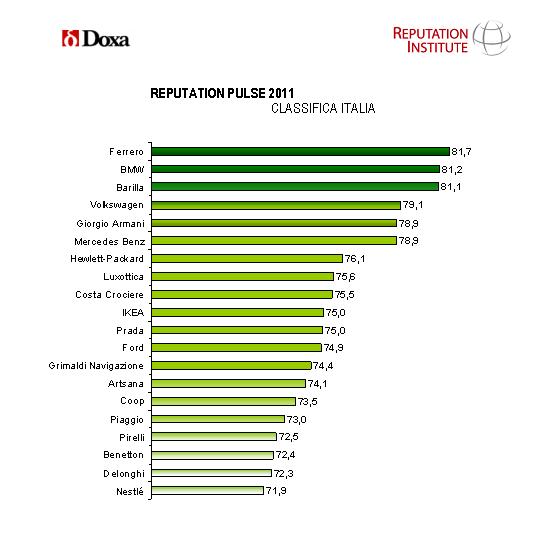
Ferrero, followed by BMW, and Barilla, are the company whose brand reputation has been rated the best one in Italy by the last “Reputation Pulse 2011″survey, the most important and extensive national research about company reputation conducted by the Reputation Institute in partnership with Doxa. The Reputation Institute, the main structure at a worldwide level dealing with issues such as corporate branding and reputation management, has been helping in the last 15 years more than 200 companies to measure, understand and enhance their potential in terms of reputation.

Every year the Institute carries out a research at a global level about company reputation and the factors affecting it, surveying more than 1500 companies from 32 countries. The Reputation Pulse Italy is produced in partnership with Doxa and examines more than 120 companies operating in Italy ranking them following a reputation criteria, with a score ranging from 1 to 100. The survey had been carried during the first three months of 2011, with more than 3,000 people interviewed.

So this year is Ferrero standing at the top step of the podium (with a score of 81.68), closely followed by BMW (81.19) and Barilla (81.16), with only three companies achieving a score of ” reputation of excellence “(over 80). Further down the rankings there are companies like Armani (78.90) ranked fifth, Luxottica (75.56) eight, Coop (73.54) fifteenth, Pirelli (72.55) 17th, followed immediately by Benetton (72.42), 18th. The “top 20” companies outweigh the positive threshold of 70 points, the remaining companies are hardly reaching that level: of the 124 firms surveyed, only 30% are showing a score higher than 70.

The 2011 survey considered only the companies amont the 100 rated in Mediobanca’s annual report about the “Leading Italian Companies”. The Pulse Reputation Italy survey has also expressed an evaluation in terms of gain or loss of reputation as compared to year 2010: Alitalia sees the highest score reputation increase (+12.8 points), followed by Intesa Sanpaolo (+ 7.1) and Unipol (+6.5). Mediaset (-10.7) with Lottomatica (-10.6) and Mediolanum (-10.2) are the protagonists of the worst loss of reputation, with a drop of about 10 points compared to 2010.

“Corporate reputation – said Michele Tesoro-Tess, head of the Reputation Institute in Italy (Advice dept.) – has a primary strategic importance for companies: when positive, can be a source of value, but if it is weak or negative it can make the company vulnerable. ” “We analyzed – adds Guido Argieri responsible for the Reputation Institute in Italy (Research dept.) – that in Italy more than 50% of the public has a favorable attitude toward the first three companies in our ranking, leading to consumers to be more willing to accept any increase in prices or tariffs applied to these three companies products.” (Source: Purpleandnoise)

QATAR FOUNDATION to develop local luxury brands

Qatar Luxury Group (QLG), the first venture of Qatar Foundation in the luxury segment, will unveil a series of all-new Qatari brands this year in the fashion, hospitality and lifestyle sectors. Gregory Couillard, Chief Executive Officer of Qatar Luxury Group, said that two years after the Group started it is creating a structured portfolio of culturally informed high-end brands that offer exclusive experiences and timeless products.

The press release posted in the CPP website does not mention whether the Qatar Luxury Group will embrace sustainability and responsibility- a big must now in the Middle East countries, as shown by the Masdarcity  and the many project requests ECOFFEE receive everyday. We will investigate about and keep you updated.

CPP-Luxury, an online business magazine, adds that the Group is currently active in two main sectors — fashion and hospitality. Fashion represents the core activity of the Group, which has invested heavily in world-class design and engineering equipment for in-house development of product lines. Prototyping units on jewellery, luxury ready-to-wear apparel, shoes, leather goods and accessories are all located at the QLG’s headquarters and soon a manufacturing facility will be opened for mass production of the unique product lines which is not only meant for the local market but for the international sphere as well.

The first initiative of the Group will be the launch of a restaurant later this year in collaboration with an internationally recognised 3-star Michelin French chef, two more restaurants in 2012 and one luxury fashion brand alongside the Group’s development of projects in the lifestyle sector. Couillard is optimistic QLG will contribute considerably in the country’s thrust toward diversifying its economy. The Group has a strong team with members from 14 nationalities including designers from Belgium, Chile, Qatar and US.

The press release posted in the CPP website does not mention whether this huge project will embrace sustainability and responsibility- a big must now in the Middle East countries.

Greenburgers guide: Greenopia

EVOS, Le Pain Quotidien and Pizza Fusion received the highest marks of any fast food restaurants in the latest ratings issued by Greenopia.
 
The three chains each received four green leafs, meaning they met at least 90% of the criteria across five categories: green building design, supply chain, recycling/take-back programs, stock and sustainability reporting.
 
Greenopia said EVOS is the “greenest burger chain in the US.” The company sells a variety of organic and fair trade products; incorporates green building design into its locations; uses recycled-content items; and purchases wind credits to offset its energy footprint.
 
Bakery and sandwich shop Le Pain Quotidien uses organic and local ingredients; incorporates green building design; composts food waste; and uses its spent food oil for biodiesel.
 
Pizza Fusion “tackled an incredible amount of green projects for a food chain” Greenopia said. All of its projects are LEED certified; their pizza is made with organic ingredients and delivered by hybrid delivery vehicles; employees wear organic cotton uniforms; and they have a take back incentive for their used pizza boxes.
 
Further down in the rankings Chipotle and Starbucks received three leafs, and McDonald’s improved to two leafs this year. With more than 32,000 stores worldwide other major chains should look to McDonald’s to see how to properly begin to incorporate green initiatives, Greenopia said.
 
Below is the full description of the company’s efforts and shortcomings, as cited by Greenopia:
 
Green Efforts:
McDonald’s has begun to incorporate some green elements into its culture. McDonald’s has 2 green stores, with more on the way. In fact, McDonald’s has been one of the more aggressive chains in incorporating green building designs into its locations. McDonald’s uses some recycled content in their packaging and has a comprehensive waste diversion program. It also only gets its beef from responsible sources (especially in regard to rainforest degradation) and has taken steps to green its seafood and coffee sourcing. Finally, McDonald’s has begun analyzing and scoring its supply chain to search for environmental efficiencies (as well as conducting audits) and publishes one of the better sustainability reports in the industry.
 
Green Issues:
In the green spectrum, McDonald’s is at least light green in every category. What we have listed above is good, but there is still room for improvement. For starters it would be nice to see natural and/or organic products offered and some more widespread and consistent green building design elements as well as some renewable energy sourcing. McDonald’s deserves to be applauded for what it has done (especially when compared with other major burger chains) and we hope to see improved commitment as time goes on.