Category Archives: Fresh Worldwide Press

What is going on in the Franchisig, Ho.Re.Ca, Hospitality and Retail business worldwide? A selection of my favorite news, with sustainability on top!

Enoc Retail plans expansion to Middle East

Enoc Retail Systems Holding, the retail division of Emirates National Oil Company (Enoc), plans to franchise its Zoom convenience-stores and Pronto, a fresh food and gourmet coffee concept.
Zoom, which operates six stores at Dubai Metro stations, is looking to expand to 28 stores in total, Enoc stated recently.

The convenience store brand, which is currently also present in eight stores within the Enoc/EPPCO network, is set to expand both as stand alone stores and at more Enoc/EPPCO service stations, it added.

Pronto, established in 2008, currently operates 21 outlets within Enoc/EPPCO service stations. Burhan Al Hashemi, managing director of Enoc Retail, said that expansion plans were part of a long term strategy to establish Zoom and Pronto as premier retail providers across the Middle East.

“Enoc Retail has proven its competencies in a short span of time. We are now open to share our expertise by franchising the successful retail concepts and reach out to a wider audience in the Middle East,” added Al Hashemi.

Enoc/EPPCO is the pioneer of convenience store retailing in the UAE, introducing mini marts in 1988 in Dubai and the Northern Emirates.

Currently, Enoc Retail employs more than 4,500 frontline staff, meeting the needs of over 600,000 customers a week. Enoc Retail operates a network of 170 Enoc and EPPCO service stations in Dubai and the Northern Emirates. (Source: Arabianbusiness.com)

Preparing for the consumer economy of 2020

In a recent super session at Retail’s BIG Show, Ira Kalish, Director of Global Economics for Deloitte Research, gave an all-encompassing overview on the state of the global retail industry ten years from now, as well as his take on what the consumer of the future will look like.
Kalish kicked off with a run through of recent developments in global retailing, noting that it’s always useful to think about the future by reviewing the past.
In particular, Kalish highlighted some of the paths that lead towards the economic crisis of 2008 and 2009 and the lessons that were learned from that crisis: massive consumer leveraging in the U.S., U.K. and Spain; the collapse of the asset price bubble; emerging currencies rising; U.S. consumers paying down debts and saving more; housing no longer being seen as a source of economic growth; China’s move towards consumerism and consumer spending rising as a source of GDP; and the challenges faced in Europe due to imbalances between countries like Germany and Portugal, Ireland and Spain.

As for what retailers can expect in the consumer economy of 2020, Kalish pointed to a number of challenges and opportunities retailers should certainly have on their long term radar, such as the massive increase in emerging middle classes and the disproportionate share of growth in emerging areas of the world like Indonesia, Colombia and Africa.

The effects of an aging population in an increasingly affluent world will also be a key consideration for retailers of all shapes and sizes, while hot markets with younger demographics (India, Middle East and Africa) will also keep global retailers on their toes.

Kalish also noted, the impact of obesity, changing global food market dynamics, an ever-increasing focus on sustainability and the possibility of a social media revolution could play a heavy role within the consumer economy of 2020.

So what can retailers do to prepare for this new consumer outlook? Kalish believes that aligning company values with those of consumers will be critically important, as will leading and listening to customers. Taking care of your brands, your people and your investments will also pay dividends when it comes to engaging with consumers, something that will be fundamental for 2020’s consumer – and not a bad idea for 2011. (Source: NRF)

Sodexo and Costco for a sustainable seafood

Food giants Sodexo and Costco have both committed to improve the sustainability of their seafood.

Sodexo, the $21 billion food service company, has announced a goal for all its contracted seafood to be certified by the Marine Stewardship Council (MSC) or the Global Aquaculture Alliance’s Best Aquaculture Practices (BAP) by 2015.

Under the plan, Sodexo will review all wild caught and farm raised seafood purchases and set short, medium and long-term goals with its contracted seafood vendors.

The target is part of Sodexo’s Better Tomorrow sustainability plan. The Better Tomorrow Plan makes 14 commitments to the environment, health, wellness and community support.

Meanwhile, Greenpeace has announced that after eight months of pressure, the world’s ninth-largest retailer has agreed to remove over a dozen seafood items from sale until the company can find an MSC-certified option. Costco will place a hold on selling Atlantic cod, Atlantic halibut, bluefin tuna, Chilean sea bass, Greenland halibut, grouper, monkfish, orange roughy, redfish, shark, swordfish, skates and rays.

Costco is also in the process of shifting towards more sustainable sources of tuna for fresh, frozen and canned varieties of the fish, Greenpeace said.

Costco will work with the World Wildlife Fund (WWF) to examine its remaining wild-caught species and determine the best way of moving to sustainable alternatives, Greenpeace said.

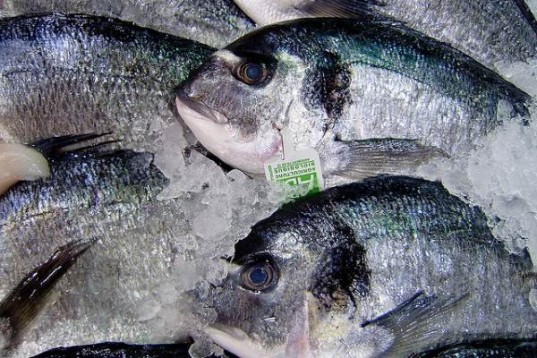
Costco and WWF have had a partnership since July of last year. Its first goal was to gauge the adherence of Thai-based shrimp farmers to draft standards drawn up by the Shrimp Aquaculture Dialogue, WWF said, and then to develop a strategy to guide those suppliers to full compliance. (Source: Environmentalleader.com, Photo: Thomas Quine)

DSE: See-through display showing the way for retail digital signage?

The STRATACACHE PrimaSee system  was what appeared to draw most of the attention at the last Digital Signage Expo in Las Vegas. 
So is the display basically an LCD without a black background? Sort of. PrimaSee showcases high-definition, dynamic video advertisements embedded in a see-through glass panel. These translucent promotional videos would correspond with products visible behind the displays, say in a grocer’s freezer aisle, to convey point-of-purchase or point-of-decision brand messages

“Effectively it’s an LCD technology, (but) the base nature of the screen is different than you’d have in a normal LCD, both because of the background and then the color masks and other things that go into translucency,” STRATACACHE CEO, Chris Riegel said. “But in basic prospect, yes, same kind of idea.”

The content for a translucent panel also has to be different, as is the way it is lit, but the technology of the display isn’t the most important aspect of it, he said.

“I think the most important thing is that it shows an example of — if you look at all the digital signage in the show, too much of it is bolt-on, things that you can tell in a retail environment or a customer service environment after the fact,” he said.

“This is a prime example of where the digital signage industry needs to move, which is integrating the digital experience into that consumer experience so that it’s seamless for that customer and helps to transform or change an existing experience. Everybody can understand going to the freezer in the grocery store, going to the cooler at the convenience store. How do I integrate media into that environment … to have digital media help that experience?” (Source: Retailcustomerexperience.com)


EuroShop: green is “hot”

Back from the EuroShop, with lots of a ideas and a big certainty: green is “hot”. From Green IT to green supermarkets and green products: retail is now aware of the trend toward sustainable economic management. Obviously, the market is still immature and retailers have lot to learn about what can be really sustainable in the long term – and this is where professional services like the ones we offer can be of a great help.

As stated on the EuroShop website, earlier this year, German Federal Minister of Economics Rainer Brüderle visited the “Klimamarkt” (“climate market”) by Tengelmann, across from the Tengelmann headquarters in Mülheim an der Ruhr. The politician of the FDP party said: “We need pilot projects like this to gather experience on how climate protection and economic efficiency can be reconciled.” Tengelmann deems the “Klimamarkt”, which already opened in December of 2008, to be “Germany‘s first CO2-free supermarket.”

The project admittedly does not stand up to an intense cost effectiveness analysis. “Demolition and new construction would have been cheaper”, Tengelmann spokesperson Jutta Meister admits on inquiry. And this is issue n.1 to take into account: the economics of retail sustainability.

“Particular attention also always needs to be paid to the economical aspect of sustainability”, says Tobias Walter of tegut. “We build beautiful marketplaces for our customers, which thanks to our consolidated know-how generally are not more expensive than the otherwise widely common ‘shoe box buildings’”. Kai Falk, Managing Director of Communication and Sustainability at the German Retail Federation HDE also believes: investments in sustainability in retail have a chance on a larger scale only if they also pay off financially.

And this pay off can be energy savings. In food retail, according to the EHI more than 55 Euros per square meter of sales floor are incurred for energy, in which cooling at 44 percent accounts for the largest electricity consumption. In non-food retail on average 31 Euros per square meter need to be spent. Here the largest portion at 65 percent is caused by lighting expenses.

The EHI notices a large willingness in retail to invest in energy savings practices. 80 percent of polled retailers are said to be willing to invest in energy-saving cooling systems and equipment. This high readiness can be explained by savings expectations of up to 20 percent. Aside from investments in new cooling devices, the choice of cooling agent is also getting more and more important, especially since the old R22-systems have to be converted. Cooling with CO2 was one of the big trade fair topics at the EuroShop 2011.

Many commercial enterprises work on new projects and initiatives about a more sustainable retail. Hardly anybody believes they can afford to not be a part of green topics. The discerning public will intently look at what’s show and what is true concern. But ultimately it is the consumers themselves that have to start rethinking, because they choose where they shop. They choose what they would like to stay away from.

MENA: retail sales are still growing

Retail sales in the MENA region jumped 13.2 percent last year, making it the only region in the world to post double digit growth, accountancy firm Deloitte has said.

In its latest retail report, Deloitte said emerging markets were the most promising for consumer sales and marked the Middle East as a stand-out region.
“While global economic growth is on the mend, most of it is taking place in emerging markets, many of which are experiencing rapidly increasing consumer spending,” said Nasser Sagga, audit partner at Deloitte and Touche.
“Within the Middle East there is a number of emerging economies that meet the criteria of strong growth prospects and good demographics – Egypt and Turkey being two such examples.”

The report identified the 250 largest retailers around the world in 2010, more than 11 percent of which were based in the MENA region.
Despite seeing a significant drop in trade and tourism during the financial crisis, the Gulf remains a key a market for retailers.

A report last year by real estate consultancy CB Richard Ellis found Dubai ranked second only to London in terms of the number of global brands with a presence in the city.
In a ranking of 294 of the world’s top retailers, more than half had a presence in Dubai. “Despite continued uncertainty for some retailers across the world, luxury brand retailers have remained active and were responsible for the most new store openings,” said Peter Gold, head of Europe, Middle East and Africa cross-border retail at CBRE. (Source: ArabianBusiness.com, Photo: hadiyahrewardnetwork.com)

Need some customer interaction? Here it goes!

There are many ways to enhance customer experience..Let’s start from the window display, for istance. Technology is helping retailers a lot, and we have found some great examples that we would like to share with you. Not so much to add, just watch and enjoy – and maybe give us your feedback!


Interactive Window Concept made for the module Advanced Interface Design at Hyper Island hosted by North Kingdom


Project for an interactive display window for BNP Paribas, place de l’Opéra, Paris


The Interactive Apple Store in Berlin, Germany.

How to add another plus to organic food: this is marketing!

We have always written about communication being the success key to sustainability in the retail business. Thanks to communication retailers can help consumers understand the real value of their efforts when it comes to sustainability: why they choose this product instead of the competitor one, why they are recycling, why they are preferably purchasing locally grown food and so on.

A post on Hive Health Media made me smile, considering it a great example of how to market organic food in a more appealing way. Everywhere, organic food is associated with “not that good-looking food that does not pollutes the Earth” concept. This might be not strong enough to convince the average consumer. But what about saying: “Buy organic and keep in a good shape”?. This was essentially the message broadcasted in that post. Three key points:

– The organic food at the supermarket is often 30-50% more expensive than standard food, doesn’t contain chemicals such as herbicides, pesticides, hormones and antibiotics( This means is healthier and it is true  that consumers buy less because of the price, but in this case, less food means a better shape.)
– Organic food also helps detoxify the body and puts it in a state that makes it easier for the consumer to get in shape.
– As an added bonus, an overall sense of wellness will develop over time when consumers are living organic.

Obviously, there was some marketing in that post, not related to organic food though but to how to cook it, but this is a different story.

The colors of Ikea Italy: blue, yellow and.. green!

Ikea Italy announced an environmental investment of € 20 million: 150,000 solar panels to be installed by the end of August 2011in each store so that to create a small solar power station. Clean, renewable, sustainable.

About 150,000 solar panels modules will be placed on a aluminum structure resting on the Ikea store roofs, and in Catania (Sicily), also on the bus shelters in the parking lot. An area as big as 16 football fields to cover about 10% of the electricity needs of Ikea Italy. The first floor (showroom) of all stores will be then lightened with this renewable energy. A total of 10,000,000 kWh of electricity, equal to the average consumption of 3,300 households will be produced each year with a reliable and innovative technology.

This will prevent the annual emission of approximately 4,000 tons of carbon dioxide, equivalent to the quantity of CO2 absorbed annually by 400 acres of tropical forest and the emissions of 3,300 cars travelling an average of 10,000 km. Another key point of the Company policy is to reduce waste and an effective use of raw materials, recycled materials or easy to recycle ones, natural and renewable energy, CO2 emission reduction thanks to a clever consumption, the optimization of facilities’operational activities and electricity from renewable sources (in 2010 equal to 83% of the total consumption).

When dealing with waste management, the goal is to reduce it thanks to the development of a less bulky packaging and a careful waste disposal collection so that to assure their almost full recycling. Ikea is bio too. In restaurants, the group includes more than 58 recipes and organic products from biological origin. In 2010, Ikea Italy purchased 2,080 tons of organic products (+38% compared to 2009). Ikea Italy is now the third third largest Ikea supplier company in the world after China and Poland, as stated by the managing director of Ikea Italy, Lars Petersson during a meeting in Milan. (Source. Greenbiz.it)

Biometrics and retail marketing: the future is now

Biometrics, methods for uniquely recognizing humans based upon one or more intrinsic physical or behavioural traits, is very important when evaluating the efficacy of a retail store design or display and assessing counter actions to make the retail environment more customer friendly. According to NY Times, IBM is currently testing a revolutionary biometrics method in two location in downtown Milan – a fashion company flagship’s store and an electronic store. Biometrics the future of retail marketing
The I.B.M. solution, involves tracking biometrics through a mini camera in a mannequin’s eye or placed somewhere in a store and the collected data will be aggregated so that not to be traced to any individual.

“We started with fashion because it is a creative and innovative industry, but it’s clear that people have to be educated so they know their privacy will not be compromised,” said Enrico Bozzi, the manager of I.B.M. Forum Milano, the department that developed the technology. “It is a question of changing people’s perception.”

 The IBM biometric test is already showing its first results. At the pilot in the Milan fashion store, for example, the client noticed that almost all Asian customers enter the store through one particular door, even though five are available. “We thought it was a mistake, but we checked it out and it was right and it continues to happen,” Mr. Bozzi said. “We don’t know why yet but, in the meantime, the store is considering positioning products by that door that are known to appeal particularly to Asian shoppers.”

I.B.M.is now also working on software that will let clients try on jewelry and makeup wirelessly thanks to a mobile phone or computer, with an iPad application likely to debut soon.