Category Archives: retail fashion

Retail, web 2.0 and sustainability:an analysis

A recent Zumer and Sustainable Life Media research is helping medium to small size retailers to better understand what is the connection among sustainability, consumers and web 2.0 tools.

The survey analizes the behaviour of 50 of the biggest companies leader in sustainability, at a worlwide level. Names such as Chevron, McDonald’s, PepsiCo, Coca-Cola, Campbell’s Soup, Microsoft, Toyota, Starbucks appear in the list of the companies whose online conduct on the three top social media, Facebook, Twitter and YouTube was analyzed for six weeks between December 2010 and January 2011.

We have found three key points that can be summerized as follows:

1. Authenticity: sustainability must permeate the whole company and must involve the company’s stakeholders so that ensure an authentic online communication, a more effective management of external reputation and brand perception. This is perfectly in line with the Cone research we have posted a while ago: consumers DO PUNISH not authentic communication about sustainability.

2. Sustainability helps acquiring new market share: almost three quarters of the professional interviewed stated that sustainability-themed social media are the channels to be in in order to get the attention of new market segment and reinforce the company’s position in the more traditional ones

3.Mix platforms to get the best results: although Facebook is still the most favourite platform among the big 50 companies in the survey, with investments rising in 2011 too. Tweeting about sustainability is becoming very common too -investments will double by 2015, as well as are CSR dedicated company’s websites, while YouTube actions are still fragmented. Blogging about sustainability might be a very powerful tool, not yet fully implemented by companies (1-2% of total blog posts).
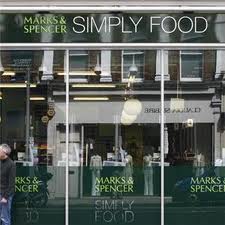
Mark’s and Spencer opens greenest store ever

On March 1st, 2010 Marks & Spencer announced a programme to be the world’s most sustainable retailer by 2015 launching 80 major new commitments under M&S’ eco and ethical plan, Plan A.

Plan A, started on 2007, had already proven its efficacy achieving these great results in 2009/2010:
• Cost savings of around £50m for M&S;
• New products and services, including 250,000 customers from M&S Energy;
• Cut CO2 emissions by 40,000t;
• Recycled 2 million used garments via Oxfam;
• Reduced 10,000 tonnes of packaging;
• Diverted 20,000 tonnes of waste from landfill;
• Saved 387 million food carrier bags;
• Used 1,500 tonnes of recycled polyester (equivalent to 37 million bottles);
• Saved 100 million litres of water;
• Recycled or re-used over 130 million clothing hangers;
• £15m for charities.

Yesterday, April 18th 2011, Marks & Spencer achieved a new great result opening the retailer’s “greenest-ever” store at Ecclesall Road in Sheffield.

The store is the first of a number of new ‘Sustainable Learning’ stores, that are part of M&S’ drive to become the world’s most sustainable major retailer by 2015.

The new 12,400 sq ft Simply Food store, built from scratch on a former brownfield site, incorporates a host of sustainable design and construction features, including an LED screen giving real-time public transport information, electric car charging points and a green living wall to attract wildlife.

All the bricks used in the build have also been reclaimed from a local mill.

Marc Bolland said:

“We’re delighted to be opening M&S’ greenest-ever store, providing customers with top quality M&S food and drink products in such a convenient location.”

The store is “firmly on course” to achieve a BREEAM rating of Excellent, making it one of the most sustainable retail outlets in the UK.

Its carbon emissions will be 23% lower and energy usage 30% lower than a traditional similarly sized store.

Innovative features include:

  • LED lighting, which is 25% more efficient than standard lighting, is used throughout the store, a first in the UK.
  • Sun pipes bring natural lighting onto the shop floor;
  • 100% of the timber used is FSC certified, a UK first;
  • All the bricks have been reclaimed from an old local mill;
  • Water costs will be reduced by up to 40%, compared with a traditional similarly sized store, by using harvested rainwater;
  • Capturing heat expelled from the store’s refrigeration units to help heat the store;
  • A living green roof of sedum plants and green living wall have created wildlife habitats, as well as insulating the store;
  • Bird boxes have been placed around the perimeter wall of the site;
  • In total, 62 different species of plants have been planted on or around the store;
  • Polished concrete floors have removed the need for floor covering;
  • 100% of the construction waste has been recycled.

All employees at the store have also been fully trained to understand its environmental features and will be encouraged to share this information with customers. (Source: The Food and Drink innovation Network)

Business Retail: a global view

Retail is big, but how big it is and is it equally distributed worldwide or are there countries where retail is at its best?  

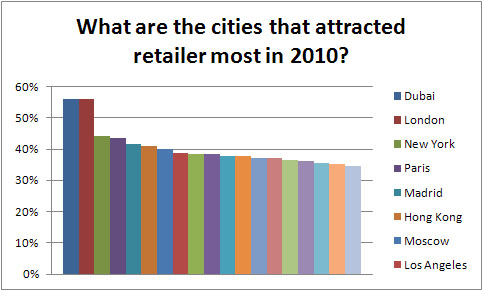
The last CB Richard Ellis Survey  about the business of Retail, reveals how fluctuating this market is, measuring how the most important 323 retailers changed their strategies in 73 countries during the last year.

The survey findings are very interesting, showing us that Dubai is the most favorite city for both American (61%) and European (63%) retailers, while only 23% of retailers from the Asia-Pacific area are present in that city – not because of lack of interest, but just because the Asia-Pacific consumer market is the fastest growing, therefore retailers from those countries do not need to branch out abroad.

Retail expansion rate saw a decrease during 2010, only a 2%, compared with 4% in 2009 and 12% in 2008, with new target countries being India (8 new retailers) and Turkey (7). United Arab Emirates (UAE), Kuwait, Ireland, Romania, and Belgium all attracted six new retailers.

Online retail is becoming more and more important for retailers: 82% of the brands in the survey do have an online catalogue, even though only a smaller percentage (46%) offers to consumers the chance to purchase goods online, with Value&Denim being the most active (43%) followed by mid-range fashion  (26%) and Luxury & Business Fashion (32%). To have an online retail shop is the favored choice by those brands who already have a physical store (46%), while in more advanced market such as the U.S.A., there is a slight percentage of online seller (24%) who do not have a physical store, and that are using online sales platform to test the market before opening a physical point of sale.

Fashionable sustainability or sustainable fashion?

Starting from Edun fashion brand, by Ali Hewson and Bono, whose mission is to encourage trade with Africa, to H&M’s Conscious Collection and Zara’s eco-friendly stores, it seems that “sustainability and responsibility” are now a must in the fashion industry.
The latest news regarding fashion and sustainability is the PPR Group’s (home of GucciPuma,Yves Saint Laurent and Stella McCartney) Sustainability Initiative PPR HOME to Set New Standard in Luxury, Sport & Lifestyle and Retail Sectors.

By moving beyond the traditional Corporate Social Responsibility model, the group launched PPR HOME and is setting a new standard in sustainability and business practice in the Luxury, Sport & Lifestyle and Retail sectors.

My deep conviction that Sustainability creates value is part of my strategic vision for PPR. Sustainability can – and must – give rise to new, highly ambitious business models and become a lever of competitiveness for our brands. PPR HOME will provide us with novel, more sustainable approaches to contribute to a better world for the long run”, said Francois- Henri Pinault, CEO of PPR.

PPR HOME’s first announcements are setting the pace for the Group’s sustainability mission in order to reduce the social and environmental footprint for its Luxury, Sport and Lifestyle brands. These pioneering initiatives include:
-PPR HOME launches the Creative Sustainability Lab to help lead the industry and foster creativity, innovation and sustainability. Its inaugural partnership with Cradle-to-Cradle® will drive PPR HOME to challenge traditional approaches and proactively re-think and re-consider product and business development. The Cradle-to-Cradle® concept believes that ‘good design’ of products and services should move beyond typical measures of quality – cost, performance and aesthetics – to integrate and apply additional objectives addressing environmental and social concerns.
– PPR has offset its 2010 global CO2 emissions from PPR’s Luxury group, PUMA and PPR’s headquarters of 98,729 tons to achieve carbon neutrality in Scopes 1 & 2 of the Greenhouse Gas Protocol and purchased carbon credits from Wildlife Works’ leading REDD (Reduced Emissions from Deforestation and Degradation) offsetting project in Kenya that takes the needs of the local communities and the conservation of biodiversity into account. As the first step in making REDD a reality, Wildlife Works recently provided proof that REDD conforms to the accounting rigor that other carbon credit classes provide, resulting in Wildlife Works project becoming the first-ever Voluntary Carbon Standard (VCS) validated and verified REDD program.
-PPR’s premiere Sportlifestyle brand, PUMA, has applied a groundbreaking methodological approach to measuring and costing their use of ecosystems and their ecological footprint. This is the initial step to measuring the full economic impact on ecosystem services by PUMA and its supply chain and the delivery of the first-ever Environmental Profit and Loss (EP&L) account statement. PPR HOME will take a leadership role in building understanding and support for this corporate shift, encouraging others within the industry to share PUMA’s pioneering efforts towards fully-integrated reporting.

Our opinion as sustainability advocates and retail consultants is that all these strategies, well planned and communicated, must follow the companies products from production to sale. The risk is that fashion consumers do not perceive the real added value of sustainability when in-store communication lacks and when the store itself it is not sustainable. An example? Keep following us: ECOFFEE case studies to come in the next weeks!

China retail luxury: a long-term insight

China: a market that is continuously growing, a very rich but still unknown to the many. What is clear is that China is set to become the most powerful economy in the world, and this will happen in a very short time. Many are the companies that have already sucessfully entered the Chinese market, luxury good brands being the pioneers.

A McKinsey survey over 1.500 Chinese luxury consumers during spring 2010, shows interesting trends which are basically telling to the world that the “consumer culture” is changing at a very high speed, following the changes in the society and urban landscape. For those who are interested, the whole report can be downloaded here, but three are main facts:

  • “Rapid increases in wealth, and shifting social mores that sanction the display of that wealth, are driving a growing infatuation for luxury goods among Chinese consumers.”
  • “Access to an explosion of information on the Internet, an increasing penchant for overseas travel, and first-hand experience purchasing and consuming luxury goods are contributing to a substantial rise in sophistication among luxury consumers in China. Contrary to popular belief, a growing number of Chinese luxury consumers are exhibiting a noticeable trend away from overt displays of wealth, and towards more understated forms of luxury consumption.”
  • “Rapid urbanization and growing wealth outside of China’s largest cities is driving the emergence of several new geographic markets with sizable pools of luxury goods consumers. Over the next 5 years, [McKinsey] expects that the number of such cities will double from 30 to 60.”

Other key findings are social-demographics related. Not only traditional luxury brands consumers, but also 13 million upper-middle-class households (earning $15,000 to $30,000), which are stretching their budgets to buy luxury watches, jewelry, handbags, shoes and clothing. This segment represented 12% of Chinese luxury consumption in 2010, but is expected to reach 22% by 2015.

The survey also shows that approximately 73% of luxury consumers in China are under age 45, significantly younger than their counterparts in western nations or even nearby Japan. 

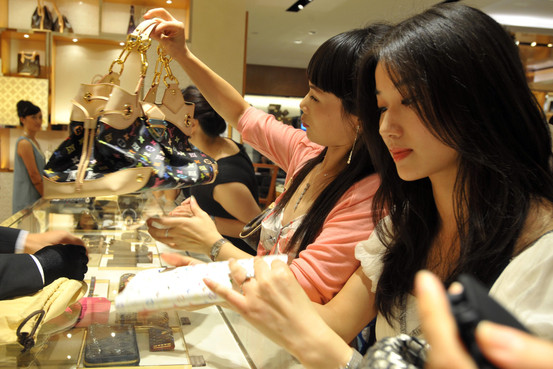
All these findings essentially reinforce the widespread idea that if this trend is going to be followed in 2011 too, China will become the biggest retal luxury market in the close future. (Source: McKinsey, Picture credits: TheChinaObserver)

Sustainable supply chain: how to build it?

At the beginning of March 2011, McDonald’s announced its Sustainable Land Management Commitment (SLMC), a long-term plan to ensure the corporation only serves food (and uses packaging) certified as sustainably sourced. The initial focus is on five high impact products: beef, poultry, coffee, palm oil and packaging.  McDonald’s certainly have all the power to be able to win negotiations with suppliers and reach its goals, but what about small retailers who are buying from overseas?

Shirahime, a UK based ethical fashion consultancy, has published a guide to responsibly sourcing textiles and clothes from India.

Despite its narrow country and industry focus, the guide is packed with advice for any business looking to find responsible goods or services suppliers from overseas. Here’s an excerpt of the Shiraname’s guide.

Be clear about the outcomes you want to achieve
Define aims clearly and build a strategy around the outcomes you want to achieve. Don’t look exclusively for suppliers who have certification. Certification is a costly process and may not guarantee the specific outcomes youwant.

Instead, visit potential suppliers and examine their operations for yourself. If you do this, make sure you have a suitable translator and cultural liaison who can guide your decision making process. In addition, start networking, even if it’s with your competitors. If you do this up front it can vastly increase your chances of success in finding the right supplier.

Consider company size alongside business practices
There can be a correlation between a supplier’s size, the goods or services it provides, and its ability to operate responsibly.

As a broad rule of thumb, the larger the company the more comprehensive their offering will be. Yet the larger the company, the more likely it is that their business is focussed upon financial efficiency, not responsible practice. Therefore, if you’re looking for a responsible supplier it may be worth choosing smaller producers rather than bulk providers as your partners.

Consider alternatives to your preferred goods, service or country
In order to get the most responsible procurement deal, businesses have to change their mindset and be open minded about both the country of origin and the goods or service they’re looking to procure.

Be prepared to invest as well as purchase
Businesses need to think about how they can contribute long term value to their suppliers’ enterprise beyond a simple commercial deal. This is where the value of being clear in your outcomes and partnering with other companies can yield substantial benefits. (Source: Guardian.co.uk)

How to deliver customized in-store offers to shoppers?

One of the in-store marketing biggest issues ever is how to reach customers with customized offers while they are shopping. U.S.A retailers and consumers are going to have a solution handy in the next future: Shop O’Lot.  

Shop O’ Lot is a self service platform which makes major retailer participation very easy. The model is based on a predictive analysis engine, that builds a customer’s shopping profile, then allows retailers to reach these customers in real-time while they are shopping, offering them customized discount coupons.

The app uses GPS and bar-code scanning for delivering the content and will be released on the iPhone and Android OS platforms.

Bob Pack, CEO says, “major retailers are now competing with product search and comparison apps that can actually drive a customer to buy from a competitor, a practice known as “scan and scram.” We have a complete solution to really help drive retail purchases, this goes well beyond mere Geo- location and focuses on individual target marketing. Once we understand the shoppers tastes, delivering them customized product deals only by the store they are in, will help keep shoppers loyal.”

Shop O’ Lot is still in the testing phase and plans a 2011 launch and retailers and consumers, can sign up now to be part of our beta program directly on Shop O’Lot website. (Source: americanbankingnews.com)

The Art of display: enhancing customer experience

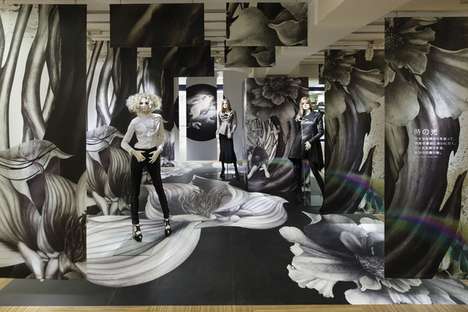
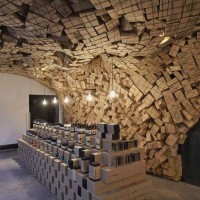
More businesses are incorporating artful accents to their shops, realizing that customers are more likely to enter and spend more time in a store with artistic retail displays than one with basic white walls and grid-like shelves. Everything from oversized art installations to crafty storefronts are giving retailers attention-grabbing elements that are simply too eye-catching for a customer to ignore.

Created by Kahori Maki, ‘Moon Princes’ begins with the window display and then leaks into the store’s interior space. It’s black-and-white coloring contrasts vividly with the relatively vibrant clothing. The result might be considered overwhelming but it charmes the most adventurous shoppers.

On the opposite, the Valencia Munich store, design by Dear Design studio, is very minimal, yet very impressive. Its all white color, the complex X display structure, seem to expand the display surface at libitum, giving to the full range of Munich Shoes on diplay the deserved importance.

At the famous Merci store in Paris, Aesop has installed a creation designed by the Melbourne-based March studio, which can not passed unnoticed. A wall of stacked Aesop cardboard boxes, held together by a black net, looks like a tornado which is going to wrap over the shopper.

These are only few examples, what is clear is that shoppers now need more stimuli: products are available almost everywhere, what differs is the shopping experience. And art can be the solution. (Credits: Trendhunter)

Preparing for the consumer economy of 2020

In a recent super session at Retail’s BIG Show, Ira Kalish, Director of Global Economics for Deloitte Research, gave an all-encompassing overview on the state of the global retail industry ten years from now, as well as his take on what the consumer of the future will look like.
Kalish kicked off with a run through of recent developments in global retailing, noting that it’s always useful to think about the future by reviewing the past.
In particular, Kalish highlighted some of the paths that lead towards the economic crisis of 2008 and 2009 and the lessons that were learned from that crisis: massive consumer leveraging in the U.S., U.K. and Spain; the collapse of the asset price bubble; emerging currencies rising; U.S. consumers paying down debts and saving more; housing no longer being seen as a source of economic growth; China’s move towards consumerism and consumer spending rising as a source of GDP; and the challenges faced in Europe due to imbalances between countries like Germany and Portugal, Ireland and Spain.

As for what retailers can expect in the consumer economy of 2020, Kalish pointed to a number of challenges and opportunities retailers should certainly have on their long term radar, such as the massive increase in emerging middle classes and the disproportionate share of growth in emerging areas of the world like Indonesia, Colombia and Africa.

The effects of an aging population in an increasingly affluent world will also be a key consideration for retailers of all shapes and sizes, while hot markets with younger demographics (India, Middle East and Africa) will also keep global retailers on their toes.

Kalish also noted, the impact of obesity, changing global food market dynamics, an ever-increasing focus on sustainability and the possibility of a social media revolution could play a heavy role within the consumer economy of 2020.

So what can retailers do to prepare for this new consumer outlook? Kalish believes that aligning company values with those of consumers will be critically important, as will leading and listening to customers. Taking care of your brands, your people and your investments will also pay dividends when it comes to engaging with consumers, something that will be fundamental for 2020’s consumer – and not a bad idea for 2011. (Source: NRF)

MENA: retail sales are still growing

Retail sales in the MENA region jumped 13.2 percent last year, making it the only region in the world to post double digit growth, accountancy firm Deloitte has said.

In its latest retail report, Deloitte said emerging markets were the most promising for consumer sales and marked the Middle East as a stand-out region.
“While global economic growth is on the mend, most of it is taking place in emerging markets, many of which are experiencing rapidly increasing consumer spending,” said Nasser Sagga, audit partner at Deloitte and Touche.
“Within the Middle East there is a number of emerging economies that meet the criteria of strong growth prospects and good demographics – Egypt and Turkey being two such examples.”

The report identified the 250 largest retailers around the world in 2010, more than 11 percent of which were based in the MENA region.
Despite seeing a significant drop in trade and tourism during the financial crisis, the Gulf remains a key a market for retailers.

A report last year by real estate consultancy CB Richard Ellis found Dubai ranked second only to London in terms of the number of global brands with a presence in the city.
In a ranking of 294 of the world’s top retailers, more than half had a presence in Dubai. “Despite continued uncertainty for some retailers across the world, luxury brand retailers have remained active and were responsible for the most new store openings,” said Peter Gold, head of Europe, Middle East and Africa cross-border retail at CBRE. (Source: ArabianBusiness.com, Photo: hadiyahrewardnetwork.com)