Does a British apple have a smaller carbon footprint than an imported one if it has to be refrigerated for up to a year after harvest? And how do you design a kitchen so your chefs are naturally working in an energy efficient manner?
These are just some of the questions explored in a new guide launched on May 31st by the Sustainable Restaurant Association (SRA) and Space Catering to help the catering industry reduce its energy bills and drive down greenhouse gas emissions.
According to The Carbon Trust, energy used in catering accounts for 4-6 per cent of operating costs, while around 20 million tonnes of food waste is created every year in the UK food service sector.
The National Restaurant Association 2008 survey also found that 62 per cent of diners would prefer to eat in an environmentally-friendly restaurant.
“Chefs and restaurateurs are always looking for simple solutions to difficult challenges,” said Mark Linehan, managing director of the SRA.
“This guide provides them with a straightforward, easy to read guide to sustainable kitchen equipment that the SRA believes will be of huge interest and practical use to any restaurant that takes seriously its environmental responsibilities.”
The 20-page guide will be free for anyone to download from the Space Catering website, covering topics such as food waste, water consumption, energy efficiency and “green cuisine.”
Much the way French Europcar shows customers the carbon emissions associated with each of its rental cars, so a new restaurant chain includes such information for every item on its vegetarian menu.
With two restaurants in each of New York and London, Australia-based Otarian bills itself as “the first ever low-carbon restaurant chain, using a cradle-to-grave analysis in the carbon footprinting of every menu item.”
Almost everything in Otarian’s restaurants—from the floor to the tables and chairs—is made from recycled materials. They use the most energy-efficient equipment available, and all the electricity powering them comes from wind, water or sun. Water use is minimised, and local supplies are selected whenever possible.
Targeting the heavy emissions associated with the livestock industry, meanwhile, the restaurant offers no meat on its menu. Most interesting of all, however, is that Otarian uses international standards like BSI PAS 2050 to carbon footprint its entire menu; it has also been selected to road test the new Greenhouse Gas Protocol product standard.
Its “Eco2tarian Labelling” shows the difference in greenhouse gas emissions between its veggie meals and similar dishes containing meat, fish or egg. Otarian even goes so far as to reward consumers for the carbon they save by eating at its restaurants.
Specifically, every purchase earns them “Carbon Karma” credits, which are tracked by way of the restaurant’s Carbon Karma cards; consumers can track both their credits and their carbon savings online. After 100 credits, they are treated to a free Choco Treat off the menu.
As legions of eco-minded consumers begin tracking their impact on the environment, there’s no shortage of opportunities for companies to stand out by offering the eco intel they need to do that.
FoodDrinkEurope has launched a report outlining its goals to move towards more sustainable food and drink production by 2030.
The report came following an event in Brussels yesterday featuring stakeholders such as Members of the European Parliament, UN representatives and key food industry players such as Nestle.
FoodDrinkEurope’s ‘Environmental Sustainability Vision Towards 2030 ’ details three core areas of focus: sustainable sourcing, resource efficiency along the food chain and sustainable consumption and production.
Sustainable sourcing
Europe’s food and drink industry accounts for 70% of all EU agricultural produce, said FoodDrinkEurope, which showcased examples from companies that could help to promote sustainable sourcing and contribute towards food security.
The report praised Ferrero, General Mills, Mars, Nestlé and Unilever, which all pledged to source 100% certified sustainable palm oil by 2015. Mars and Ferrero have also committed to used only sustainable certified cocoa by 2020.
The report also lauded the development of harmonised assessment methods through the European Food Sustainable Consumption and Production (SCP) Round Table.
Energy
FoodDrinkEurope encouraged the industry to collaborate to reduce greenhouse gas emissions (GHG). Between 1999, food and drink manufacturers in Europe cut GHG emissions by 18%, while production value rose 29%.
The report endorsed using low carbon technologies, such as Combined Heat and Power (CHP). “The best way to provide heat is from a CHP plant as this provides maximum primary energy saving opportunities,” it said.
Kellogg is one large company using CHP. Its plant in Manchester, UK, has a 4.9 MWe CHP Plant that supplies 85% of the plant’s current steam demand and approximately 50% of electricity demand, which it claims reduces CO2 emissions by approximately 12% annually.
Alternate refrigerants
FoodDrinkEurope is also promoting refrigerant alternatives. “Some of the refrigerant gases commonly used by food and drink manufacturers, such as hydrofluorocarbons (HFC), contribute to climate change if they escape to the atmosphere,” it said.
While no viable alternative is currently available, the EU trade body said that it supports a multi-stakeholder initiative by Coca-Cola, Unilever, McDonald’s and PepsiCo to find a solution.
Water use
The report estimated that the industry’s water use accounts for 1.8% of the European total. It encouraged employing tools to measure water use through a Life Cycle Analysis, but said the method was not ideal for communication with consumers.
Several FoodDrinkEurope companies are involved in developing a new ISO standard (14046) on water footprint based on a life-cycle approach which is expected to be completed by 2014.
Other initiatives
FoodDrinkEurope’s report also details ways manufacturers have converted waste into energy to power operations. Nestlé and Kraft for example have been recycling coffee grounds to power production processes, which has contributed 12% to Nestlé’s on-site renewable energy resources in plants in the UK, Germany and France.
FoodDrinkEurope also supports using biofuels for transport operations to limit the environmental impact. Nestlé, for example has been using liquid methane powered trucks in the UK.
European Commissioner for the Environment Janez Potocnik said: “It is also clear that consumers should be increasingly informed via modern communication channels, such as smart phones applications and social media.”
The French food and drink industry association (ANIA) has developed the smart phone app ProxiProduit, which allows consumers to scan barcodes and obtain environmental information such as GHG emissions, biodiversity and water use.
The report concluded that its ‘vision’ was not a benchmark for the industry as “no one-size fits all”, but it could give inspiration to companies to promote sustainable growth.
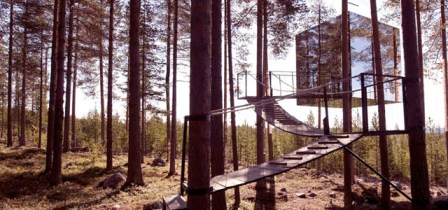
Situated in the forest area around Harads, Sweden, Treehotel has now implemented five of the 24 rooms it has planned for the area. Among those are “The Blue Cone,” “The UFO” and “The Bird’s Nest,” all suspended four to six meters above the ground and designed in eco-minded fashion by some of Scandinavia’s leading architects.
Designed to blend into its surroundings so as not to ruin the view, the Mirrorcube is an addition to this collection, featuring mirrored walls that reflect their surroundings and yet are safe for passing birds thanks to a layer of infrared film. Featuring six windows and a panoramic view, the Mirrorcube accommodates two people with a double bed, bathroom, lounge, and rooftop terrace.
Perhaps most interestingly of all, the Mirrorcube is now for sale, with a delivery time of roughly four months. Retail pricing is reportedly about EUR 275,000 excluding transportation costs.
Because of the cube’s ability to blend into its surroundings so well, it may be a perfect choice for those looking to create accommodation in areas of natural beauty. Treehotel is currently looking for suitable resellers for its Mirrorcube.
Harris Interactive found that while concern and awareness around environmental issues has slipped since 2009, it has not affected how consumers say environmental issues influence their purchasing behavior. Young adults are the exception – those18 to 24, are actually more likely to consider the environment in their spending now than than before.
Adults between the ages of 18 and 24 show the biggest change in shopping behavior when it comes to environmental awareness and responsibility:
35 percent said they are willing to pay extra for a green product, an increase from 27 percent in 2010 and 25 percent in 2009.
Although just 4 percent of all U.S. adults seek out green products and services regardless of the cost—virtually unchanged from 3 percent in 2010 and 2009 – 18- to 24-year-olds are at 11 percent, far above the 3 percent rate in 2010 and 2009.
However, 51 percent of this youngest adult age group said they are not willing to pay extra for green products.
Among total adults, however, the survey found that consumers are now less likely to do each of the following activities in their daily life:
Reuse things they have instead of throwing them away or buying new items (65 percent in 2009 vs. 61 percent in 2012).
Make an effort to use less water (60 percent in 2009 vs. 57 percent in 2010 and 2012).
Buy food in bulk (33 percent in 2009 vs. 30 percent in 2012).
Purchase all-natural products (18 percent in 2009 vs. 16 percent in 2012); and Purchase organic products (17 percent in 2009 vs. 15 percent in 2010 and 2012).
A quarter of U.S. adults (26 percent) said that environmental issues are either “extremely” or “very” important to them when deciding which products or services to purchase. This number remains consistent across gender, geography, education and income, according to the study. The percentage has moved little over the years: 27 percent of U.S. adults said environmental issues were extremely or very important to their purchasing decisions in 2010 and 26 percent said the same in 2009.
Americans also show a preference for products and services that are “green,” with 79 percent seeking out green products, slightly up from 78 percent in 2010 and 76 percent in 2009. Additionally, 31 percent of U.S. adults said they are willing to pay extra for a green product, up from 28 percent in 2010. Thirty-two percent said the same in 2009.
More than 2,451 U.S. adults aged 18 and older were polled for this survey.
Periodic lulls in business are a fact of life for most retailers, and we’ve already seen solutions including daily deals that are valid only during those quiet times.
Recently, however, we came across a concept that takes such efforts even further. Specifically, Korean Emart recently placed 3D QR code sculptures throughout the city of Seoul that could only be scanned between noon and 1 pm each day — consumers who succeeded were rewarded with discounts at the store during those quiet shopping hours.
Dubbed “Sunny Sale,” Emart’s effort involved setting up a series of what it calls “shadow” QR codes that depend on peak sunlight for proper viewing and were scannable only between 12 and 1 pm each day. Successfully scanning a code took consumers to a dedicated home page with special offers including a coupon worth USD 12. Purchases could then be made via smartphone for delivery direct to the consumer’s door. The video below explains the campaign in more detail:
As a result of its creative promotion, Emart reportedly saw membership increase by 58 percent in February over the previous month, they also observed a 25 percent increase in sales during lunch hours. Retailers around the globe: One for inspiration?
We’ve seen numerous ways to add personalized messages to products ranging from chocolate bars to cookies to cans of soup, but recently we came across one that has an interesting new twist.
Created by Seattle cloud texting company Zipwhip, Textspresso is an espresso machine that can not only send and receive text messages, but can also print those messages on coffee foam using edible ink.
To create the Textspresso device, Zipwhip installed a Jura Impressa Xs90 espresso machine with SMS and printing capabilities using an Android app, servo motors, an Arduino microcontroller and a retrofitted Canon printer. Users can text their order to the device, which will then brew their coffee and keep it hot on a warming plate until they pick it up. Perhaps most interesting of all, though, is that the machine can use edible ink to print text on the coffee’s foam, opening the door to a world of personalization possibilities. For example, the machine can be used to text the last digits of a customer’s phone number, enabling them to easily identify their coffee when they go to pick it up. The video below explains the premise in more detail:
Zipwhip actually created its Textspresso machine as a way to showcase its cloud texting service, and it has no plans to produce more of them, it says. The code and plans for making the device are open source, however, and available to anyone seeking to make their own. Tech-minded entrepreneurs and coffee shop owners worldwide: time to build one for yourself?
Sustainability at retail can be perceived as being illogical if not contradictory. Because according to logic, if the purpose of retail is about promoting only purchase and thereby consumption, then it runs counter to sustainability principles such as reduce, recycle and re-use. But retail in its broadest sense is not just about stores. It also refers to having a physical, local or direct to community business presence (i.e. a bank or post-office would qualify as retail). But in order to bring the concept of “sustainability” out beyond the niche and to the masses, we will need to transcend logic and find more ways to get people to care about life tomorrow – today.
This is why retail is vital. Because the power of retail comes not from logic, but that which inspires emotion. Great retail brands i.e. Nordstrom or Amazon, have the ability to not only respond to needs, but also open our eyes to new ideas through delight and surprise. Retail adds physical and experiential dimension to concepts that would otherwise be too cerebral. And through retail storytelling the principles of sustainability can come to life in ways that can truly excite interest, promote engagement, and quite possibly change behavior.
Skeptics need to remember that only ten years ago when the thought of buying shoes without ever touching or trying them-on seemed incomprehensible. It took a retailer such as Zappos to change behavior and raise the bar on service expectations. Since then, shopping for shoes has never been the same. In fact the experience of shoe shopping (whether online or in-store) has only gotten better because of Zappos’ impact.
Since as much as 80 percent of communication is nonverbal, then what better way to communicate the principles of sustainability than to allow people to experience it first hand. And because human thought and memory is formed not from words but from images and emotions, what better way to get people to care and identify with a new concept than to show them how it can be applied today.
Such principles are the reasons why Chipotle’s “Back to the Start” video is a stellar example of sustainability storytelling. Unsustainable farming is a universal and serious issue. It affects the lives of all in one way or another. The magnitude of the issue is a key reason why people find it hard to connect to the issue. For the general public, systemic issues such as this or climate change and social/community health and well-being are such complex and overwhelming issues. When we are unable to understand, let alone relate, our human instinct is to distance ourselves and possibly disconnect through indifference.
Chipotle’s video does a brilliant job of taking a huge and complex issue and humanizing it to a level that makes us care. The story is powered by pure emotion. It is endearing and enlightening as it illustrates the bigger picture issue while inspiring us all to take part. No words are needed. No voice-over to direct our thoughts (unless you count Willie Nelson singing). No numbers, charts or science is ever used to convey the story.
But even with or without words, there is still the real challenge of overcoming public perception and biases. There is such a limited range in how “sustainability” is articulated today – especially on a local retail level. It is why I believe that “sustainability” has become such a polarizing word. We need to find ways of giving it added dimension and broader relevance. We won’t get sustainable thinking to stick through ubiquitous use of the word. Nor can we expect people who are indifferent to willingly pursue greater understanding of the term. We need to be able to communicate the principles and concepts of sustainability in ways that are not limiting interpretation or opportunities of relevance.
Consider for a moment how “sustainability” principles are brought to the attention of people on a daily basis? In order to gain critical mass support, we need more than reminders i.e “Remember to Recycle,” or ”green” products, eco-friendly materials or responsible choices called out in marketing materials (i.e “We run on clean energy).” Many brand efforts that call out support for the environment is often presented at retail as being more like an FYI or directional signage/labeling.
Promoting sustainability conscious ways at retail must strive to connect – not just be present.
Retail brands must have the courage to not only make a statement, but to do so in a way that transcends the norms of what I refer to in the chart below as the “What” and “How” in sustainability communication.
Humanizing Sustainability :Requires reinterpretation, re-scaling and reconnecting the principles of sustainability to the issues that matter to people today.
Within retail it seems that every store these days features their own line of re-usable shopping bags, or will ask for a donation upon checkout to support a cause. In principle, there is nothing wrong with any of this. But if you look at it through the eyes of someone who may not even care in the first place, all of this “me too” and very predictable promotion of environment and community related causes can eventually dilute if not potentially repel further support or interest.
We need retail brands to leverage their unique storytelling ability to find new ways of manifesting sustainability principles on a humanized, physical and local level. There is far more room for sustainability storytelling and expression. Retail has the unique ability to expose new ideas, experiences and opportunities to engage. We need all of this and more so that people will not only understand, but also care enough to actively apply such principles going forward.
I believe the shift in expanding retail’s relationship with sustainability needs to begin with how we think about “retail.”
Retail brands who understand and embrace the social role they play in a community’s well being will act with a greater sense of duty and civic responsibility. Through their active participation they will not only contribute to improving the local ecosystem, but also benefit from community trust and loyalty.
Retailers need to enrich the community, not degrade or overpower their identity. Retail that is thoughtfully managed and conscientiously integrated into the social ecosystem can become an enduring source of local pride. Sustainability on a local level means “me” becomes “we.” Consumers are now valued and regarded as people. Retail becomes a citizen of the community and conduit for the endurance of social well-being.
I mention this example not because Steiner & Associates, the developers of Easton, is a client of E.B. Alliance, but because of the integrity of their development and management ethos.
It exemplifies the symbiotic relationship that retail can have with its local community. Since the opening of Easton ten years ago, it has evolved into becoming not only the benchmark for the development of mixed-use property (retail, entertainment, office and hospitality). More importantly, it gave residents outside of the city of Columbus a true sense of community identity and a meaningful sense of “place.” In fact, Easton has become a beacon for the central region of Ohio because of the yearly traditions (i.e. Summer Concerts, Outdoor Movies, Holiday Parades etc.), community access to green and open spaces, and generous philanthropic support of local causes. Easton has become a truly beloved retail brand (even though it is not even a store) so much so that Easton has earned a net promoter score that is even higher than Apple!
(…)
Here are some examples of how retail brands have brought the principles of humanizing sustainability to life in the form of actions, commitments and support of citizens/local communities. Their bold actions and dedication towards community building and environment enrichment are great examples of how to express “sustainability” without using the same language or means of communicating reinforcing ideas.
Restore, Enrich and Revitalize
Zappos & Downtown LasVegas – Zappos & Downtown LasVegas – “Return on Community” is Tony Hsieh’s (CEO of Zappos) guiding philosophy. And given the success and impact Zappos has had in retail within the last decade, there should be no doubt as to the merits of such an approach. In fact, late 2011 Tony committed $350 million towards the revitalization of downtown Las Vegas. The goal is to build “The most community focused large city in the world” and to do so within five years!
Loren Becker, of Zappos – is responsible for stewarding the move of the company into downtown Las Vegas over the next year and a half. I’m thrilled to have Loren join me at Sustainable Brands c0nference this coming June for our talk on “Retail with Purpose.” Loren will be sharing more about how the community minded culture of Zappos has now become a physical and culture lifestyle reality.
Climate Change, Waste, Sustainable Raw Materials, Health & Fair Partnerships
Marks & Spencer’s Plan A CSR program was launched in 2007 with 100 commitments to achieve in five years. They were so effective in their efforts that they increased their commitments to 180 by 2015. The retail brand’s ultimate goal is to become the world’s most sustainable major retailer. What is refreshing to see in their execution is the amount of personality, wit and even humor put into their communication efforts. For example, just the name of their CSR program is crafted to make the point via the punchline “Plan A –we believe it’s the only way to do business – because there is no Plan B.”
Recently Joanna Lumley, the iconic actress and TV personality launched ”M&S “Shwopping” an effort to raise awareness about the impact of wasteful attitudes towards clothes. The goal is to reduce the 1 billion items being dumped into UK landfills each year by encouraging shoppers to drop off their unwanted clothes at M&S for recycling or resell by Oxfam.
Lumley was quoted as saying “I think young people have been encouraged to buy something, wear it for months and throw it out.” So perhaps M&S with the help of Lumley will be able to discourage enough people to make a sustainable difference. Although the use of retail as recycling centers is not a new idea, it is the way in which such ideas are communicated and brought to life that make even old ideas seem new again! It’s OK to re-use and recycle campaign ideas – only if it is done in a way that gets notice and drives emotional appeal.
I’m looking forward to having Gwen Morrison, Co-CEO of WPP Retail also joining me at SB’12 for my “Retail with Purpose” session. Gwen’s talk at NRF in 2010 about retail innovation in emerging markets was so inspiring that I felt compelled to write about it a year go. Gwen will be sharing more about M&S as well as some of the examples mentioned in my earlier post. What retailers are doing throughout South America or South Africa serve as great reminders that you don’t have to be a big brand or have big budgets to make a big sustainable difference in people’s lives.
It is in the best interest of every retailer to be amongst a thriving and enduring community. It is also smart business. Retail can only endure if the economic and emotional health of its local community is sustainable.
Now more than ever, retailers need to bring to bear all the magic of storytelling and experiential communication that can give people more reasons to care and engage a more eco-conscious way of living.
If a retail brand such as Zappos can even get shoe fanatics such as I to change the way I shop for shoes, then why would it be difficult to imagine that retail can inspire the change in people’s attitudes and behaviors towards sustainability? (Anneliza Humlen for Sustainablebrands.com )
We have already seen food outlets in the US doing their bit to tackle global hunger with the Halfsies initiative, which donates to charity when customers order half-sized meals. Now a risky advertising campaign cooked up by agency ONIRIA/TBWA has seen two pizzerias in Paraguay provide a deliberately slow service to raise awareness of hunger.
Teaming up with the Food Bank Foundation, the agency persuaded the “two most important pizzerias in Asuncion” to accept delivery requests from customers, advising them that the food would arrive within 45 minutes. Feigning bad service, all the pizzas were delivered much later than this specified time frame, prompting angry calls from those who had placed an order. However, when the food finally arrived, each box came with a note explaining: “When you’re hungry, you understand hunger.”
Couriers then told each customer that the pizza was free of charge, but any money they did give would be donated to the Food Bank Foundation to help those for whom hunger is a genuine fear, rather than an irritation. The idea behind the concept was to help those who can afford takeaway food to put their complaint into perspective, in return offering them a pizza for free as a thank you for taking part in the experience.
Where traditional campaigns may appeal to rational thought or emotion to convince viewers to help, the ONIRIA/TBWA campaign gave pizza customers an unusual experience they are not likely to forget. According to a Fast Company report, the campaign helped collect 50 tons of food for the Food Bank Foundation, but would you be prepared to risk permanently dissatisfying your customers for a single campaign?
Just as sites such as Brayola have used the crowds to help women find recommendations for bras, now a new site is providing hints at the most popular color choices in three European cities. The Pimkie Color Forecast analyzes webcam footage to provide infographics detailing current trends in Paris, Milan and Antwerp.
With the help of interactive artist and software developer Pedro Miguel Cruz, France-based fashion retailer Pimkie has set up webcams in the “most fashionable” areas of the three cities, the images from which are then put through a computer program. The program isolates the pixels that represent people by monitoring their motion over time – the environment stays still but people move across the image space. The color of these pixels is then logged and the data is organized and presented in an easy-to-understand way to visitors of the Color Forecast.
Users can watch the live feed, see the most popular shades at different times of the day, week or month (in bar chart or pie chart form), or check Pimkie’s clothes recommendations for each city based on its most popular color.
These recommendations can then be purchased through the Pimkie store. The video below explains more about the process behind the site:
The fashion industry is full of opinions on the latest trends, but the Color Forecast provides digestable information based on actual data from the street, as well as providing a unique way to engage customers for the brand. Retailers, could you take inspiration from Pimkie’s lead?






 normancescut.com